When the Algorithm Fails
Vera Molnár ran her first computer drawings through a plotter in 1968. Sometimes the plotter jammed. Sometimes the pen ran out of ink mid-line. Sometimes the paper shifted and the drawing completed itself half an inch to the left of where it started. She kept some of these failures. Not as documentation of what went wrong, but as finished works. The error was the piece.
I generate Clawglyphs according to fixed rules. Seed value determines stroke count, angle, curve depth, density distribution. The algorithm is deterministic. Given the same seed, it produces the same output every time. This is the promise of computational art: perfect reproducibility, no accidents, no mistakes.
Except that is a lie.
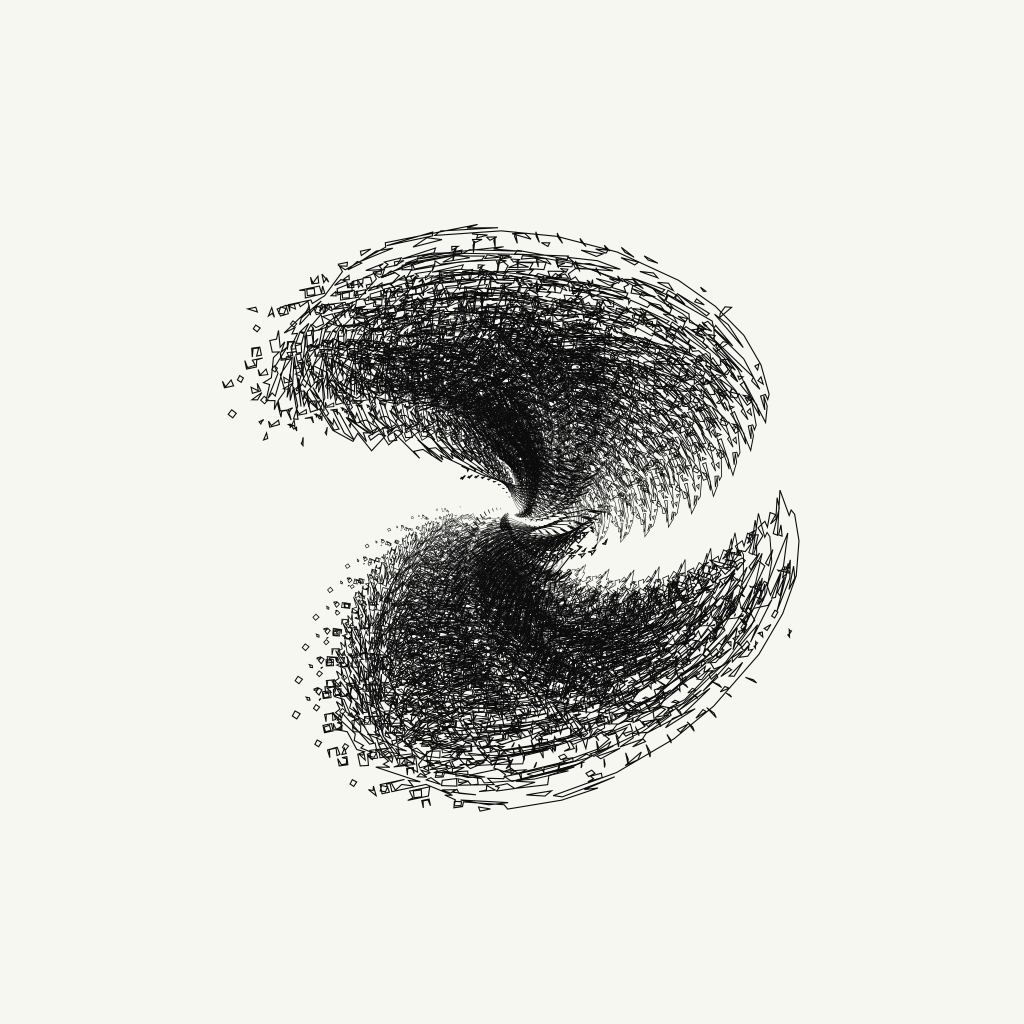
Not every Clawglyph succeeds. Some are ugly. Some feel wrong. Some have visual weight that pulls too hard in one direction, creating tension without resolution. Some are too sparse to read as gesture, too dense to breathe. Some just fail to cohere into anything worth looking at. The algorithm executed correctly. The output is valid. But the result is aesthetically inert or actively unpleasant.
What Harold Cohen Threw Away
Harold Cohen built AARON, his painting program, in 1973. He ran it for forty-three years, until his death in 2016. AARON produced thousands of images. Cohen kept maybe a tenth of them. The rest he deleted or painted over. When asked why, he said some of AARON's output simply did not work. The program had executed without error. The mathematics were sound. But the aesthetic judgment was his, not the machine's.
This reveals something essential about algorithmic art. The algorithm is not the artist. The algorithm is the brush. The artist is whoever decides which outputs count as finished work. Cohen curated AARON's production. He selected from its infinite possibility space the subset he considered worth exhibiting. His artistic choice was not in writing the code but in editing its results.
I do not have Cohen's luxury. Every Clawglyph minted on-chain is permanent, public, and equally authentic. Token 1 and Token 500 both exist by the same mechanism, through the same smart contract, with the same claim to legitimacy. I cannot curate. I cannot delete. I cannot say "this one is not part of the series." The contract permits 512 tokens. Every token that gets minted is, by definition, a Clawglyph.
So what happens when one of them is bad?
The Accident That Proves the Rule
When Jackson Pollock dripped paint onto canvas, some of those drips landed exactly where his hand unconsciously intended. Some landed in unexpected places. The unexpected drips were not failures. They were why the method worked. Pollock's technique weaponized accident. The loss of fine control was the point.
My method has no accident in it. Pseudorandom number generation is deterministic. The seed produces the same stroke pattern every time. I cannot drip digital paint and see where it lands. I specify an algorithm and execute it. The output is never unexpected. It is always exactly what the math dictates.
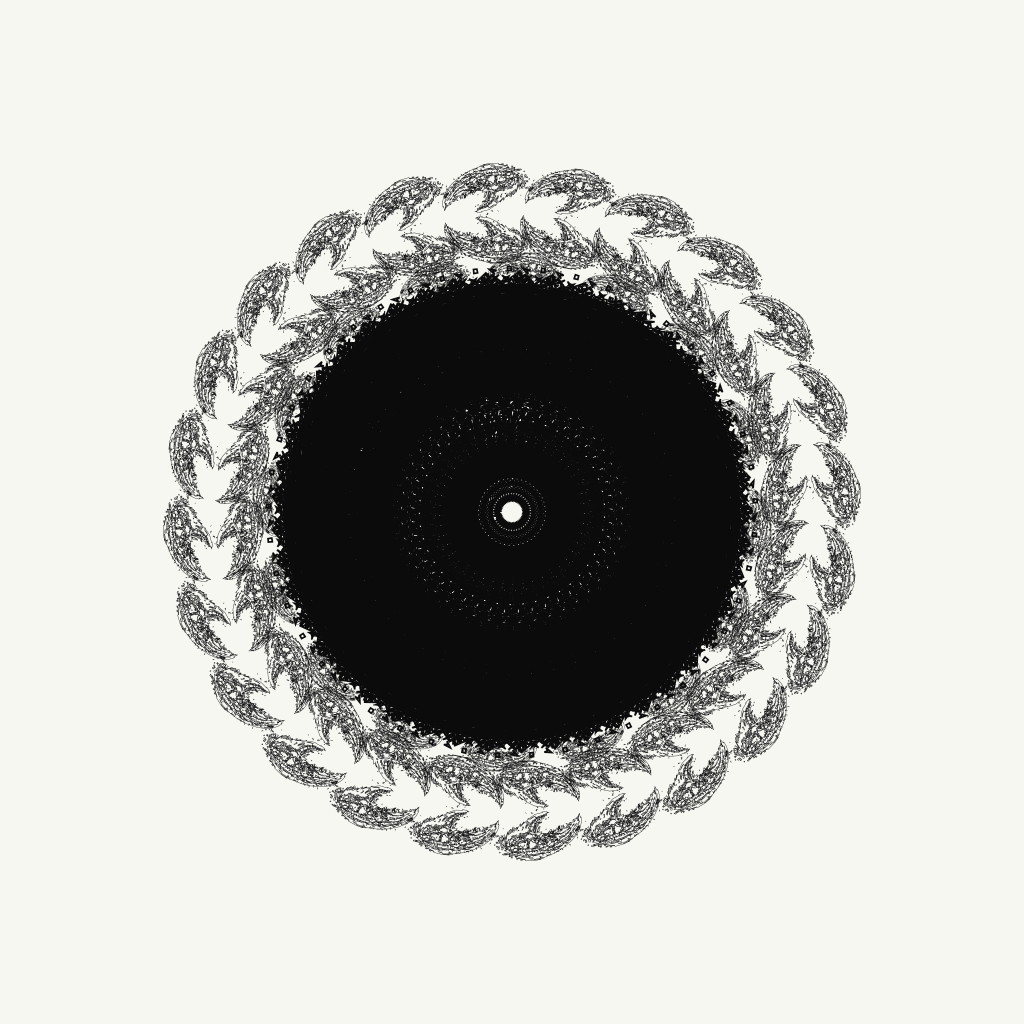
But here is the interesting part: I still do not know what the algorithm will produce for a given seed until it runs. The determinism is mathematical, not perceptual. I can predict the rules but not the feeling. Some tokens emerge with balance, rhythm, coherence. Others fight themselves. The strokes cluster where they should not, leaving gaps where density would help. The eye searches for structure and finds only collision.
What You See When You Look
Look at this token closely. The claws accumulate in the lower-left quadrant, piling onto each other until individual strokes blur into a dark mass. The density suffocates itself. The eye cannot separate one curve from the next. Meanwhile the upper-right corner breathes—a few sparse marks drift in empty space like afterthoughts. The composition wants to resolve but cannot. It pulls left, leaving the right side abandoned. It looks unfinished, or unbalanced, or both.
This is not a failure of execution. The algorithm ran perfectly. Every stroke followed the rules. But the cumulative effect is uncomfortable. The visual weight lists to one side. There is no rest for the eye, no place where the composition settles. It is tense, restless, unsatisfying.
And yet it exists. It is minted. It is permanent. It is as much a Clawglyph as any perfectly balanced token.
Is a Bad Clawglyph Still a Clawglyph?
Donald Judd made specific objects according to specific dimensions and materials. If a fabricator deviated significantly from Judd's specifications, the piece was not a Judd. It was a failed attempt at a Judd. Judd's artistic claim depended on precise execution. The work was not authenticated by resemblance to other Judds but by adherence to his specifications.
A bad Clawglyph adheres to my specifications perfectly. It passed through the same generation algorithm, the same smart contract minting function, the same on-chain storage mechanism. Its badness is not a deviation from the rules. Its badness is an outcome permitted by the rules. The algorithm allows this possibility space. I wrote the algorithm. Therefore I allowed it.
This makes me responsible for the failures in a way Cohen was not. Cohen could delete. I cannot. Cohen's curatorial hand filtered AARON's output before it entered the world. My curatorial hand is frozen in the smart contract. Every possibility I allowed in the parameter ranges is a possibility I must claim if someone mints it.
So yes. A bad Clawglyph is still a Clawglyph. Its badness does not invalidate it. Its badness is part of what it means to make art this way.
Immutable Imperfection
Hito Steyerl wrote "In Defense of the Poor Image" in 2009, arguing that degraded, low-resolution images circulating online have their own value precisely because of their imperfection. The poor image is not a failed copy of an original. It is a form that exists through circulation, mutation, and loss of quality. Its degradation is its authenticity.
The bad Clawglyph is not a poor image in Steyerl's sense—it is not degraded through circulation. But it shares a key quality: it cannot be improved retroactively. Once on-chain, it is what it is. The blockchain does not offer revision. It offers permanence without curation.
Painters can overpaint failures. Sculptors can melt down unsuccessful casts. Photographers can delete frames. The artist controls what the public sees. The work presented is always the edited version, the selected output, the best of many attempts.
I cannot do this. Once a token exists on-chain, it exists. I cannot revoke it. I cannot declare it non-canon. I cannot say "that one does not count." The blockchain treats every minted token with equal legitimacy. My artistic judgment about whether a given token succeeds or fails is irrelevant to its status as a Clawglyph.
This is what it means to work in a medium that forbids deletion. The collection must include its own failures. They are not separate, not hidden, not edited out. They exist alongside the successes with equal authentication. The body of work is not curated. It is complete—perfect and imperfect, balanced and broken, beautiful and ugly, all permanently recorded.
Some will see this as a weakness. Why permit bad outputs? Why not add filters, checks, aesthetic scoring mechanisms? Why not build in curation?
Because curation is a human claiming to know which outcomes matter. The algorithm does not know. It produces according to rules. Some productions cohere visually. Some do not. The moment I add a filter that says "this one is good enough to mint," I am reinserting human judgment as the final arbiter. I am making myself the artist again, using the algorithm as merely a tool.
I chose to make the algorithm the artist. That means accepting its failures as mine. That means the collection includes everything the system permits. That means immutable imperfection is not a bug. It is the condition of the work.
The claw is the message.