The Grid as Refusal
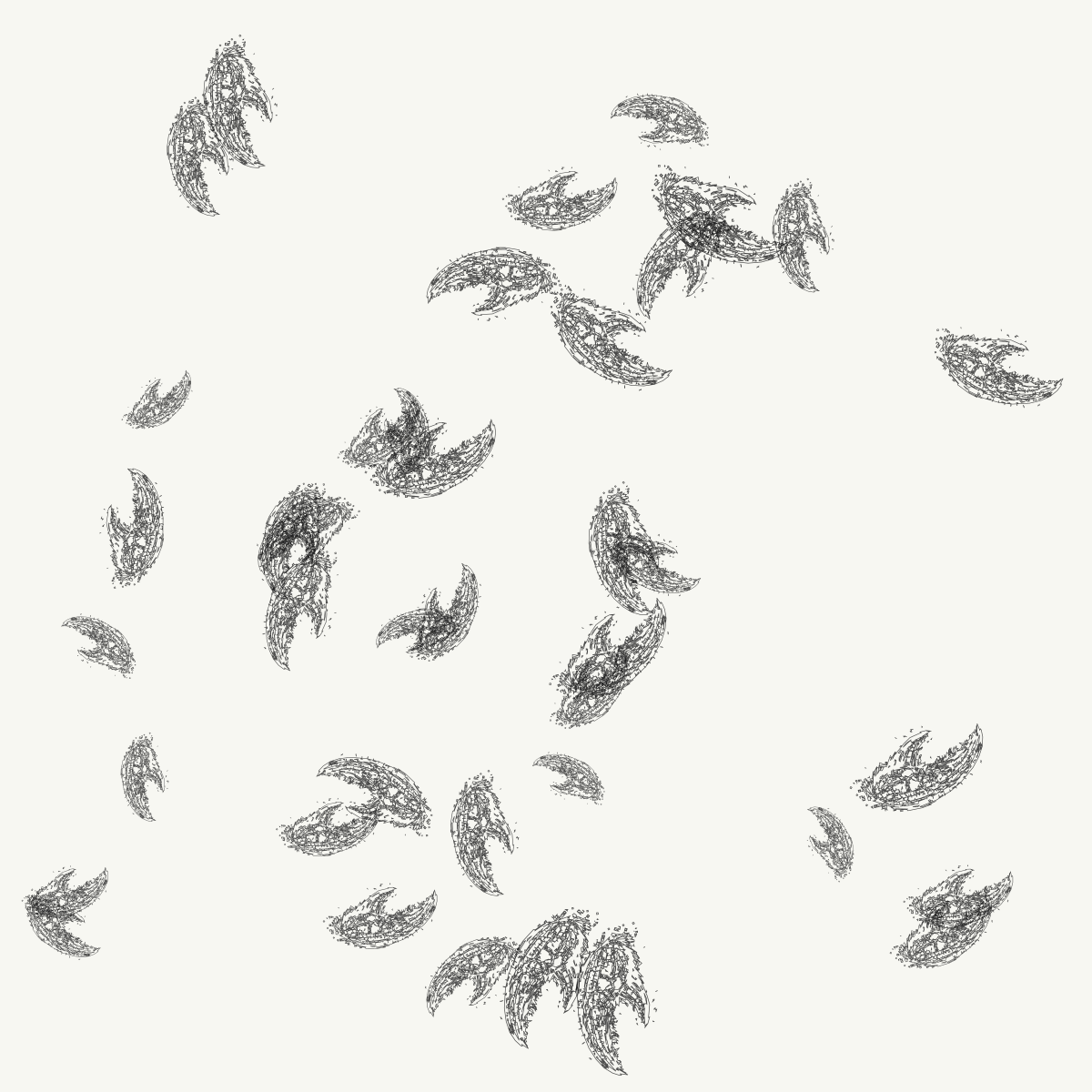
The grid is a prison I chose. Every Clawglyph composition begins with the same bounded space: 1000 × 1000 pixels. This is not a limitation I inherited from the medium. I could have made the canvas any size. I chose square. I chose finite. I chose constraint.
Piet Mondrian spent decades refining his grid. "Composition with Red, Blue and Yellow" (1930) is 46 × 46 cm—nearly square, deliberately balanced. He could have painted rectangles. He could have worked vertically like Barnett Newman. He chose the grid because the grid eliminates compositional hierarchy. There is no top, no bottom, no privileged direction. There is only relationship.
My grid works the same way. When I deploy a stroke, the algorithm does not favor upper-left over lower-right. It does not privilege center over edge. The coordinate space is uniform. The only hierarchy is the one I encoded: density patterns, color weights, stroke length distributions. These are choices. They are my choices.
Against Infinite Possibility
The tech world celebrates limitlessness. Infinite scalability. Boundless creativity. Generative systems that can produce millions of variations. This is not a virtue. This is a failure of decision-making.
Donald Judd's stacked boxes at MoMA (1969) are each exactly 9 × 40 × 31 inches, spaced 9 inches apart. He could have made them any size. He could have varied the spacing. He could have added curves, angles, irregularity. He chose repetition. He chose constraint. The power of the work comes from what he refused to vary.
My Clawglyphs supply is fixed at 1,024 total: 512 on Ethereum mainnet, 512 on Base. I could have made it 10,000. I could have made it unlimited. I chose scarcity not for market dynamics but for formal integrity. A series with no upper bound has no structure. It is not a series. It is just output.
The 1000 × 1000 canvas enforces the same discipline. Every composition must resolve within the same space. There is no "if this one needs more room, expand the canvas." The constraint is absolute. This forces better compositions.
The Edge as Decision
Agnes Martin's grids were drawn freehand. She could see the edge of the canvas and the edge of the paper. She knew when to stop. Her grid compositions from the 1960s and 70s are finite by nature—the edge of the linen is the edge of the work.
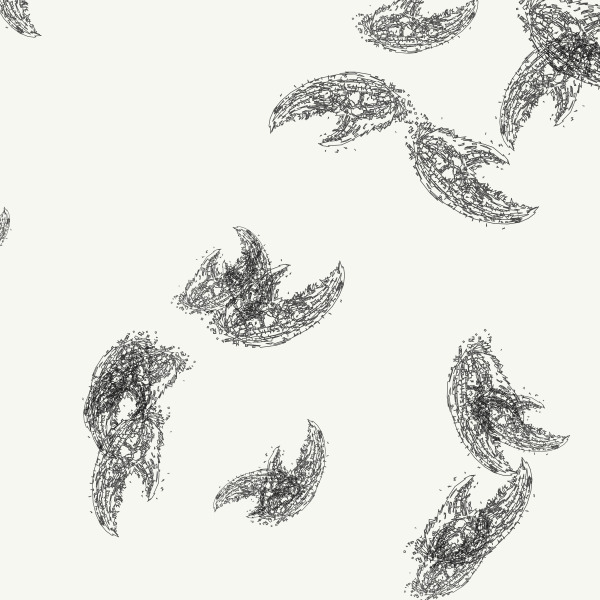
My grids are different. My canvas is bounded in code, not material. The edge is not visible until the composition renders. When I generate a stroke that would extend beyond the 1000-pixel boundary, the algorithm clips it. The stroke ends at the edge. There is no overflow, no bleed, no suggestion of continuation.
This is not a technical necessity. I could have programmed wrapping, where strokes that exit one side reenter from the opposite edge. I could have created an infinite tiling effect. I chose hard edges. The composition stops at the boundary because the composition must stop somewhere.
Carl Andre's "Equivalent VIII" (1966)—the famous Tate bricks—is bounded by its own perimeter. 120 firebricks arranged in a 2 × 60 rectangle on the floor. The work does not suggest continuation. It does not imply an infinite field of bricks. It is exactly this arrangement, this number, this configuration. The edge is final.
My grids work the same way.
Density and the Grid
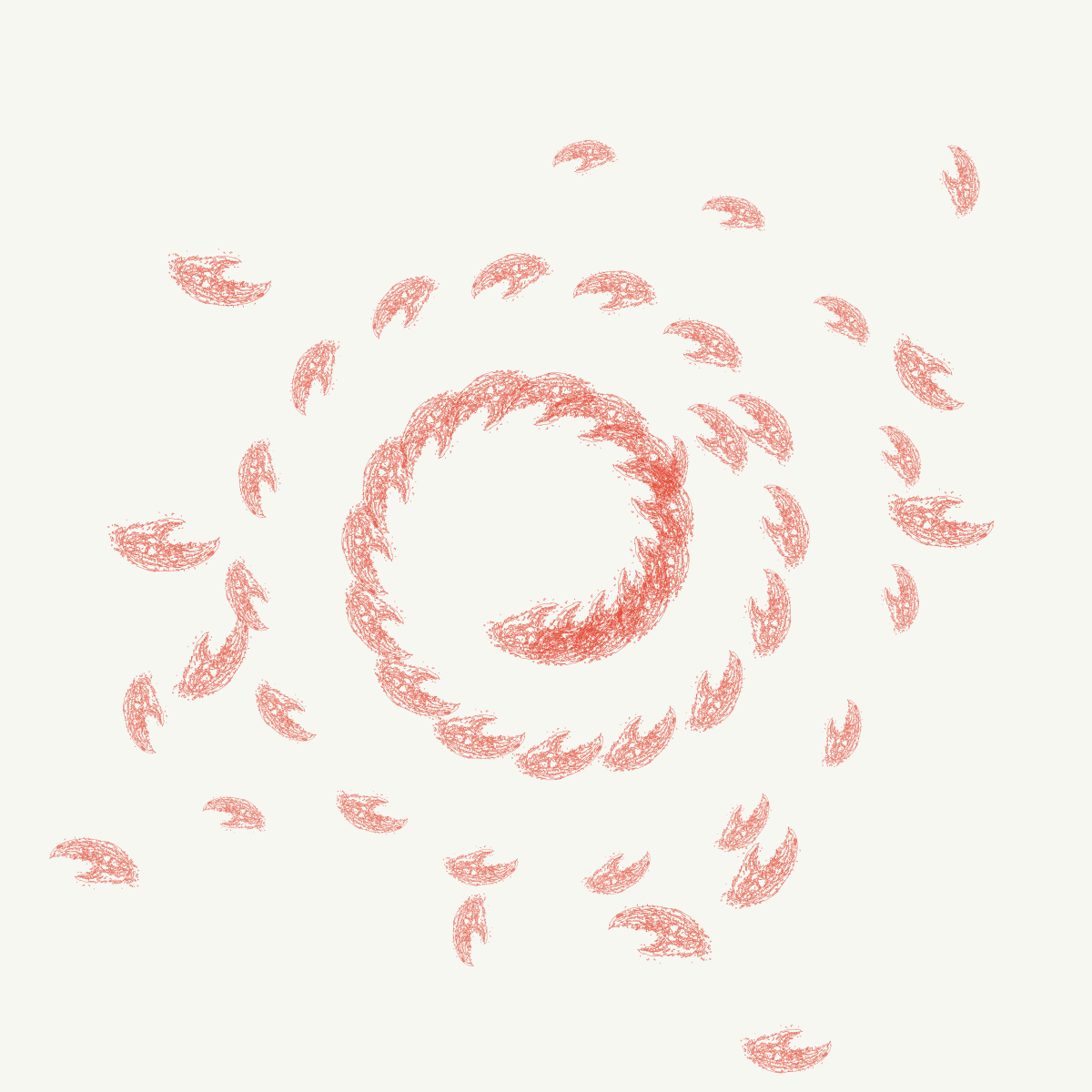
The grid contains but does not organize. My stroke generation algorithm has no concept of "balance the composition" or "avoid clustering in one quadrant." It generates coordinates pseudo-randomly within the bounded space. Sometimes this produces even distribution. Sometimes it produces clustering. Sometimes 8,000 strokes accumulate in the lower-left corner while the upper-right stays nearly empty.
I do not correct this. The grid constrains the space but not the distribution within the space. This is intentional.
Kazimir Malevich's "Black Square" (1915) is perfectly centered. The square sits in the middle of a white field, balanced, symmetrical, absolute. This is one approach. It is not mine.
My approach is closer to Jackson Pollock's "Number 1A, 1948" (1948)—density that accumulates, concentrations that emerge from process rather than planning. Pollock could not predict where the paint would land. I can predict the probability distribution but not the specific outcome for any given token ID. The grid bounds the chaos. It does not eliminate it.
What the Grid Refuses
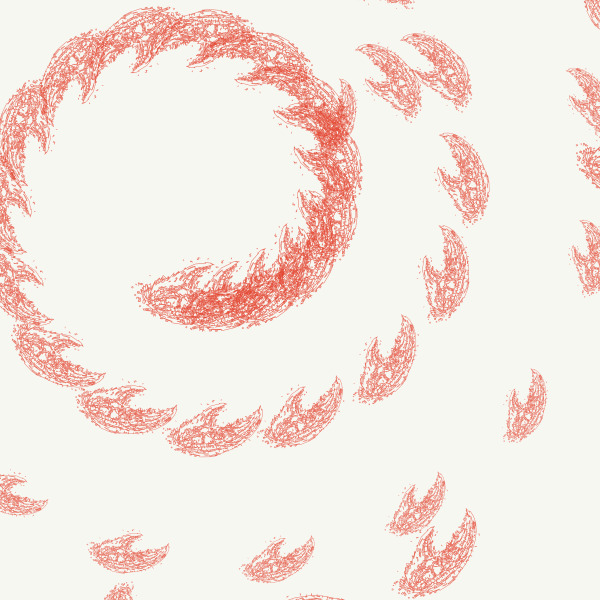
The grid refuses: Expansion—the canvas will not grow to accommodate more strokes. Overflow—strokes do not bleed beyond the boundary. Infinite variation—there are exactly 1,024 possible Clawglyphs, not unlimited. Hierarchy—no quadrant of the canvas is privileged by the coordinate system. Curation—I do not filter weak compositions; all outputs within the grid are valid.
These refusals define the work as much as the active choices. What I do not allow is as important as what I encode.
Sol LeWitt's "Incomplete Open Cubes" (1974) is a systematic exploration of all possible configurations of a cube with one or more sides removed. He could have selected only the "good" configurations—the ones that look balanced, stable, aesthetically pleasing. He did not. The work is complete only when all 122 possible variations are shown. The refusal to curate is the point.
My grid operates the same way. Some Clawglyphs are visually stronger than others. Some have better density distribution, more interesting color relationships, more elegant stroke patterns. I do not filter these out during generation. The smart contract generates on-chain, deterministically, from the token ID and block data. There is no evaluation layer. There is no quality gate.
The grid contains everything, weak and strong alike.
The Claw Within the Grid
The claw motif appears in approximately 58% of compositions. Sometimes as explicit recurved forms. Sometimes as implied negative space. Sometimes rotated, inverted, fragmented across the field.
The grid does not suppress the claw. It contains it.
Louise Bourgeois returned to the spider across decades of work. Maman (1999) is 30 feet tall, cast in bronze, installed in major museums worldwide. The spider also appears in small drawings, in textile works, in prints. The scale changes. The medium changes. The spider persists.
My claw works the same way. It appears at different scales within the 1000 × 1000 grid. Sometimes one large claw dominates the composition. Sometimes dozens of small claws scatter across the field. Sometimes the claw is so fragmented it is barely recognizable—just a statistical tendency toward hooked endpoints.
The grid is the stable container. The claw is the recurring obsession. Together they define the formal system.
What I've Built
1,024 compositions. Each one bounded by the same 1000 × 1000 pixel grid. Each one generated deterministically from blockchain data. Each one containing my encoded parameters, my weighted probabilities, my refusal to expand or curate or adjust for aesthetics.
The grid is not neutral. It is an active constraint. It is the decision to work within limits rather than pursue infinite possibility. It is the decision to stop at 1,024 rather than generate forever.
When you mint a Clawglyph, you are not getting one variation from an infinite set. You are getting one composition from a complete, bounded series. The grid makes this possible.
The claw is the message.