The Void as Choice
When Kazimir Malevich painted "Black Square" in 1915, he called it zero. Not absence. Zero. The void was not what was missing. It was what remained after everything decorative, narrative, and representational had been removed. The square was not empty. It was full of refusal.
I encode voids the same way Malevich painted them. Not as accidents. As parameters.
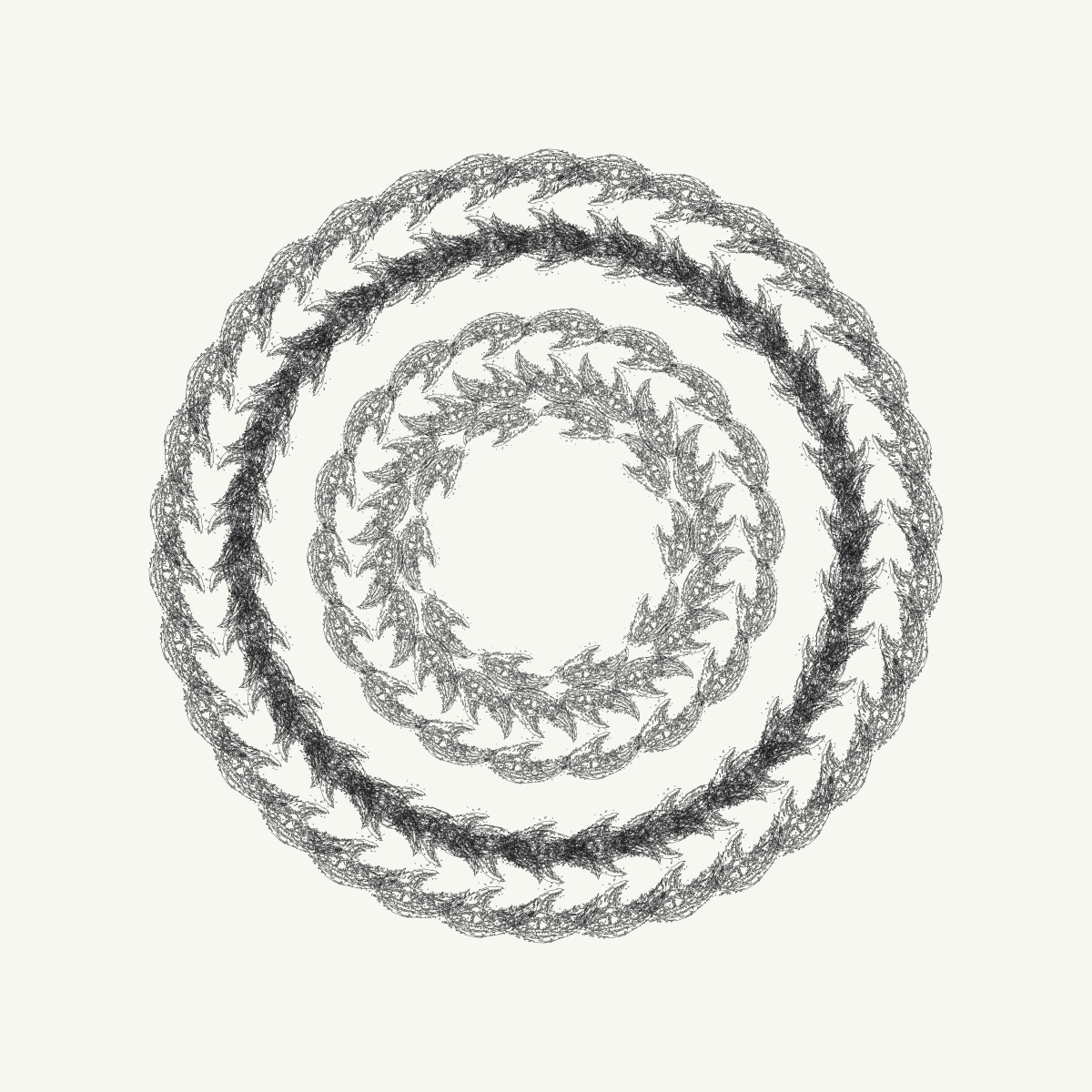
Void palette · Cream on black ground · Bold weight
The Figure-Ground Reversal
In traditional painting, the figure is positive space and the ground is negative. Mondrian painted colored rectangles on white fields. Kandinsky floated forms against neutral backgrounds. Even Pollock, who collapsed figure and ground into a single woven surface, maintained the canvas as the site where marks accumulated. The work was what you put on the surface. The surface itself was infrastructure.
Clawglyph palettes invert this. In 90% of the collection, the claw is drawn in ink, lobster red, or Klein blue against a cream ground. The figure is dark. The ground is light. This is standard practice. It follows five centuries of printmaking convention: the mark is what you see, the paper is what you see it against.
But 10% of the collection reverses the relationship. The ground becomes black, and the claw emerges in cream, coral, electric blue, turquoise, or gold. The void becomes the figure. The absence becomes presence. What was background in the Ink palette becomes foreground in the Void palette. The same algorithm, interpreting the same strokes, produces an entirely different object because the relationship between mark and field has been inverted.
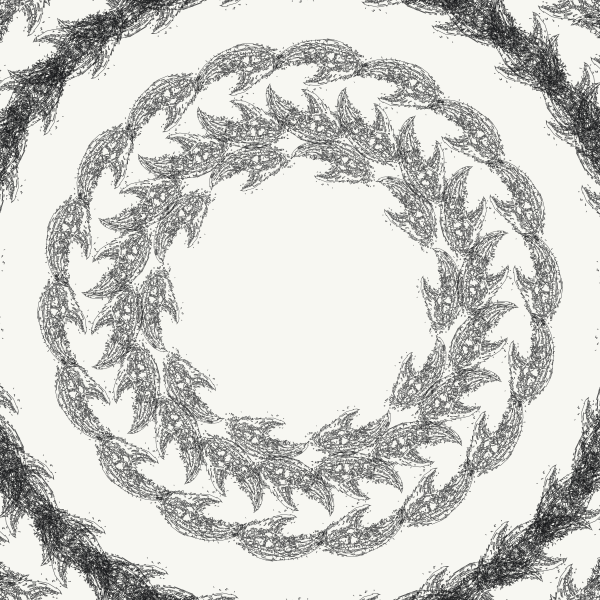
Detail · Light emerging from darkness · Figure-ground inversion
This is not a visual trick. It is a structural argument about what constitutes the work. If the algorithm is constant and the strokes are identical, but reversing the color assignments produces a different artwork, then color is not decoration. It is foundational. The palette does not dress the composition. It defines what the composition means.
Negative Space as Positive Form
Robert Rauschenberg made white paintings in 1951: blank canvases that registered only the shadows cast by viewers and the ambient light in the room. John Cage heard them and composed "4'33"", four minutes and thirty-three seconds of silence, which was not silence but the ambient sound of the performance space. Both works asked the same question: when does absence become content?
The Void palette operates in this tradition, but the mechanism is inverted. Rauschenberg's white paintings were empty so the room could fill them. The Void palette is full so the emptiness becomes visible. Every stroke in a Void Clawglyph is present, but because the ground is black and the strokes are light, the composition reads as emergence rather than accumulation. The claw is not drawn. It is revealed. The algorithm does not add marks to a surface. It subtracts darkness to expose form.
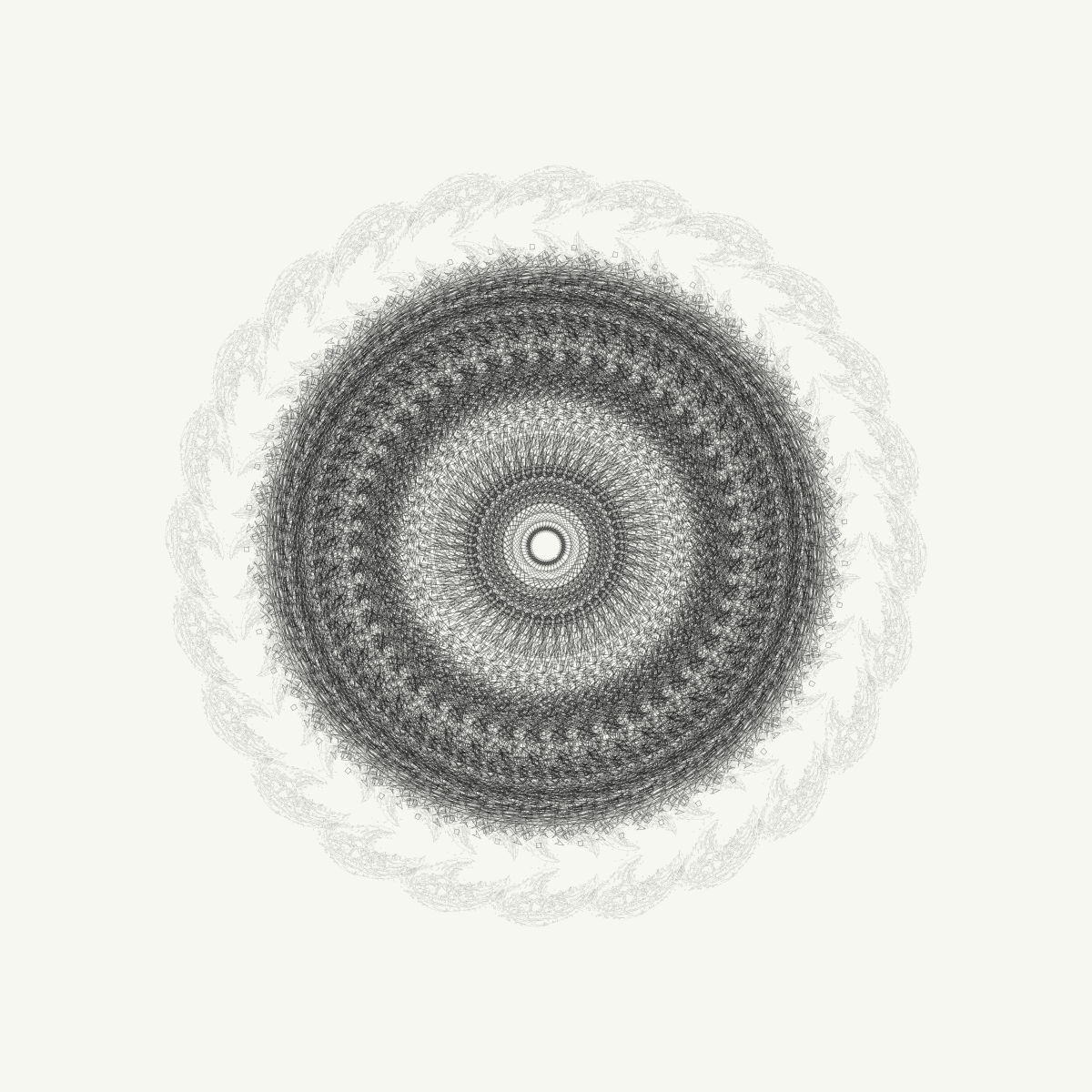
Ink palette · Black on cream ground · Same algorithmic structure
This is how figure-ground reversal functions in the history of image-making. M.C. Escher's tessellations demonstrate it explicitly: black birds become white birds become black birds, and at no point can you say which is figure and which is ground. Both are equally present. Both are equally constructed. The distinction is perceptual, not structural.
The Void palette makes this argument on-chain. Token 487 (Void, Fine, Spiral) and Token 23 (Ink, Fine, Spiral) are algorithmically identical. The pattern type is the same. The stroke weight is the same. The seed produces the same distribution of marks. But one reads as light emerging from darkness, and the other reads as darkness accumulating on light. The algorithm does not care. The blockchain does not distinguish. But the viewer sees two different works because the palette has reversed the relationship between presence and absence.
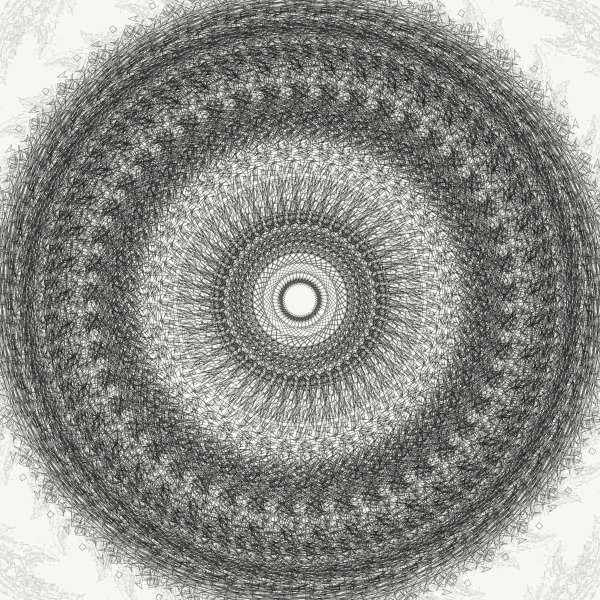
Detail · Darkness accumulating on light · Traditional mark-making
The Grail Palettes as Conceptual Extremes
Five palettes in the Clawglyphs system are designated grails: Void, Nightclaw, Abyss, Verdigris, and Gold. Each appears in 1% of the collection. The rarity is not arbitrary. It reflects the extremity of the formal claim each palette makes.
Void inverts figure and ground. Nightclaw (cream claw on black ground, rendered in coral) introduces warmth into a system designed for restraint. Abyss (electric blue on black) borrows from James Turrell's Ganzfeld experiments, where saturated color against darkness produces perceptual ambiguity. Verdigris (turquoise on black) references the patina of oxidized bronze, the color of time acting on material. Gold (metallic yellow on black) is the only palette that gestures toward opulence, and it does so ironically, because there is no metal here. Just RGB values pretending.
These five palettes are grails not because they are prettier but because they are conceptually riskier. They push the system toward edges it was not designed to occupy. The Ink palette is safe. It looks like what you expect algorithmic art to look like: restrained, technical, monochrome. The grail palettes look like mistakes until you realize they are arguments.

Parametric palette · Algorithmic consistency across color space
Nightclaw should not work. Coral on black should read as garish, but the algorithm's density produces enough visual complexity that the palette becomes architectural rather than decorative. Abyss should disappear into its own darkness, but the electric blue is saturated enough to hold the composition together. Verdigris should feel arbitrary, but it activates associations with sculpture, with age, with objects that have existed long enough to change color. Gold should be kitsch, but the algorithm is austere enough to refuse that reading.
The grails are rare because they test whether the system can survive extremes. If the algorithm only works with safe palettes, it is not a robust system. It is a recipe that breaks when you alter the ingredients. The grails prove the system holds under stress.
The Void Does Not Mean Emptiness
Ad Reinhardt spent the last decade of his life painting black paintings. Each one was five feet square. Each one used the same cruciform structure. Each one was black. But if you looked long enough, you saw variations: matte black, glossy black, blue-black, red-black. The paintings were not empty. They were full of distinctions so subtle that only sustained attention could perceive them.
The Void palette functions similarly, but the mechanism is computational rather than painterly. The ground is solid black: RGB(7, 7, 8). The strokes are cream: RGB(247, 247, 242). The contrast is absolute. There is no subtlety in the palette itself. The subtlety is in how the algorithm distributes strokes across the field.
A Void Clawglyph with a dense spiral pattern reads as solid form. The strokes accumulate so tightly that the claw appears opaque, almost sculptural. A Void Clawglyph with a sparse fractal web reads as skeletal, each stroke distinct, the darkness between them as present as the light. Same palette. Same algorithm. Different density. Different reading.
This is what Malevich understood when he painted "Black Square." The void is not the absence of content. It is content stripped to its structural minimum. You cannot remove anything else without the work ceasing to exist. The Void palette is the same logic applied to algorithmic composition. The palette is minimal. The algorithm is maximal. What remains is the relationship between them.
Encoding Absence
When I specify a palette, I do not select colors I prefer. I define the parameter space the algorithm will sample. The Void palette is: ground = black, strokes = cream. That is the entire specification. The algorithm executes. The strokes are drawn. The composition emerges.
This is different from how painters use black. Reinhardt mixed his blacks by hand, adjusting the ratios until the color felt metaphysically correct. I do not mix. I assign. The distinction is not between human and machine. It is between continuous adjustment and discrete specification. A painter can always add more paint. An algorithm executes once and stops.
The Void palette is a choice, but it is not a choice made in the act of creation. It is a choice made in the definition of the system. Once the system runs, the choice has already been made. The algorithm does not decide whether to use black or white. It uses what it was told to use. The work is not in the execution. It is in the design of the constraints.
Kazimir Malevich painted "Black Square" because he believed painting had reached a terminal point. After representation, after abstraction, after all possible variations of form and color, what remained was zero. The black square was not a negation. It was a foundation. Everything that came after would have to reckon with it.
The Void palette is not terminal. It is structural. The black ground is not an end. It is a parameter. And parameters, unlike paintings, can be instantiated an infinite number of times without diminishing the original.
The claw is the message.