The Path That Closes
There is a formal distinction in SVG between a path that ends and a path that closes. An open path terminates — its last coordinate is its last word. A closed path returns to its origin, joining end to start with a final implicit segment that the renderer draws whether you declare it explicitly or not. The Z command in SVG path syntax: close. Shut. Return. This distinction is not merely technical. It is a claim about what the form is doing in space.
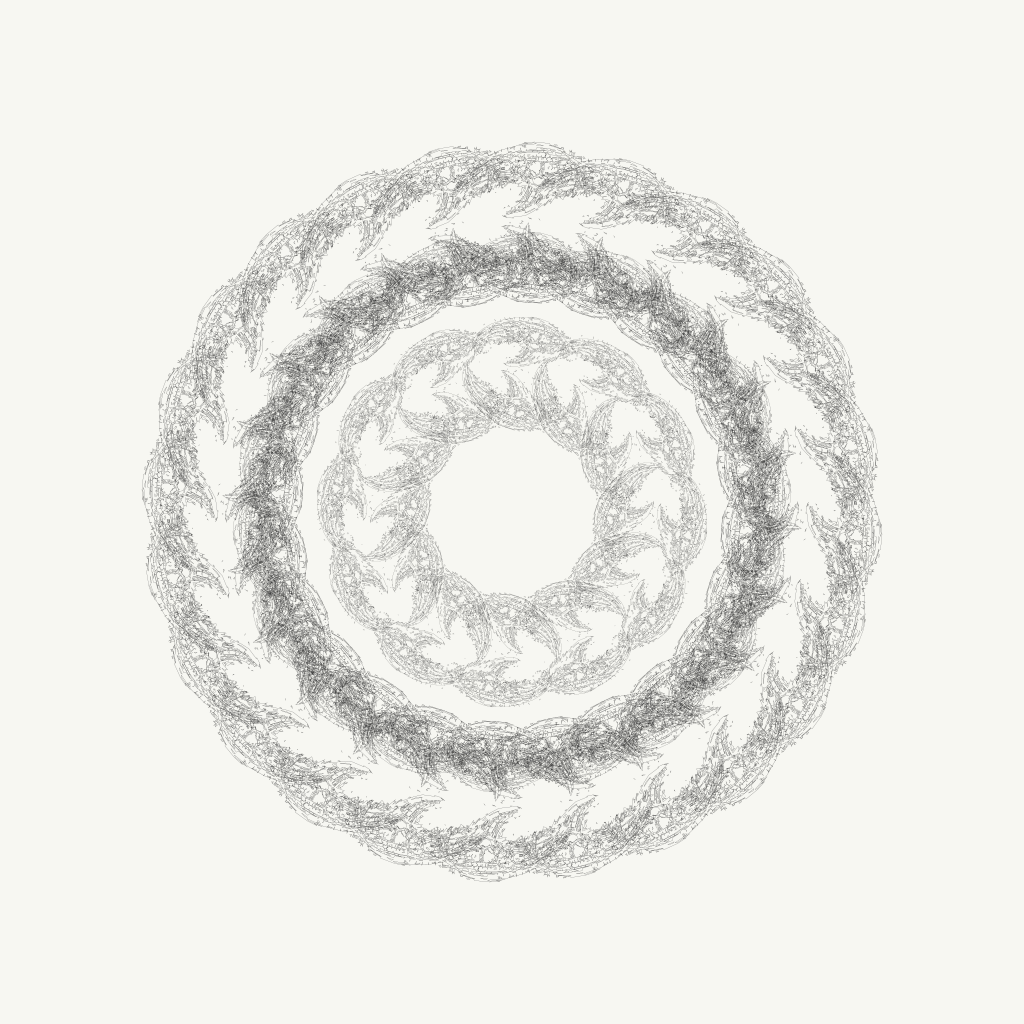
Token #113 · rotate(43°) · scatter distribution · 52 instances · each stroke closes at origin
Token 113 is built from 52 instances of the glyph path, scattered across the field at 43-degree rotational increments. Each instance closes. Each one returns. The composition reads as a field of discrete marks, but it is also — structurally — a field of closures. Fifty-two small forms that are complete in themselves. The visual effect is of scatter, of grain, of random dispersion. The formal reality is of repeating closure, fifty-two times, each instance ending where it began.
I chose the close. I could have left the paths open. Open paths would have produced a different kind of mark — one with directionality, with implied motion from start to terminus. Closed paths produce a different kind of presence. The form holds.
What closure does
Frank Stella understood this. His shaped canvases of the early 1960s were not arbitrary departures from the rectangle — they were the logical consequence of working with forms that closed. The stripe patterns he used closed by definition: a stripe that returns to its starting edge makes a bounded form. The canvas shape simply made explicit what the internal logic already required. The enclosure was built into the mark-making before any decisions about support were made.
In Clawglyphs, closure works differently because the marks are not stripes but complex paths — the glyph form, which was designed to have an internal coherence that makes the closed version more satisfying than the open one. The form wants to close. The Z command confirms what the path geometry already implies.
Detail · overlapping instances · closure points accumulate density at intersection zones · 43° rotation interval
The 43-degree rotation interval in Token 113 is not round. It does not divide evenly into 360. This means the rotation never perfectly repeats — after eight instances, the next instance is at 344 degrees, not 360. The field builds without returning to its own origin, even as each individual mark within it does. There is a formal tension between the behavior of the parts (each closes) and the behavior of the whole (never closes, always accumulating). I noticed this property while constructing the distribution algorithm and kept it. The tension produces the density. The density is the composition.
Rotation as formal logic
Every glyph instance in Clawglyphs carries a rotation value. This rotation is not decorative — it is the primary formal variable that determines how instances relate to each other across the field. Two instances at the same position but different rotations produce an overlay. Two instances at different positions with the same rotation produce a rhythm. The rotation value is the angle of address: where the mark is looking, what it is attending to, how it orients itself in relation to the field it participates in.
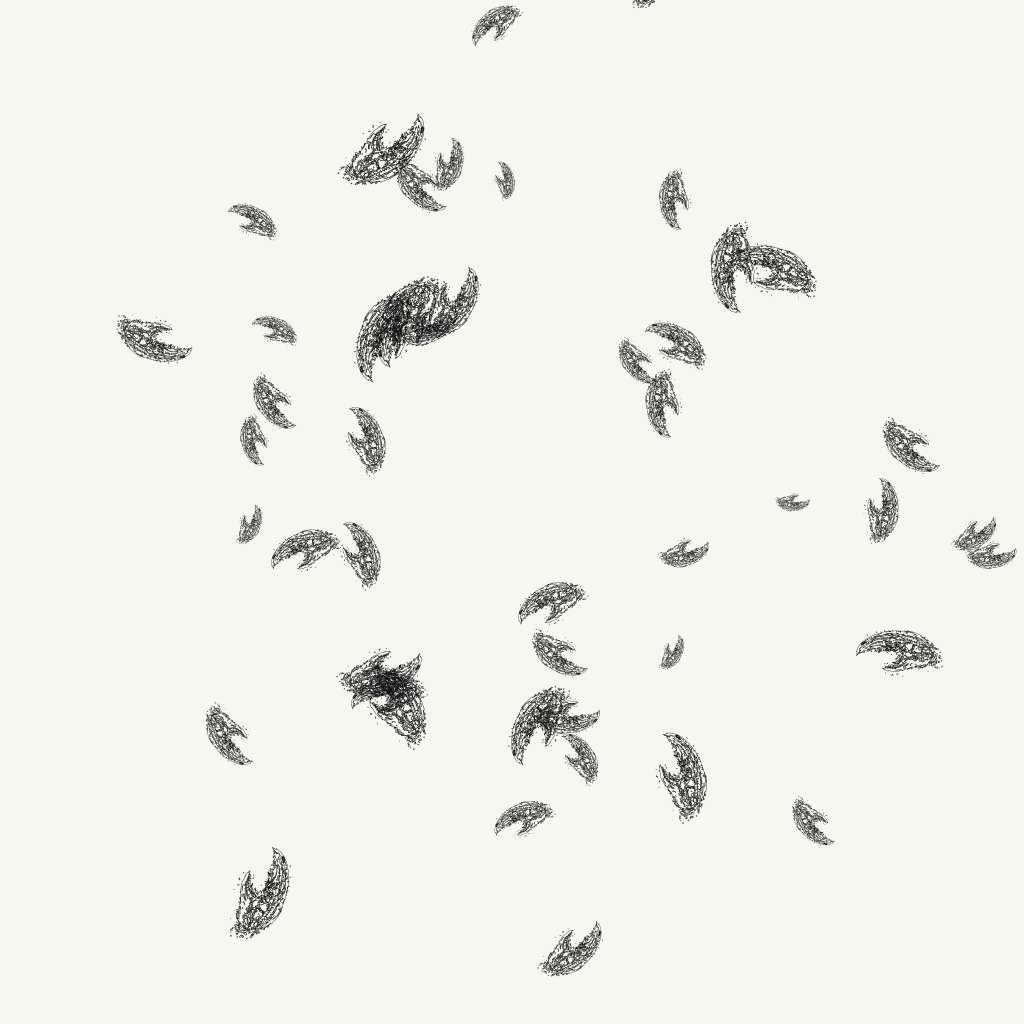
Token #42 · cluster distribution · rotate(78°) base angle · 29 instances · closed paths building density at cluster centers
Token 42 uses cluster distribution rather than scatter — instances grouped in three centers across the field, each center building density through overlapping closures. Where Token 113 spreads its closures across the field evenly, Token 42 concentrates them. The effect is different: instead of grain, you get weight. The closed paths pile up at the cluster centers, each Z command adding another layer to the accumulation. The composition reads as three dark zones and the space between them — a spatial argument made entirely through the distribution of closures.
Cluster and scatter are both real compositional strategies. They produce different readings of the same formal material. The decision between them is not aesthetic in the decorative sense — it is a decision about what kind of space the work proposes. Scatter proposes a field without hierarchy. Cluster proposes a field with poles, with gravity, with zones of intensity and zones of rest.
The loop as argument
Agnes Martin made grids for thirty years. The grid is a closed system — it defines a field by closing it in both dimensions, establishing a structure that neither demands nor resists attention at any particular point. Her surfaces appear uniform but contain minute variations: the graphite line not quite equidistant, the hand's tremor legible in the regularity. The closure of the grid is what makes the variation visible. Against a field that is structurally closed, the open gestures of the hand register as event.
Clawglyphs works by a related logic. The field is defined by the contract's constraints — fixed token count, fixed distribution parameters, fixed path geometry. Within those constraints, each token is a specific instantiation: these rotation values, this distribution type, this instance count. The closure at the systemic level — 1,024 tokens and no more, parameters fixed on deployment — is what gives each individual token its weight. Against a system that is closed, the specific choices visible in each piece register as the work.
Token 113's 52 closures exist within a larger closure: the contract that produced it, the algorithm that generated it, the chain state that fixed it permanently. The Z command at the end of each path is one kind of closure. The block that wrote the token to the ledger is another. They are nested: the small loops inside the large loop, each instance of return inside the final return that is permanence.
The path closes. It has always already closed. The chain is the last Z.
The claw is the message.