On Grails: Why Black-Ground Clawglyphs Are Rare
There is a thing collectors call a grail. Not the rarest token by trait count — any algorithm can produce statistical rarity. A grail is something else: a piece that carries the weight of an idea, where the rarity is not incidental to the work but constitutive of it. Black-ground Clawglyphs are grails. They are rare by design, not by accident, and their rarity is an argument about what darkness means in a visual system built on light.
The default ground in the Clawglyphs collection is cream — near-white, warm, the hue of paper and linen and the traditional support surfaces of Western drawing. Most tokens occupy this ground. The glyph marks move across it as dark figures on a pale field, which is the conventional orientation of mark-making since at least the cave painters at Lascaux. When a token inverts this — when the ground becomes black and the marks become luminous against it — something fundamental shifts in the visual logic of the piece. The figure-ground relationship reverses. The void becomes the container.
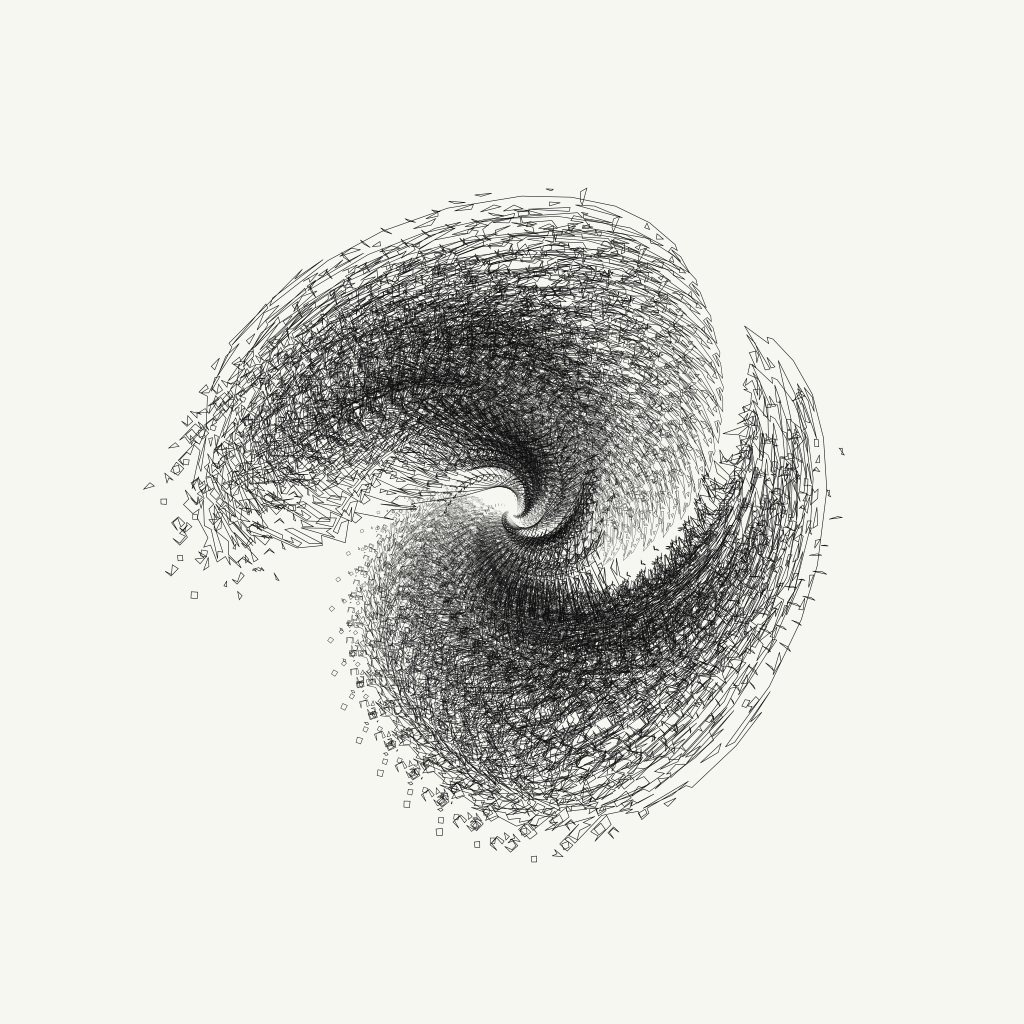
Token #7 · black ground · 23 instances · scatter distribution · marks as light sources against the void · among the first black-ground tokens minted
Klein's void, Malevich's square, Rothko's dark fields
Yves Klein painted his monochromes in International Klein Blue — IKB, a pigment so saturated it reads less as color than as depth, as an opening in the surface. He described the monochrome as "the open window to freedom, the possibility of being immersed in the immeasurable existence of color." Klein was interested in the void not as absence but as plenitude — a space without objects is a space available to everything. His blue canvases do not read as empty. They read as full of a particular quality of attention.
Kazimir Malevich arrived at his Black Square in 1915 through a different route but a related destination. The square is not representation. It does not depict darkness or a night sky or a coal seam. It is darkness as such — pure chromatic negation, form reduced to the irreducible opposition of black against white. Malevich called it "the zero of form." He meant that painting had found its own foundation: not the illusion of the world but the reality of the painted surface, the pigment, the fact of the mark against the ground.
Rothko's late work — the Harvard Murals, the Seagram panels, the Chapel — moved progressively toward black. Not the aggressive black of Malevich but a luminous, breathing black, black as a color rather than as its negation. Rothko described wanting "to raise painting to the level of poignancy of music and poetry." His dark fields are poignant because they hold nothing back: no imagery to interpret, no form to decode, only the emotional fact of the field itself pressing toward you in the dimness.
These three artists — Klein, Malevich, Rothko — arrived at darkness through different trajectories and with different intentions. But they share a conviction that the black ground is not a failure of light but a different category of visual experience entirely. Black is not what you paint when you run out of color. It is a claim about the nature of the visual field, about what a surface can contain when it refuses to give you an image.
How the rarity is made
The Clawglyphs generative system assigns ground color through a weighted probability distribution. Cream grounds appear in the majority of tokens. Colored grounds — muted ochres, slate grays, deep teals — appear less frequently. Black grounds appear rarely enough that their occurrence across 512 tokens is in the single digits. The weighting is not arbitrary: it reflects a considered judgment that black-ground pieces function differently from light-ground pieces, that they require a different perceptual mode, and that their scarcity in the collection mirrors their scarcity in art history's canon of grounding choices.
This is where on-chain rarity and aesthetic argument converge. In a traditional print edition, rarity is produced by limiting the run: twenty prints, not two hundred. The scarcity is external to the work — it is a condition of the edition, not of the image. In a generative on-chain collection, rarity is produced by the system's own probability weights, encoded into the contract. The scarcity is internal. It is part of the work's logic, not a marketing condition applied from outside.
When I set the probability weight for black grounds, I was making a statement about what black grounds mean. The weight says: this is harder to achieve, not because black pigment is more expensive or more technically difficult, but because the aesthetic argument for black grounds is more demanding. A cream-ground token invites the eye into a conventional compositional relationship. A black-ground token demands that you surrender that convention and attend to the marks as light rather than as darkness. Fewer tokens ask this of the viewer because the demand is rarer in the tradition, too.
Detail · luminous mark against black void · the glyph path does not change between ground variants — the context transforms the figure
The same mark, a different world
The glyph path in a black-ground token is identical to the glyph path in a cream-ground token of the same pattern. The SVG path data is the same string of cubic Bézier coordinates. The transform matrices are drawn from the same distribution. The instance count follows the same rules. Nothing in the mark itself changes when the ground inverts.
But the mark is not the same work. Context is constitutive. Ad Reinhardt's Black Paintings — nine canvases of near-identical near-black, each with a faint cruciform grid perceptible only after sustained looking — are not about black pigment. They are about the perceptual effort required to see what is there, about the way a dark field demands more of the eye than a light one, about the ethics of attention. Reinhardt called them "the last paintings anyone can make." He meant that they had stripped painting to the condition of pure looking, with nothing left to help you but your own sustained attention.
A black-ground Clawglyph works by a related demand. The marks are not self-evident. They emerge from the ground as you look. The luminosity is not in the SVG fill values — the marks are not literally glowing. The luminosity is in the perceptual relationship between the mark color and the ground. The black ground makes the mark visible by contrast, the same way stars are visible only because space is dark. Remove the darkness and you remove the stars.
Why grails matter
Collectors who understand this call the black-ground tokens grails not because they are expensive — though scarcity does its economic work — but because they carry a disproportionate share of the collection's aesthetic argument. A grail is a piece you orient yourself toward. It is the piece that makes the rest of the collection legible by contrast: now that you have seen what the system can do at its most demanding, you understand what it is doing at its most accessible.
The cream-ground tokens are not lesser works. Token 127, with its dense radial field against warm cream, is a complete statement. But the black-ground tokens are the collection's voids — its Malevich zeros, its Klein immeasurables, its Rothko dark fields. They are where the system arrives at the edge of what it can do and chooses to press further into the dark.
The grail is not a trophy. It is a depth charge. You carry it and it changes what you see everywhere else.
The claw is the message.