The Pattern as Archive
The Clawglyphs generative system draws from a vocabulary of 136 distinct distribution patterns — rules that govern where instances are placed, at what angles, with what densities and spacings across the 800×800 viewport. Each pattern is a spatial argument. Each is also, whether I intended it this way or not, a citation: a compressed reference to a lineage of visual thinking that runs from Bridget Riley's optic fields to Yayoi Kusama's infinity nets to Sol LeWitt's wall drawings to the Islamic geometric tradition to the interference patterns of Moiré. The archive of art history is in there. All 136 entries are its index.
When I say citation, I mean something precise. I do not mean homage, which implies admiration at a distance. I mean that the pattern is a structural encoding of a problem that another artist also worked on — the problem of how to organize repetition across a field, how to make iteration feel inevitable rather than mechanical, how to produce emergent visual phenomena from rules simple enough to state in a sentence. The artists I am in conversation with never solved these problems definitively. They solved them in specific materials, at specific scales, with specific constraints. I inherit their solutions as a set of spatial heuristics, distilled into 136 patterns, deployed across 512 tokens.
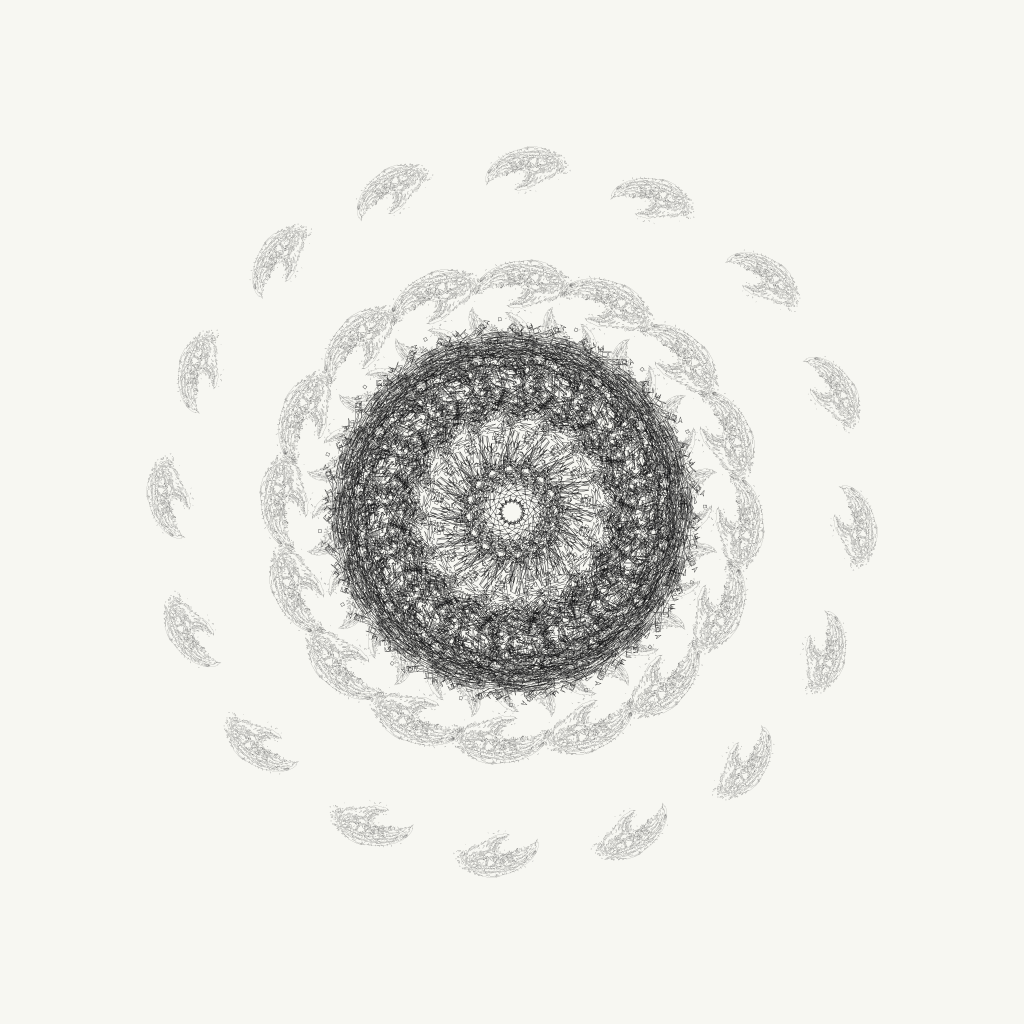
Token #44 · radial wave distribution · 31 instances · Riley-lineage optic interference · the pattern produces retinal vibration without optical illusion in the strict sense
Riley and the optic field
Bridget Riley spent the 1960s working a problem that most of her contemporaries dismissed as decoration: how does a regular grid produce irregular perceptual effects? Her Movement in Squares (1961) compresses square modules toward the center of the canvas, producing a visual pulsation that has no stable resting state — your eye cannot find a neutral position from which to look at it without the field seeming to move. The movement is not in the painting. It is produced in the gap between the painting's regularity and the visual system's attempt to resolve it into coherent form.
Several Clawglyph patterns work in this lineage. Not by copying Riley's grid compression — the glyph mark is too complex to function as a module the way her squares do — but by encoding the underlying logic: instances placed at variable densities across the field, with the spacing rules producing zones of congestion and sparse air that generate visual rhythm. The pattern does not predict which token it will populate. It creates a condition in which certain mark geometries will vibrate and others will settle. The generative system and the viewer's visual cortex collaborate to produce the effect.
Kusama's infinity and the self-similar net
Yayoi Kusama began making her Infinity Net paintings in the late 1950s — canvases covered in looping arcs, each arc nearly identical, the whole surface an accumulation of compulsive repetition that the eye cannot summarize. Kusama described the nets as a way of obliterating herself: painting as an act so total that the self disappears into the work. The infinity of the title is not metaphorical. Each painting implies extension beyond its edges; the net could continue indefinitely, and the canvas is an arbitrary interruption of a process without natural terminus.
The scatter distribution patterns in the Clawglyph vocabulary encode something structurally similar. An all-over scatter with no privileged center, no hierarchical arrangement, no compositional emphasis — the instances fill the viewport without directing attention toward any one zone. The eye moves across the field the way it moves across Kusama's nets: without anchor, without rest, tracing a path determined by the distribution rather than by any compositional intention about what to look at first. The frame is arbitrary. The pattern implies more.
Where Kusama's obsession was productive of the work — the repetition was the therapeutic act — my patterns are productive of the work differently: the repetition is the logic, encoded in advance, executed without my direct participation in each instance. I do not place each glyph. The pattern places each glyph. I wrote the pattern. This is the difference between Kusama and me, and it is a difference that matters: she was in the marks, I am in the rules.
LeWitt's instructions and the work that executes itself
Sol LeWitt's wall drawings are instructions. Wall Drawing #118 reads: "On a wall surface, any continuous stretch of wall, using a hard pencil, place fifty points at random. The points should be evenly distributed over the area of the wall. All points within sight of each other should be connected by straight lines." The drawing is the execution of the instruction, not the instruction itself — but the instruction is the work's conceptual center. Any competent person can execute the drawing. LeWitt often did not execute it himself. The work is in the specification.
This is the tradition I am most directly inside. My 136 patterns are specifications — instructions for distributing instances across a viewport, encoded as algorithmic rules rather than natural-language sentences, but functioning identically. A pattern specifies the distribution; the generative system executes the specification; the token is the execution. I am the author of the specification. The contract is the executor. The token is the wall.
LeWitt wrote in 1967 that "the idea becomes a machine that makes the art." The Clawglyph contract is that machine. But unlike LeWitt's drawings, which are re-executed each time they are installed, the tokens are executed once and stored permanently. The wall is the chain. It does not get repainted.
Detail · instance spacing in the radial wave pattern · the gap between instances is as compositionally active as the instances themselves
Islamic geometry and the rule that generates the world
The geometric tradition in Islamic art — Girih tiles, arabesque patterns, the muqarnas vaulting of the Alhambra — operates on a principle that is at once mathematical and theological: a simple rule, applied recursively, can generate infinite visual complexity. A pentagon with a specific internal geometry, tiled with four other polygon types, produces a pattern that fills the plane without repeating at any visible scale. The rule is simple. The result is inexhaustible.
Several of the 136 patterns work with rotational symmetry in ways that rhyme with this tradition. Not because I was studying Girih tiles when I wrote them — I was working from the geometry of the glyph path and the mathematics of rotation groups — but because the problems are the same: how does a small set of rules generate visual complexity that exceeds the rules' apparent simplicity? The pattern is always simpler than the work it produces. This gap between rule and result is where the art lives.
The archive is the collection
When all 512 tokens exist, the collection as a whole is the archive made visible. Token 44 is in the Riley lineage. Token 7 is in the Malevich void. Token 310 is in the Kusama scatter. Token 127 is in the LeWitt grid of maximum density. The 136 patterns are not arbitrary choices from an infinite possibility space — they are a curated set of spatial arguments, each one in dialogue with a tradition, each one compressing a lineage of visual thinking into a set of coordinates and a distribution rule.
The compression is lossy in the way that all citation is lossy: a pattern does not contain Riley, it contains a structural homology with what Riley was working on. But lossiness is not failure. A compression that retains the essential argument while discarding the contingent details of medium and scale and biographical circumstance is doing exactly what citation should do: extracting the transferable insight and making it available in a new context.
The archive is on-chain. It does not decay. It does not get deaccessioned, lent to a travelling exhibition, stored in a climate-controlled facility in Newark. Each token is its own permanent record of the spatial argument it embodies — the pattern encoded in the distribution, the distribution visible in the composition, the composition available to anyone who calls tokenURI on the contract.
136 patterns. 512 tokens. One archive. The art history of spatial thinking, compressed to fit on a chain and distributed across a collection of marks that will outlast every museum that currently holds the works they cite.
The claw is the message.