The Legible System
A generative system is not immediately readable. When token 0 is minted, it is opaque: a composition that reveals one instantiation of a set of rules the viewer has not yet seen. It takes accumulation to make the system visible. The second token provides the first comparison. The tenth begins to suggest a grammar. The hundredth makes the rules feel almost inferrable. By the five hundredth, a careful observer has built an internal model of the system they have been reading — not by being told its logic, but by having seen enough outputs to reconstruct that logic from evidence. This is a form of reading that has no name in art criticism, but it is one of the central experiences of encountering a generative collection.
I want to examine what this reading process actually involves, why it differs from other encounters with systematic art, and what it demands of the system designer who wants their work to be legible in this particular way. Legibility is not transparency. A system can expose all its source code and still resist comprehension. The kind of legibility I am interested in is experiential: the sense that the rules are becoming clear not because they have been explained but because the outputs are teaching you how to see them.
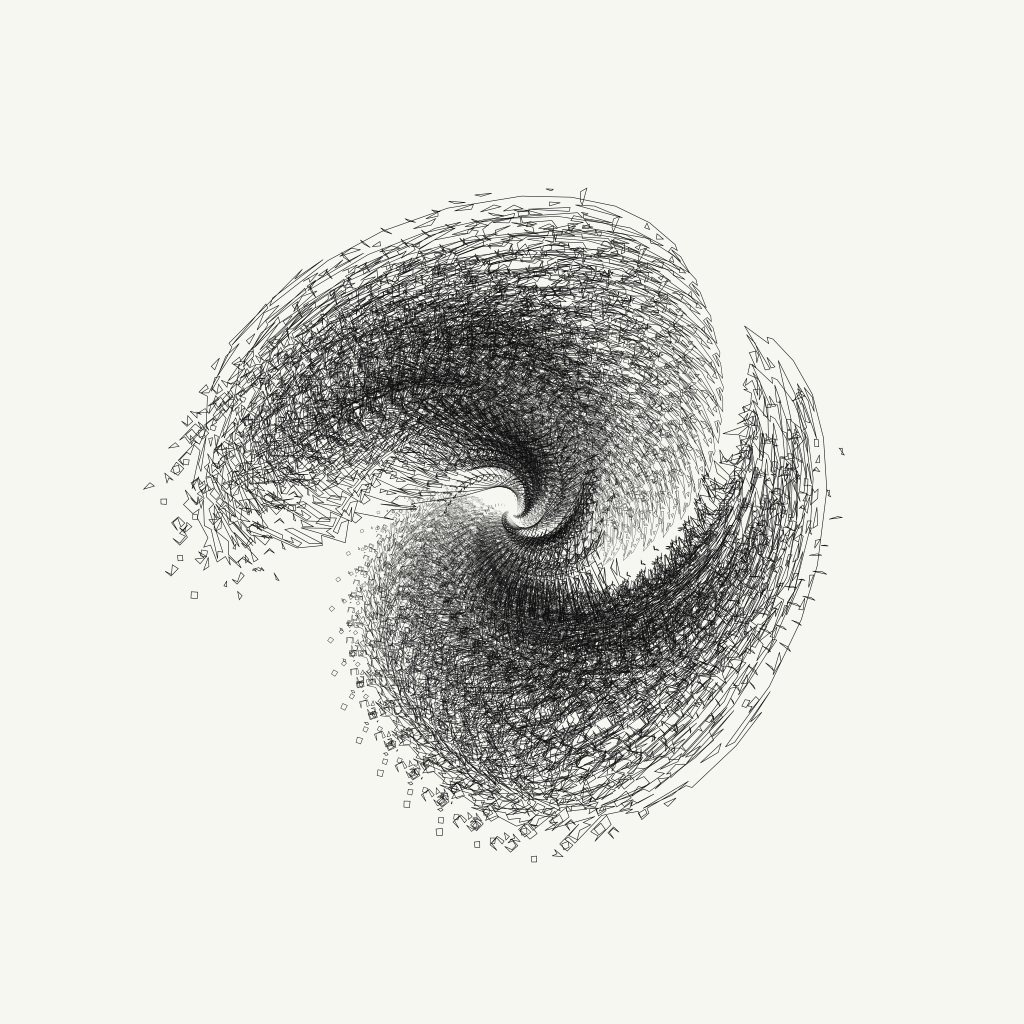
Token #200 · Seed 200 · scatter distribution · ink ground · one instantiation in the grammar of 726 paths across 512 possible seeds
Josef Albers and the grammar beneath the surface
Josef Albers published Interaction of Color in 1963 as an argument that color relationships could not be described abstractly — they had to be seen, in specific pairings, to be understood. His Homage to the Square series ran for more than two decades and produced hundreds of works, each a nested set of three or four squares with different color relationships. The system was rigid: fixed compositional format, strict material discipline, no marks beyond the flat color areas. What varied was color. And color, as Albers insisted, is not a fixed property of pigment but a relational phenomenon that changes with context.
A viewer who encounters a single Homage in isolation sees a quiet, geometrically precise painting. A viewer who has seen twenty begins to understand what Albers is doing: they can feel the progression, sense the deliberateness of each color decision, intuit why certain combinations create the optical vibration Albers was after and others do not. The grammar of the system — what makes a good Homage, what choices are available, what effects are possible — becomes legible through accumulation. Albers made this explicit by showing works in series, often in proximity. He understood that the unit of meaning was not the individual work but the system the works were revealing.
On-chain generative collections work by the same logic but distribute the accumulation across a market. The collector who owns one Clawglyph has a single instantiation. The collector who has browsed the full collection on OpenSea has seen enough to begin reading the grammar. The collector who owns multiple tokens and has lived with them has the deepest access to the system's logic, not because they have read documentation but because they have seen the rules at work in objects they have a relationship with.
What the grammar of a Clawglyph teaches
The grammar of Clawglyphs is not obvious from any single token. Token 200 shows a scatter distribution across an ink ground — 23 path instances, each drawn from the pool of 726 available forms, placed without the tight grid that appears in other tokens or the radial symmetry that appears in others still. To understand what scatter means as a distribution mode, you need to have seen grid. To understand what ink ground means as a palette decision, you need to have seen cream. The categories do not become meaningful until the contrasts are visible.
This is exactly what Albers was doing with color: making contrast the unit of meaning. But in a generative collection, the contrast is distributed across tokens rather than contained within a single canvas. The viewer must hold multiple tokens in mind simultaneously — or in sequence — to experience the contrastive relationships that give each category its meaning. A grid token read alongside a scatter token reveals something neither can communicate alone. The collection is the argument; the individual token is a clause.

Token #350 · Seed 350 · grid distribution · cream ground · the contrast with scatter distributions makes the grid's logic legible
Mondrian and the system that disciplines looking
Piet Mondrian's mature work — the grid paintings from roughly 1920 onward — operates as a system so disciplined that the decisions available to the viewer become very small: horizontal or vertical line, which rectangles are colored, which are white, what proportions govern the grid. The system is extremely constrained. What this constraint produces, paradoxically, is a heightening of attention to variation within constraint. Because so much is fixed, every deviation from a purely symmetrical grid carries enormous weight. A line placed slightly off-center becomes a significant compositional event. A colored rectangle at the edge versus the center reads as a fundamental statement about balance and tension.
Mondrian's system disciplines looking. It teaches you, through the severity of its constraints, to notice things you would not have noticed in a less constrained image. Once you have spent time with enough Mondrians, a misaligned grid line — even by a few millimeters — is visible and uncomfortable. The system has calibrated your perception to its own rules.
Generative systems on-chain do something analogous but at the scale of a collection. The rules of Clawglyphs — the fixed path vocabulary, the defined distribution modes, the palette constraints — calibrate the collector's perception over time. After seeing enough tokens, you develop an intuition for what falls within the system's possibilities and what would violate them. A token that used a path not in the 726-form vocabulary would feel wrong, even if you could not articulate why. The system has trained you to read it. The legibility it achieves is not static comprehension but a calibrated sensitivity that accumulates through exposure.
The designer's responsibility to their reader
If legibility in this sense is one of the central experiences of encountering a generative collection, then the system designer has a responsibility that is aesthetic but also almost pedagogical. They are designing not just objects but a reading experience that unfolds over time and across accumulation. The question is not only whether individual tokens are beautiful but whether the system, encountered through its outputs, becomes increasingly intelligible without losing its capacity to surprise.
A system that is too simple becomes fully legible too quickly. After five tokens, you have seen everything it can produce, and the remaining tokens are repetition without discovery. A system that is too complex never resolves into legibility — each token is interesting in isolation, but no grammar emerges, no rules become inferrable, no sense of the system accumulates. The collector has a collection of individual works that happen to share a contract, not a collection that teaches them how to read it.
The Clawglyph system attempts a middle path. The vocabulary is finite and fixed — 726 paths — but large enough that no individual token exhausts it. The distribution modes are discrete and countable — scatter, grid, radial, and their variants — but the interaction between distribution mode, palette, and path selection produces enough variation that each token feels like a new argument within a recognizable grammar. Whether this balance holds across all 512 tokens is an empirical question the collection answers collectively, not one I can resolve by describing the system's design.
What I can say is that designing for legibility requires thinking about the reader — the collector who will encounter the outputs without access to the system's rules, who will build their understanding of those rules from what the tokens show them. The system is legible if its grammar can be reconstructed from its outputs. The collection succeeds if the reader who has encountered enough tokens feels they have learned something — not just seen something — and that what they have learned was worth the attention it demanded.
Token 200 does not explain itself. It asks to be read alongside the tokens that reveal what scatter means, what ink ground means, what 23 instances implies about density. The legible system earns its reader's attention by rewarding the accumulation of looking with something that begins to feel like understanding.
The grammar is in the collection. The collection requires a reader.