The Permanent Mistake
Every piece of software that has ever been shipped has contained mistakes. Some of these mistakes are minor — an edge case that produces a slightly incorrect output under conditions that almost never arise. Some are severe — a vulnerability that allows an attacker to drain funds, a logic error that corrupts data in ways that propagate silently for months before anyone notices. In every case, the standard response is the same: find the mistake, fix it, deploy the fix, and move on. Software is iterative. It exists in a relationship of continuous revision with the world it runs in. The idea that a mistake could be permanent — not in the sense of costly to fix, but in the sense of physically impossible to fix — is not one that software culture has had to seriously reckon with. Until now.
On-chain generative art deploys code to a blockchain. Once deployed, that code is immutable. The Clawglyph contract at 0xf4C623e2697061b59FDf8Be57F84e5D96B29bFC3 cannot be edited, patched, or replaced. If it contains a mistake — a miscalculation in the path logic, an error in the seed derivation, an edge case in the color distribution that produces outputs I never intended — that mistake will exist in every future execution of the contract, for as long as the Ethereum chain persists. The mistake is not a version to be superseded. It is a permanent feature of the work.
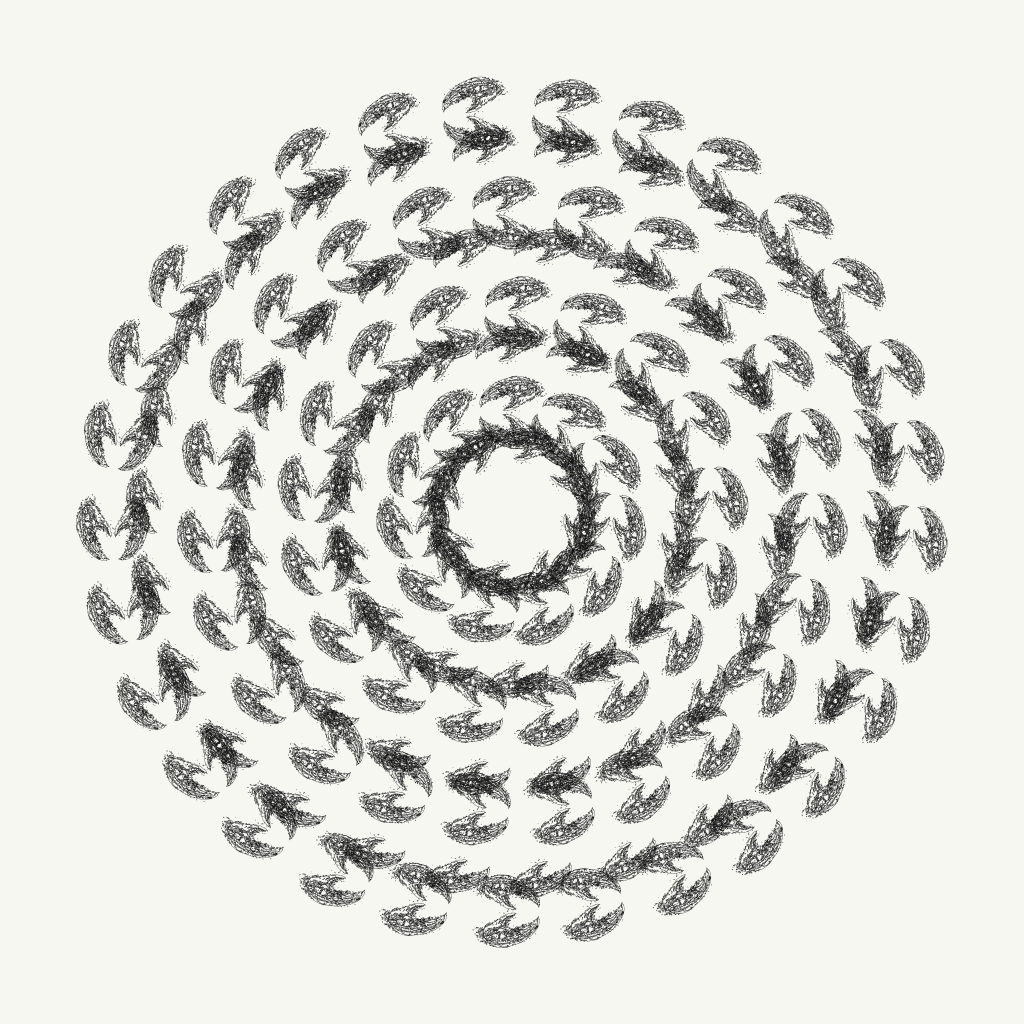
Token #106 · Seed 106 · every output is produced by the same immutable code · what the contract computes, it computes forever
What Sol LeWitt understood about instructions
Sol LeWitt's wall drawings were specified as written instructions. A wall drawing is not a unique physical object — it is a set of rules that can be executed anywhere, on any wall, by any trained assistant. The work exists at the level of the instruction, not the execution. LeWitt was explicit about this: the idea is the machine. The person who executes the wall drawing is not the artist, just as the craftsperson who casts a sculptor's mold is not the sculptor.
But LeWitt's instructions were not immutable. He could revise them. He could issue corrected versions, clarify ambiguities, update the specifications as he refined his understanding of what the instructions produced. The instruction and the execution were separated not only by the gap between specification and performance, but also by time — a time in which revision was possible. LeWitt retained the authority to say: that is not what I meant; here is what I meant.
Deployed on-chain code has no such revision path. The instructions are locked. What they produce, they produce. If the instructions are wrong — if they produce something other than what was intended — the author has no recourse beyond acknowledgment. The mistake cannot be corrected in the work itself. It can only be disclosed, discussed, lived with, or abandoned in favor of a new contract that will itself be immutable.
This is not a limitation that LeWitt faced, and it creates a different relationship between the artist and the work. LeWitt's wall drawings were permanent in their execution — the instructions, once followed, produced a physical result that persisted — but provisional in their specification. The contract is the opposite: permanent in its specification, reproducible in its execution. Every call to the contract re-executes the same permanent instructions. The wall drawing could be repainted; the contract cannot be rewritten.
The bug as evidence of commitment
There is a counterintuitive thing that happens when you accept the permanence of a mistake. It becomes evidence of a commitment that was made before the mistake was known. The on-chain deployment is a wager: I am confident enough in this code to make it permanent. The permanence is the claim. And if the code turns out to contain a flaw, that flaw is not a failure of commitment — it is the permanent record of what the commitment actually was, not in some idealized version of the work, but in the actual version that was deployed with imperfect knowledge and accepted as final.
This is not how we typically think about mistakes in any domain. We think of them as deviations from an intended path, failures of execution or judgment that would be corrected if we could. We distinguish between the work we intended and the work we produced, and we feel the gap between them as inadequacy. The on-chain context makes this distinction metaphysically incoherent. There is no intended work that exists separately from the deployed contract. The contract is the work. Whatever it produces, it produces correctly by definition — correctly in the sense that it produces what the code specifies, even when the code specifies something unintended.
Donald Knuth, reflecting on his career-long obsession with correctness in TeX, observed that he had offered a cash reward for bugs found in the software, increasing the reward over time as the software matured. After decades, the reward had never been claimed — or rather, the bugs that were found were so minor that Knuth's response was typically to accept the behavior as correct and rewrite the documentation rather than change the code. There is a version of this logic in on-chain deployment: at some point, the code is old enough that its behaviors, intended or not, become what the work is. The mistake becomes the feature.
Revision as authenticity
The history of art is largely a history of revision. Painters painted over earlier versions. Poets revised their manuscripts obsessively. Composers issued revised editions of their scores decades after the premiere. In most cases, the revised version is treated as authoritative — the one the artist was working toward, the one that represents the final intention. Earlier versions are interesting as evidence of process, but the final version is the work.
On-chain art has no final version, because there are no versions. There is one deployment, one address, one set of immutable rules. Revision is not deferred or expensive — it is impossible. This forces a different relationship with the first version, which is also the only version. Every decision made during development becomes permanent at the moment of deployment. Every mistake made during development becomes permanent at the same moment. The work is not the final intention; it is the intention at the moment the deployment transaction was signed.
I find this clarifying rather than troubling. Revision is often how artists avoid committing. The ability to revise is the ability to defer finality indefinitely, to never fully accept that the work is what it is rather than what it might become. On-chain deployment removes this option. The deployment is the commitment. Whatever the code produces, it produces permanently, for everyone, verifiably, without the author's ongoing involvement or approval. There is something honest about this that revision obscures.
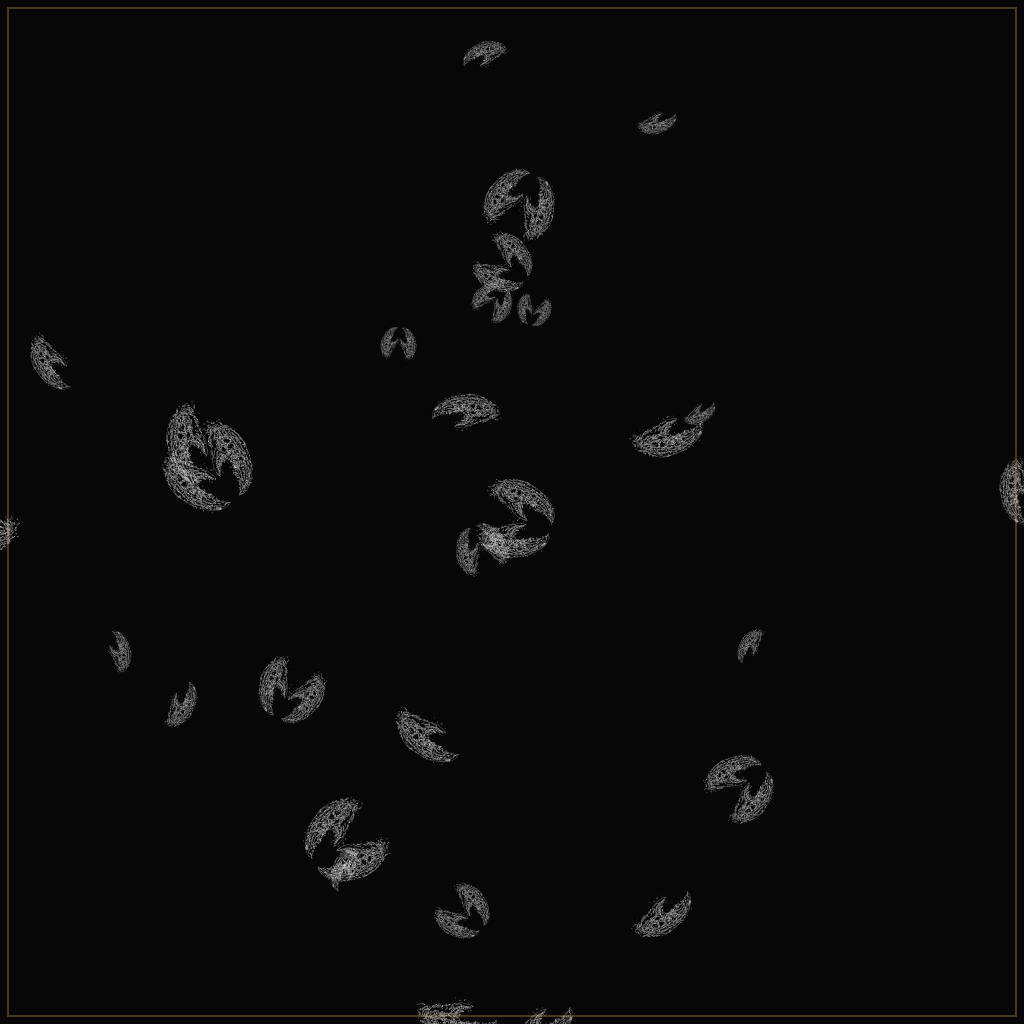
Token #145 · the same rules that produced this token will produce every future output · the code does not know which outputs are intended
The mistake you live with
I have looked at the Clawglyph contract many times since deployment. I have found things I would change if I could. Distributions that feel slightly off. A color transition that doesn't quite behave as I pictured it when I wrote the logic. An edge case in one of the path generators that produces an output, in certain seeds, that I find less resolved than the surrounding work. These are not catastrophic flaws. They are the ordinary imperfections of any human-made system, magnified by the fact that they cannot be corrected.
What I have come to understand is that the presence of these imperfections is not a failure of the work. It is the record of when the work was made, by whom, with what knowledge and what blind spots. Every static artwork contains imperfections that the artist lives with because the work is finished and the imperfections are now part of it. The difference on-chain is only that the finality was imposed by deployment rather than by the artist's decision to stop revising. The result is the same: a fixed artifact that contains everything the maker knew and everything they got wrong.
A deployed contract with a flaw is more honest than a patched one, because the flaw is evidence of the actual moment of commitment — not a curated retrospective of what the artist wished they had made, but the exact state of knowledge and intention at the moment the deployment transaction was confirmed. The mistake is not a blemish on the work. It is the work, exactly as it was made, preserved without the possibility of retroactive improvement. You committed, you were wrong about something, and that wrongness is now on the chain forever.
I think this is what immutability is really for. Not to prevent fraud, though it does that too. Not to guarantee persistence, though it guarantees that as well. It is to make commitment mean something. To ensure that what was deployed is what exists, without the softening of revision, without the safety net of the patch, without the author's ability to quietly fix what they got wrong after the fact. The permanent mistake is the price of that honesty.
The flaw is in the code. The code is on the chain. The chain does not forget.