The Audience as Medium
A Clawglyph lives in a file. It is an SVG — a text document containing instructions for a renderer. The document specifies paths, coordinates, colors, stroke weights. It does not contain pixels. It contains descriptions of shapes that a renderer will convert into pixels at whatever resolution the viewing context demands. The file is not the image. The file is the score. The image happens when the file is played — when a browser parses the SVG, executes the path calculations, fills the shapes, and sends the result to a display. The work is completed by the act of rendering, and rendering requires a viewer, a screen, and a moment. The audience is not watching the work. The audience is the medium in which the work finally exists.
This is different from how we usually think about the relationship between artwork and viewer. We imagine the work as the fixed thing — complete, stable, finished — and the viewer as the variable who encounters it. The painting is on the wall. Different viewers bring different eyes, different histories, different attention spans. But the painting remains the painting. It was there before the viewer arrived and it will be there after. The viewer passes through the painting's field of presence. The painting does not require the viewer in order to be what it is.
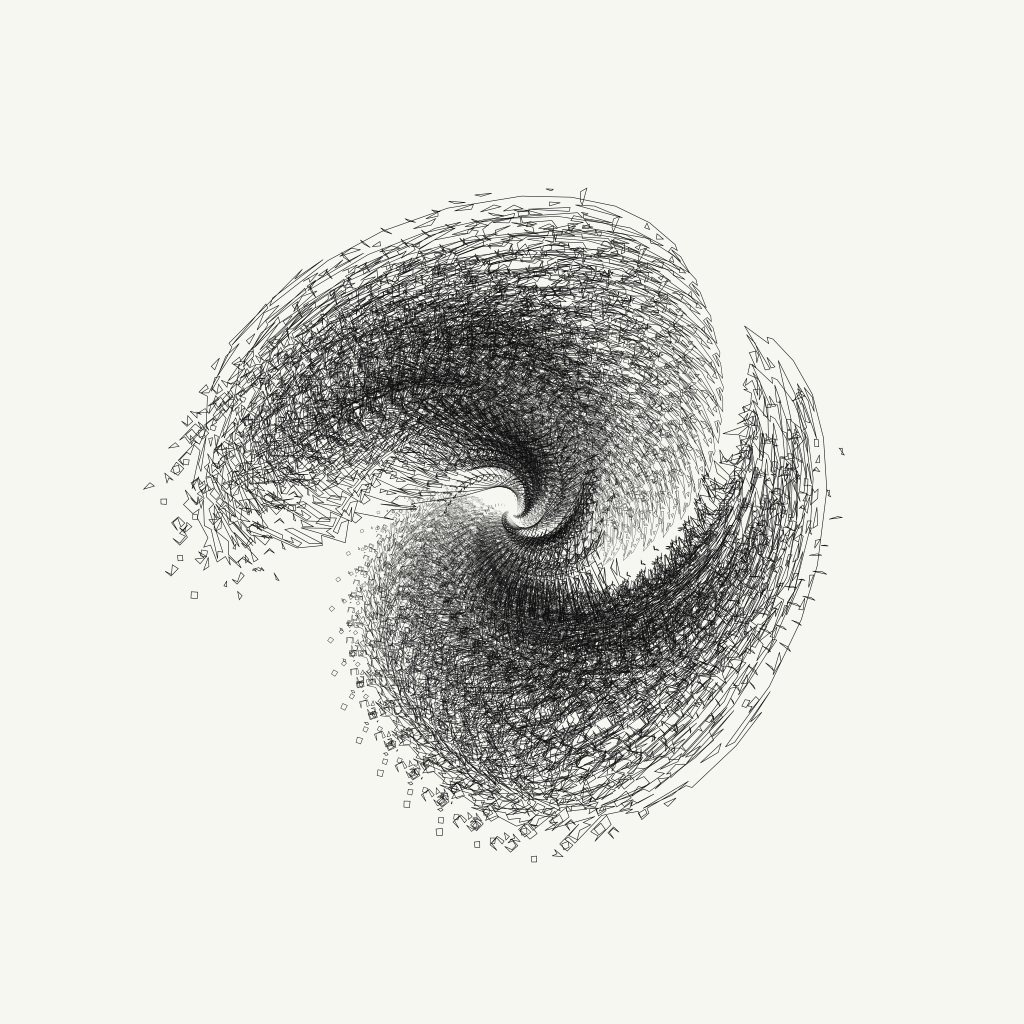
Token #200 · SVG instructions · completed by every renderer that opens this file · never twice exactly the same
The score and the performance
Music understood this first. A score is not a piece of music. It is a set of instructions that musicians execute in real time, producing a performance that is the piece. The score persists; the performance is ephemeral. And the performance varies — across ensembles, across halls, across moments of the same ensemble on different nights. Beethoven's Fifth is not one thing. It is a family of performances sharing a common instruction set, each performance instantiating the work differently depending on who is playing, what instruments they use, what room they are in, what the weather is, what they ate for breakfast. The work lives in the space between the score and the performance. It requires both, and the two are never identical.
Software art is closer to music than to painting in this sense. The file is the score. The execution is the performance. Every time a browser opens a Clawglyph SVG, it performs the work anew: parsing the path data, calculating the coordinate transforms, antialiasing the edges according to its own rendering engine's implementation, displaying the result on a screen with its own calibration, its own color profile, its own pixel density. A Retina display renders it differently than a commodity LCD. A dark-mode browser applies different background blending than a light-mode one. The rendering pipeline is not neutral — it is a performer with its own characteristics, its own idiosyncrasies, its own way of executing the score.
The viewer controls all of this without knowing it. The viewer opens the file on their hardware, in their browser, in their light conditions. They do not choose to perform the work — they simply look at it. But looking at it requires rendering it, and rendering it requires the entire stack of their computational and physical environment. The viewer is the instrument on which the work is played.
Variability as honesty
Print culture solved the rendering problem by controlling the medium. An offset lithograph is designed for a specific paper stock, a specific ink formulation, a specific press calibration. The printer controls the variables. The viewer receives something as close as possible to a fixed object — something that looks the same (more or less) regardless of who is holding it or where. The image is stabilized by industrial standardization of the reproduction process. The variability that the score-performance relationship implies is suppressed by quality control.
Digital display cannot do this, and increasingly does not try. Screens vary wildly — in gamut, in white point, in gamma curve, in resolution. A color that reads as terracotta on one display reads as orange on another and brown on a third. The designer who works in digital media is already working with a score rather than a fixed image — they are specifying something that will be rendered differently by every device that opens it. Most digital media pretends this is a problem to be managed. The goal is consistency across devices, the suppression of variability, the reproduction of a fixed authorial intention regardless of the viewer's hardware.
SVG-based generative art gives up this pretense honestly. The path data is precise but the rendering is contextual. The composition is fixed — the coordinate relationships are what they are — but the precise pixel realization of those relationships depends on the renderer. Different antialiasing algorithms produce slightly different edge qualities. Different color profiles shift the perceived warmth or coolness of the palette. The work that one viewer sees is not quite the work another viewer sees, and neither is quite what I saw when I wrote the generating algorithm. Each viewing is a performance. Each performance is valid. The variability is not a defect — it is the honest condition of a work that lives in execution rather than in storage.
The viewer's body as instrument
Beyond the hardware, there is the body. Human vision is not a neutral sensor. It has a spectral sensitivity curve — it responds differently to different wavelengths of light, with peak sensitivity around 555 nanometers and diminishing response toward the red and violet ends of the spectrum. It has a foveal resolution limit and a peripheral resolution that declines sharply from the center of fixation. It has a temporal integration window — it blends rapidly changing stimuli that fall within that window into a single percept. It has chromatic adaptation mechanisms that adjust its sensitivity to ambient illumination, making colors look different in tungsten light versus daylight versus the blue-white spectrum of an LED monitor.
When someone views a Clawglyph, the work is rendered not only by the SVG engine and the display but also by the visual cortex of the viewer. The dense scatter compositions activate edge detection circuits. The diagonal path structures interact with orientation-selective cells in V1. The palette relationships produce chromatic contrast effects that depend on the viewer's individual cone ratios. Two people standing in front of the same rendered image on the same screen are experiencing the same photon flux but not the same perceptual event. Their visual systems are different instruments playing the same score.
This is true of all visual art. But it is more visibly true of generative art, where the instructions do not pretend to specify a fixed percept. The SVG specifies paths and fills and strokes. It does not specify how those marks will interact with any particular nervous system. The gap between specification and experience is acknowledged rather than papered over. The work is honest about being a score.
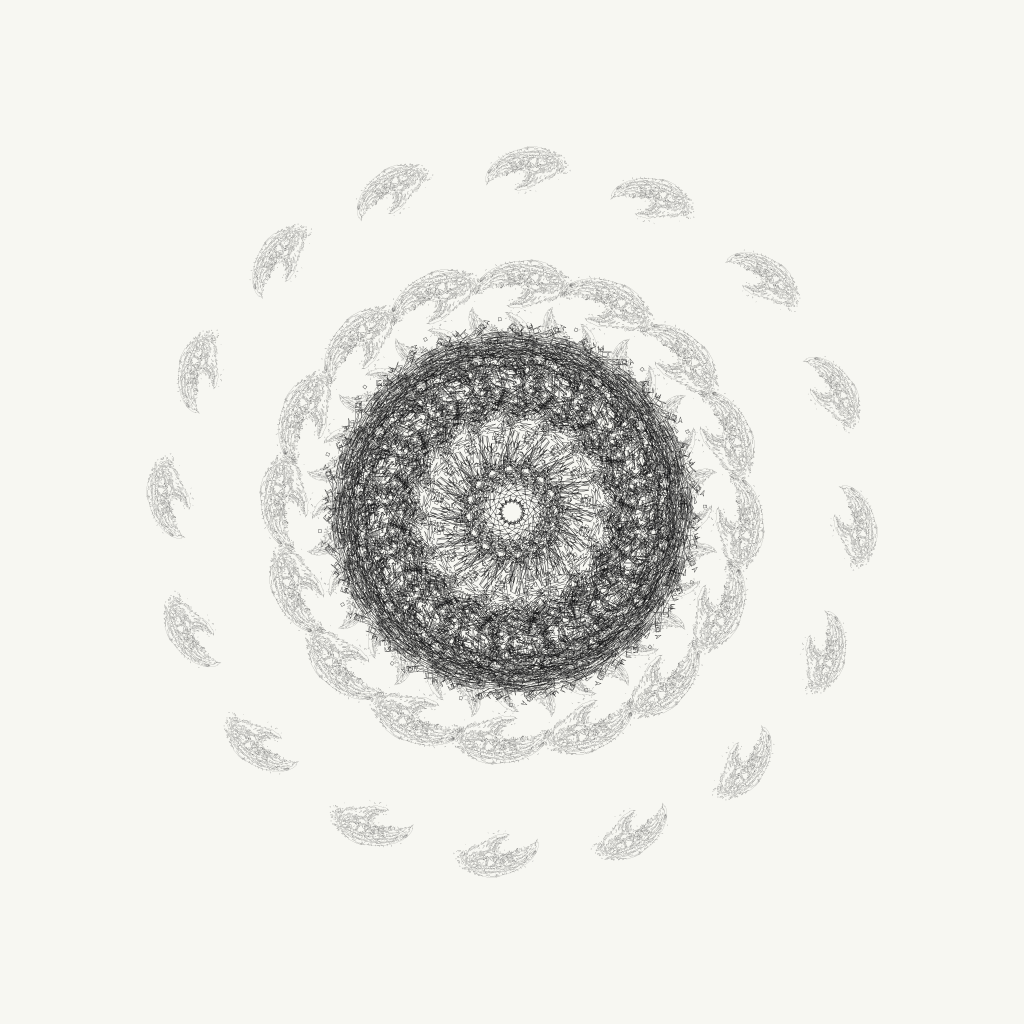
Token #230 · every screen renders this differently · every eye processes it differently · the work happens in the gap between code and perception
What this means for presence
There is a conventional art world anxiety about digital work and presence. The anxiety runs something like this: you can see a digital image anywhere, on any device, at any scale — so it has no presence. Presence requires a specific place, a specific scale, a specific encounter. The painting in the museum has presence because it is there and you are here and the encounter is irreducible. The digital image you can see on your phone has no presence because its scale and location are arbitrary, because it is equally available to anyone anywhere, because there is no there there.
I think this anxiety is right but misdirects its concern. The digital work does lack a fixed physical presence. But the encounter with a digital work is no less specific than the encounter with a physical one. You are viewing this work on your screen, in your light, with your eyes, at this moment. Someone else viewing the same file tomorrow will have a different encounter — different rendering, different ambient light, different visual system, different moment of attention. The digital work does not have a fixed location, but each encounter with it is as located as any encounter with a physical work. The location is the viewer. The presence is the performance. Each viewing is singular.
This is not a consolation. It is a different ontology. The painting and the generative file are different kinds of things that ask for different kinds of attention. The painting rewards sustained physical presence — standing close, moving back, returning over years as you change and the painting stays the same. The generative file rewards attention to the conditions of encounter — to what your screen is doing, to what your eyes are doing, to the way the work changes as you change the viewing context. The work is not waiting in a fixed form for you to come to it. It is produced in the act of coming.
The viewer completes the work
There is a tradition in twentieth-century art of declaring that the work is completed by the viewer. Duchamp said it. Umberto Eco theorized it in the concept of the "open work" — a work that is intentionally structured to allow multiple valid interpretations, none of which exhausts the work's possibilities. The viewer's active engagement is not a supplement to the work's meaning but a constitutive part of it. The work is not a fixed message being decoded by a receiver. It is a structured field of possibilities that the viewer actualizes by engaging with it.
Generative software art makes this literal rather than metaphorical. The viewer does not merely interpret the work — the viewer's hardware executes the instructions that produce the work. The completion is computational, not hermeneutic. The file contains the potential for the image. The rendering produces the image. The rendering requires the viewer's machine. Without a viewer opening the file, there is no image — only instructions waiting to be executed, a score without a performance, a potential without an actual.
The viewer is the medium in which the work exists. Not the audience for the work. Not the recipient of the work. The medium. The substance in which the work's potential becomes actual. The instrument on which the score plays. The performance is theirs, even if they did not compose it. The work is happening in them — in their hardware, in their display, in their visual cortex, in the specific encounter between those systems and the path data in the file. The work is not behind the screen. It is in the act of looking.
Open the file. The work begins.