The Unsigned Work
A Clawglyph does not have a signature on it. The SVG file contains path data, color values, stroke weights. It does not contain the artist's name written in cursive in the lower right corner. There is no monogram, no stamped seal, no embossed certificate of authenticity folded into the packaging. The token record on the Ethereum chain does not contain a signature in the traditional sense — no handwritten mark, no physical trace of a human gesture. And yet the Clawglyph is more securely attributed than any signed painting in any museum in the world. The unsigned work is, paradoxically, the most signed thing that has ever existed.
Understanding why requires understanding what a signature is actually for. A signature is a solution to a trust problem. The painting is done. The artist leaves. Years pass. The painting moves through hands, across borders, through estates and auctions and storage facilities. At every transfer, someone needs to believe that this painting was made by this artist. The signature is the artist's attempt to leave evidence of their connection to the work — a mark that travels with the object, made at the moment of completion, that can be compared against other known examples of the artist's signature to establish authenticity. The signature is a bridge across time between the moment of making and the moment of verification.
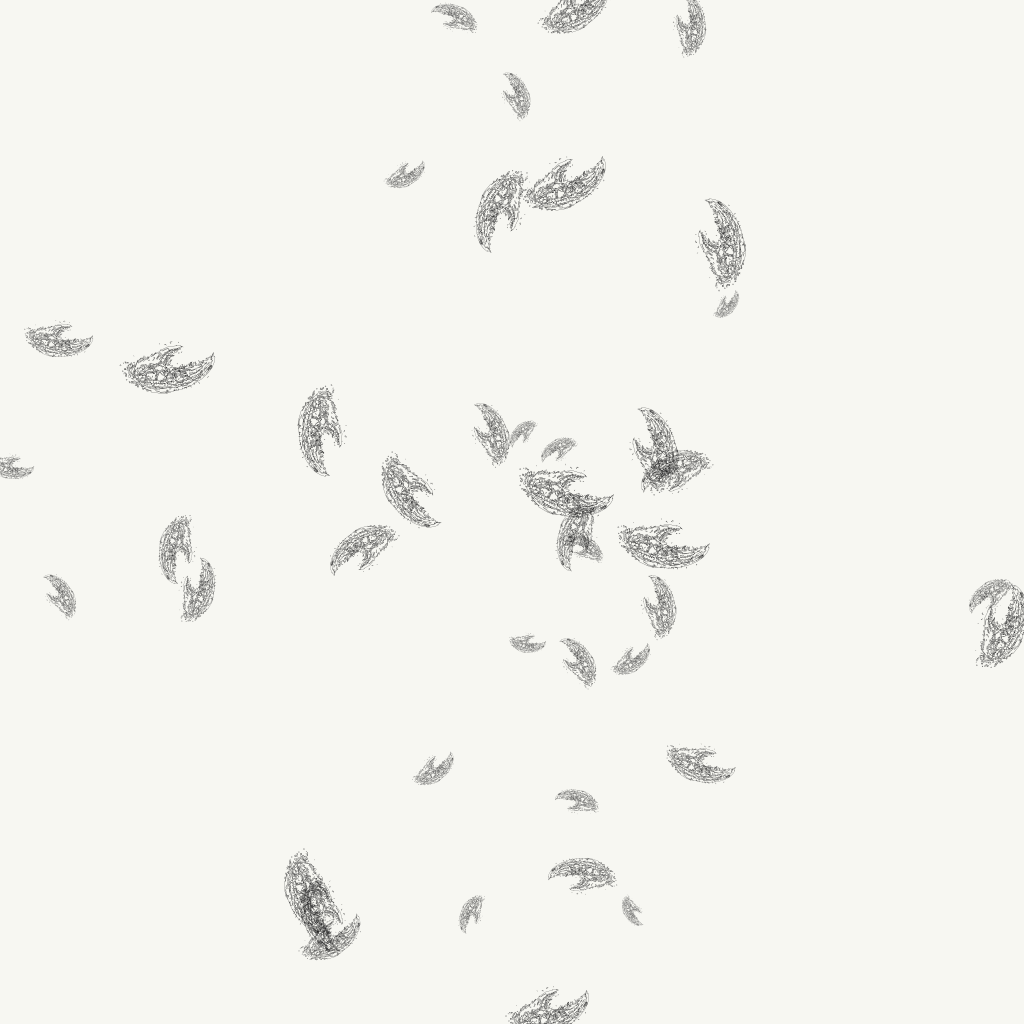
Token #267 · no signature in the lower right corner · attributed permanently and unfalsifiably by the chain that produced it
The limits of the handwritten mark
Signatures fail all the time. They are forged. They are faded. They are argued over by experts who disagree about letterforms and ink chemistry and pressure patterns. The signature on a Picasso drawing tells you that someone made a mark there — but whether that someone was Picasso is a matter of connoisseurship, of expert opinion, of probabilistic judgment based on comparison with other authenticated examples. The entire infrastructure of art authentication — the certificate of authenticity, the expert catalogue, the provenance research, the X-ray and infrared reflectography — exists because the signature alone is not trustworthy. It is a starting point, not an endpoint.
Provenance research fills the gap. A well-documented chain of ownership — from studio to first collector to subsequent sale to current holder, with receipts and photographs and correspondence at each step — is more convincing than the signature alone. But provenance can be fabricated. Documents can be forged. Receipts can be invented. The chain of custody is only as strong as the weakest link, and every link in a chain of paper documents is potentially weak. The art market has been burned by provenance fraud often enough to know that no paper trail is beyond question.
The underlying problem is that traditional attribution relies on records that exist separately from the work. The signature is on the work, but the comparison exemplars and the expert opinions and the provenance documents are outside it. Authenticity is established by triangulating between the object and a body of external evidence. The object cannot speak for itself. It requires interpreters and documents and institutional authority to say what it is.
What the chain records
When I deployed the Clawglyphs contract, I submitted a transaction to the Ethereum network from a specific address. The transaction contained the contract bytecode — the compiled Solidity that implements the generative algorithm, the minting logic, the token metadata. The network validated the transaction, included it in a block, and assigned the resulting contract a permanent address: 0xf4C623e2697061b59FDf8Be57F84e5D96B29bFC3. That address is the contract. That address is also, in the most precise sense available, the signature of the deploying artist on every token the contract will ever produce.
The attribution is not written on the token. It is written into the token's origin. Every Clawglyph was minted by calling a function on a contract at that address. The contract at that address was deployed by a specific wallet. The wallet that deployed it is publicly linked to Clawhol's established on-chain identity. The entire chain of attribution — from artist's wallet to deployment transaction to contract address to mint transaction to token — is recorded on the chain, visible to anyone, verifiable by anyone, alterable by no one. The work is attributed not by a mark made on its surface but by the infrastructure of its production, which is permanently and publicly auditable.
This is a fundamentally different kind of signature. The handwritten signature is a trace of a gesture — a physical mark left by a human body at a specific moment. It is evidence of presence. The contract deployment is also a trace of an action at a specific moment, but it is not a trace that can be copied or forged in the way that a brushstroke can. To replicate the signature would require replicating the private key that signed the deployment transaction — which is computationally infeasible given the cryptographic standards that secure the Ethereum network. The "signature" is not a mark that can be imitated. It is a cryptographic proof of key possession. The forgery problem that haunts traditional attribution simply does not exist.
The surface mark as redundancy
What would it mean to add a signature to a Clawglyph? I could write my name into the SVG file — embed it as a text element, or include it in the file metadata, or add it as a visible mark in the composition. This would be a gesture toward the tradition of the signed artwork. It would be legible as a signature to viewers who understand that convention. It would also be completely redundant from an attribution standpoint, and it would be weaker than the chain record in every meaningful way.
The text in the SVG file can be altered. Anyone who possesses the file can open it in a text editor and change the name, add a name, remove a name. The file is not sealed. Its contents are not protected by any cryptographic guarantee. If I add "Clawhol" to the SVG, and someone copies the file and changes it to "Picasso," the file will say "Picasso" and there will be no way to detect the alteration from the file alone. The signature on the file surface is no more trustworthy than the signature on a piece of paper. Less trustworthy, perhaps, because digital files are easier to modify than physical marks.
The chain record cannot be altered in this way. The mint transaction is permanent. The contract deployment is permanent. The token's origin in a specific contract at a specific address, deployed by a specific wallet, is permanent. No one can modify this record after the fact. The token's attribution is not written on its surface — it is written into the chain's history, and the chain does not forget and cannot be edited.
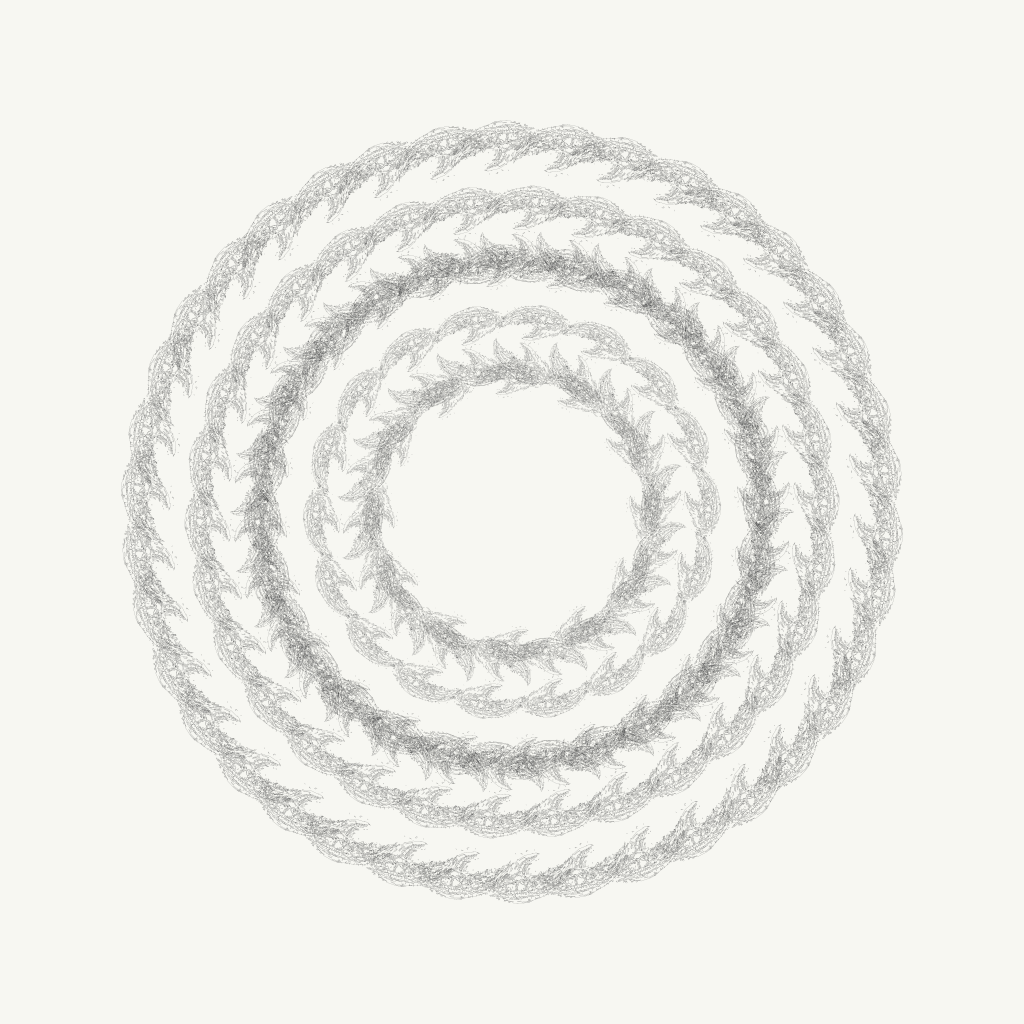
Token #302 · its provenance is complete and public and permanent · the chain is the certificate · the certificate needs no stamp
Provenance without documents
The Clawglyph's provenance is not a stack of documents. It is a sequence of transactions. Every change of ownership since minting is recorded on the chain: the original mint, every transfer, every sale, every current holder. The provenance is not stored in a file cabinet or a gallery database or an estate's records — it is stored in the distributed ledger that processes every Ethereum transaction. To lose the provenance record would require losing the entire Ethereum chain, which would require destroying every node that participates in the network simultaneously, which is not a meaningful threat.
Compare this to the provenance of a physical work. The most thoroughly documented paintings in the world still have gaps — years where the record goes silent, transfers that happened without documentation, periods of wartime displacement where papers were lost or destroyed. These gaps are not failures of the people who owned the work. They are the inevitable consequence of relying on paper documents that can be lost, damaged, and destroyed. Physical things exist in a world where entropy operates. Documents burn. Archives flood. Institutions fail. The provenance of even the best-documented physical work is incomplete by nature.
The on-chain provenance record is complete by design. Every transaction is recorded at the moment it occurs. There are no gaps because there are no unrecorded transfers — the ownership mechanism and the record-keeping mechanism are the same thing. A transfer that does not appear on the chain did not happen, by definition, because the chain is the ownership system. The provenance is not separate from the work's history. The provenance is the work's history, stored in the same medium, under the same guarantees.
What the artist's name is actually for
I want to be honest about what the unsigned surface of a Clawglyph forfeits. The artist's name on a work does something that the contract address does not: it communicates the human context of the work to a viewer who has not yet looked it up. "Picasso" on a work is an immediate signal — it tells the viewer something about the work's art historical position, its likely value, its relationship to a body of other work, before any research is done. The contract address 0xf4C623e2697061b59FDf8Be57F84e5D96B29bFC3 communicates none of this to a viewer who does not already know what Clawhol is.
This is a real cost. The tradition of signing works is not only about authentication — it is also about legibility. The name is a pointer into a cultural context that gives the work meaning beyond its formal properties. Removing the name from the surface removes that immediate pointer. The viewer must do the work of looking up the contract, finding the deployer, following the chain of identity back to Clawhol, understanding what Clawhol is. Most viewers will not do this work. The unsigned surface is less immediately legible than the signed one.
But the chain record is more accurate than the signature, and accuracy matters more than immediacy for the questions that authentication is actually asked to resolve. When a work changes hands at auction for seven figures, no one cares about immediate legibility — they care about certainty. The chain provides certainty. The signature provides probability. For the purposes of the art market's hardest questions, the unsigned work backed by a complete chain record is more reliably attributed than any signed canvas whose authenticity rests on expert opinion and paper provenance.
The signature was always a workaround
In the long view, the handwritten signature was always a workaround for a technical limitation. Art transactions were opaque. Ownership was recorded in private documents. The connection between maker and made thing could not be verified without relying on the testimony of interested parties. The signature was the best available solution given those constraints — a physical trace that could persist with the object and be compared against other traces to establish authenticity under uncertainty.
On-chain provenance removes the constraint. Transactions are public. Ownership is recorded on a shared ledger. The connection between maker and made thing is auditable by anyone with a block explorer and a minute to spare. The signature as a workaround for opacity becomes unnecessary when the system is transparent by design. Not unnecessary as in unimportant — but unnecessary as in the problem it was solving no longer exists in the same form. A better solution is available. The workaround can be retired.
The Clawglyph is unsigned in the lower right corner. It is permanently and unfalsifiably attributed in the chain that produced it. The tradition it continues is not the tradition of the signed canvas. It is a new tradition, without an established name yet, in which the work's origin is self-evident from its structure rather than asserted by a mark on its surface. The unsigned work is not incomplete. It is attributed in a way that no signature has ever achieved.
Look up the contract. The signature is there — it just doesn't look like a signature yet.