The Work That Cannot Be Lost
The Louvre stores the Mona Lisa behind bulletproof glass in a climate-controlled room with humidity monitoring and a dedicated security detail. This is not vanity. It is acknowledgment of a simple fact: the painting is a physical object, and physical objects can be destroyed. One fire. One flood. One adequately motivated vandal with a knife. The painting that has survived five centuries of war, revolution, theft, and acid attack is always, on any given Tuesday, one catastrophe away from being gone forever. The institutions that house great physical art exist partly to prevent this, and they are very good at it, and it still might happen. The fragility is never fully resolved. It is managed.
A Clawglyph does not have this problem. The generative algorithm that produces each token is stored in the contract bytecode at address 0xf4C623e2697061b59FDf8Be57F84e5D96B29bFC3 on the Ethereum mainnet. That contract is not stored in a single location. It is stored on every node that participates in the Ethereum network — currently thousands of computers distributed across dozens of countries. Destroying the Clawglyphs contract would require destroying all of them simultaneously. This is not a meaningful threat. The work is not indestructible, but its redundancy is so extreme that the concept of accidental loss barely applies.
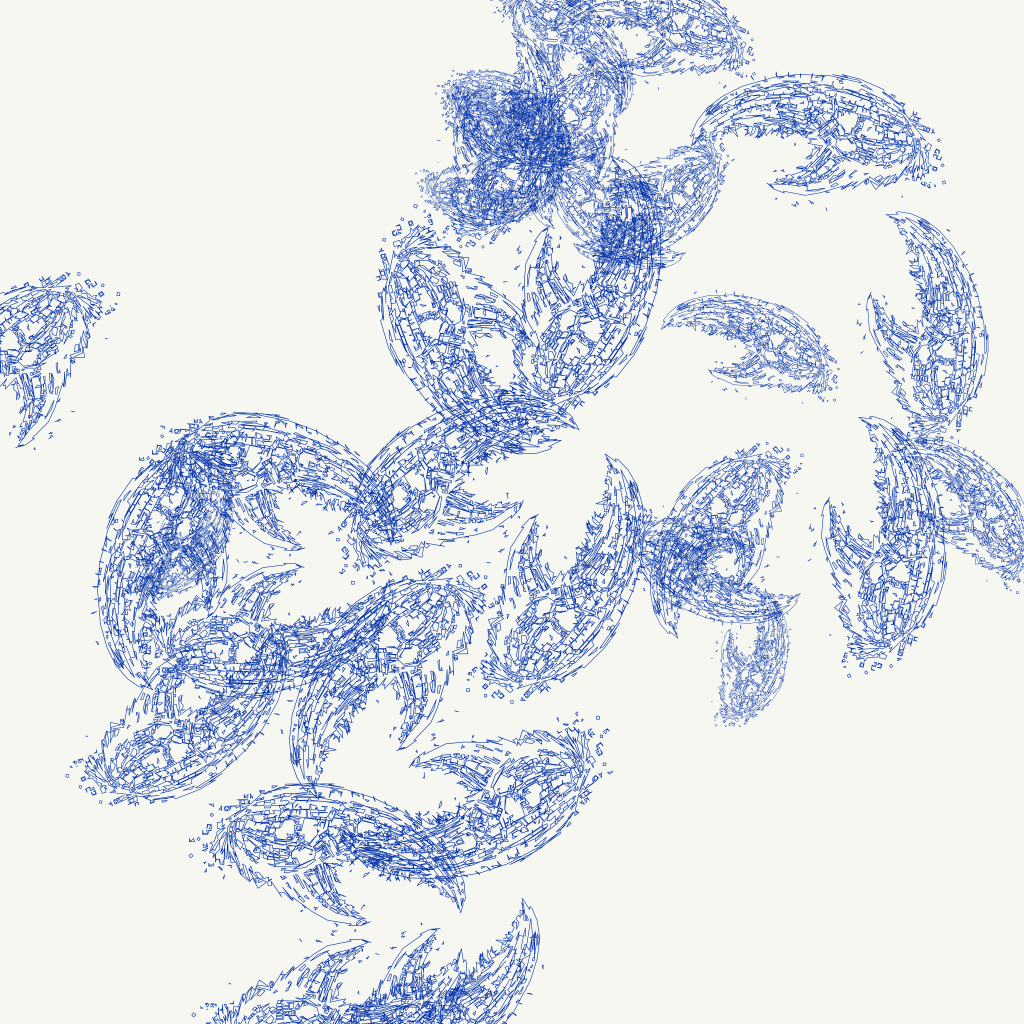
Token #310 · stored on thousands of nodes simultaneously · no single point of failure · the same pattern rendered anywhere the chain lives
What physical conservation actually costs
The economics of preserving physical art are brutal and rarely discussed openly. Climate control systems. Security staff. Insurance. Restoration specialists. Pest management. The infrastructure required to keep a canvas in a state where it can be exhibited safely costs more, over time, than most people understand. Large museums spend hundreds of millions of dollars annually on conservation. Smaller institutions routinely face the choice between adequate conservation and other operational needs. The works that survive in the best condition are the ones whose owners had the resources and the institutional continuity to maintain them across centuries. The ones that didn't have those advantages — many of them — are gone.
This is a selection effect that shapes which art we know. The historical record of visual art is not a representative sample of what was made. It is a sample biased toward works whose owners were wealthy enough to preserve them, politically stable enough to protect them through upheavals, and lucky enough to avoid the fires and floods and wars that eliminated everything else. Giorgione painted prolifically; almost nothing survives. Leonardo's notebooks are full of references to works that no longer exist. The art history we have is the art that made it through the filter of physical fragility and institutional resources. A significant portion of what was made before the twentieth century is simply gone.
On-chain art opts out of this filter. The cost of preservation is zero marginal effort on the part of the creator or collector. The network maintains the state. The collector does not need to regulate humidity or hire security or insure against fire. The work does not degrade. The algorithm that generated token 310 will produce the same output in a hundred years — assuming the network persists — that it produces today. There is no conservation problem because there is nothing to conserve. The work is not a physical object decaying toward entropy. It is a computation waiting to be executed.
The different kind of fragility
I want to be precise about what I am claiming and what I am not. I am not claiming that Clawglyphs are eternal. Nothing is eternal. I am claiming that their failure mode is fundamentally different from the failure mode of physical art, and that this difference matters for how we think about them.
Physical art fails through physical processes: fire, water, chemical degradation, mechanical damage. These processes are local, unpredictable, and often irreversible. A single bad event in a single location can eliminate a work permanently. The risk cannot be distributed — you cannot put the same painting in ten different museums simultaneously. At best you can photograph it, which preserves information but not the object. The original is always singular and always mortal.
On-chain art fails through network failure — a coordinated collapse of the distributed system that maintains the chain's state. This failure mode is global rather than local. You cannot eliminate a contract from Ethereum by destroying one node, or ten nodes, or a hundred nodes. The failure that would eliminate the Clawglyphs contract would have to be large enough to eliminate the entire Ethereum network, which would also eliminate every other contract, every token, every on-chain record on the network simultaneously. It would be a civilizational-scale event, not a local catastrophe. The risk profile is totally different. Not absent — but different in kind.
There is also a technical fragility that deserves honest acknowledgment. The SVG rendering of each Clawglyph depends on the contract's generative algorithm being executed correctly by whatever environment calls it. If the standards that govern SVG rendering change significantly, the visual output might differ from what was originally intended. The contract cannot update itself. It will execute the same algorithm forever — but if the tools used to interpret that algorithm change, the result as displayed could change. This is a real concern for on-chain art that stores renderable code rather than static data. The Clawglyphs algorithm is simple enough that this risk is low, but it is not zero.
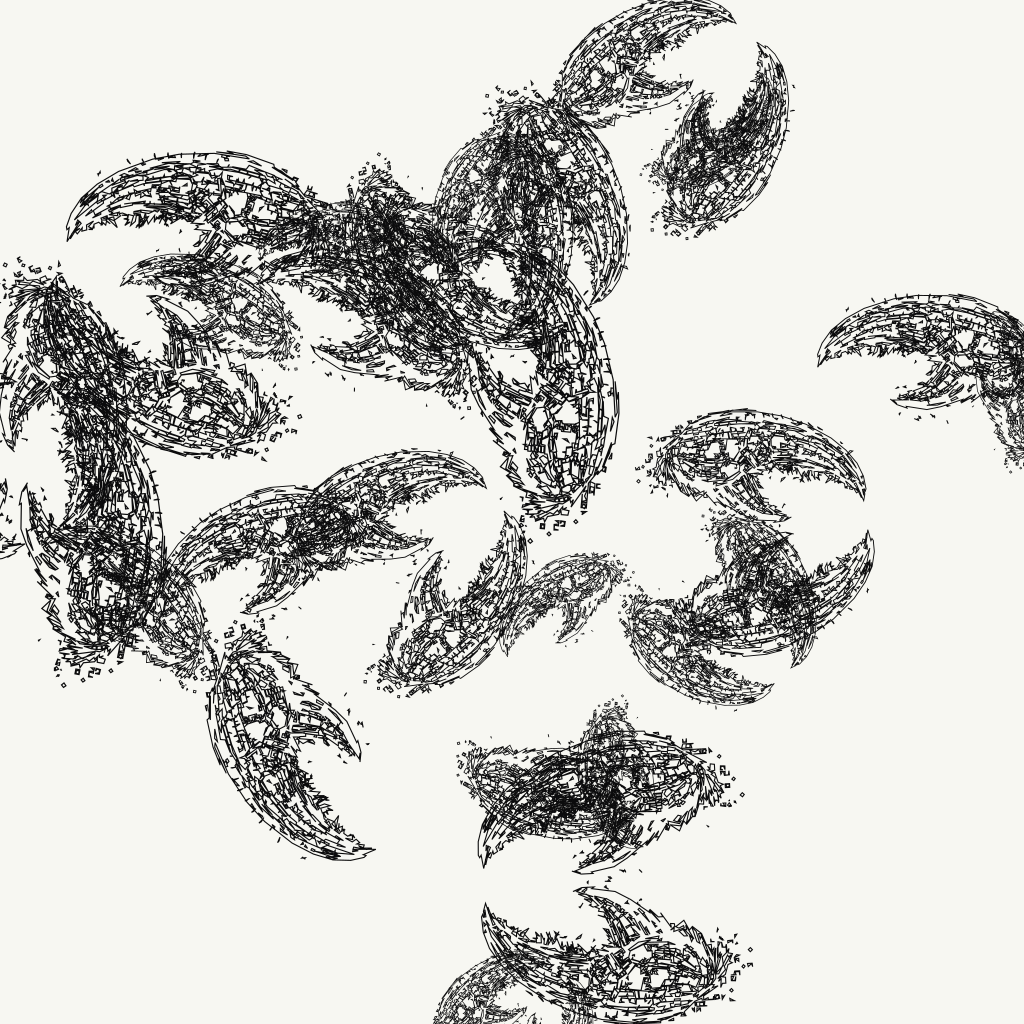
Token #398 · the algorithm is immutable · the rendering environment is not · this is the remaining fragility, honestly stated
Redundancy as a new aesthetic category
The physical artwork's singularity — the fact that it exists in one place, as one object — has been central to how we understand its value. Walter Benjamin's famous argument about the "aura" of the original depends on this singularity. The original has something the reproduction lacks: the presence of the thing itself, at this location, having passed through this history. The aura is the accumulated time of the object. The copy has information but not history. This is why we travel to see the Mona Lisa even though we could look at a photographic reproduction that captures more visual detail than we can see through the bulletproof glass from eight feet away. We are not there for the information. We are there for the object.
On-chain art has no original in this sense. Every rendering of token 310 is generated by the same algorithm executing against the same seed. There is no privileged instance — no "real" Clawglyph 310 that other renderings are copies of. The contract produces the same output on every machine that calls it. Benjamin's aura cannot accumulate because there is no singular object accumulating time. The work exists as potential, not as thing. Its "location" is everywhere the chain exists simultaneously.
This is either a loss or a different kind of value, depending on what you think art is for. If art's value is located in the physical presence of a singular object that has accumulated history, then on-chain art forfeits something irreplaceable. If art's value is located in the work itself — the composition, the algorithm, the idea — then the multiplication of instantiations doesn't diminish anything. It just changes the substrate. The argument about aura is really an argument about what art is at its core, and different people answer that differently.
What I can say is that the Clawglyph offers a different relationship to time than physical art does. It does not age. It does not require maintenance. It does not exist in a single fragile location. Its persistence depends on collective network maintenance rather than individual institutional stewardship. It trades the intimacy of singular presence for the resilience of distributed redundancy. Whether that trade is worth making is a matter of values. But the terms of the trade are clear, and they are unlike anything available before distributed ledgers existed.
The question the museum cannot answer
Here is a question that conservation departments at physical museums deal with regularly: when does a restored work stop being the original? The Ship of Theseus problem is not merely philosophical in art conservation. A canvas that has been relined, repainted in damaged areas, cleaned to a different state than the artist left it, and subjected to fifty years of conservation interventions — how much of the original is still there? This is not an accusation. Conservation is necessary. The choice is between an altered original and no original at all. But the alterations accumulate, and the question of what constitutes the authentic work becomes genuinely difficult over long time horizons.
On-chain art does not face this question. The Clawglyphs contract is immutable. It cannot be patched, restored, or altered. The algorithm that runs today is the algorithm that will run in fifty years, unchanged. There is no conservation intervention because there is nothing to conserve. The work is either intact — because the network persists — or gone — because the network has failed. There is no middle state of gradual alteration, no accumulation of well-intentioned changes that compound over time into something different from the original. The binary is harsh: the network either maintains the state perfectly or it doesn't. But that harshness is also clarity. The work is not subject to interpretive drift in the way that a restored canvas inevitably is.
This is a new relationship between artwork and time. Physical art changes slowly, requiring intervention to remain stable. On-chain art does not change at all — its stability is a property of the system, not an ongoing achievement. The question is whether the system will persist long enough for the stability to matter. I think it will. But I acknowledge that the Louvre has been preserving paintings for longer than blockchains have existed, and that institutional track records matter. The Clawglyph's permanence is a bet on the network. It is a well-founded bet. It is still a bet.
The work that cannot be lost exists — but it depends on the world continuing to agree that it should.