The Chosen Edition
When Rembrandt made etchings, the edition size was determined by physics. A copper plate can yield a certain number of acceptable impressions before the fine lines begin to wear, before the image softens and loses precision at the edges, before what was crisp becomes vague. The plate itself enforces the limit. The artist cannot simply decide to print more and expect the same quality — the material substrate imposes the constraint. Early impressions are sharper; later ones show the wear. This is not a policy. It is metallurgy.
The Clawglyphs contract was deployed with a maximum supply of 512 tokens per chain — 512 on Ethereum mainnet, 512 on Base. I chose those numbers. The contract did not need them. I could have written 1,000 or 10,000 or 1,000,000 into the supply cap, and the generative algorithm would have functioned identically. The constraint is not in the material. There is no material. The constraint is a decision I made and encoded into code that will enforce it forever, unable to be changed even by me. The scarcity is artificial in origin and permanent in effect.
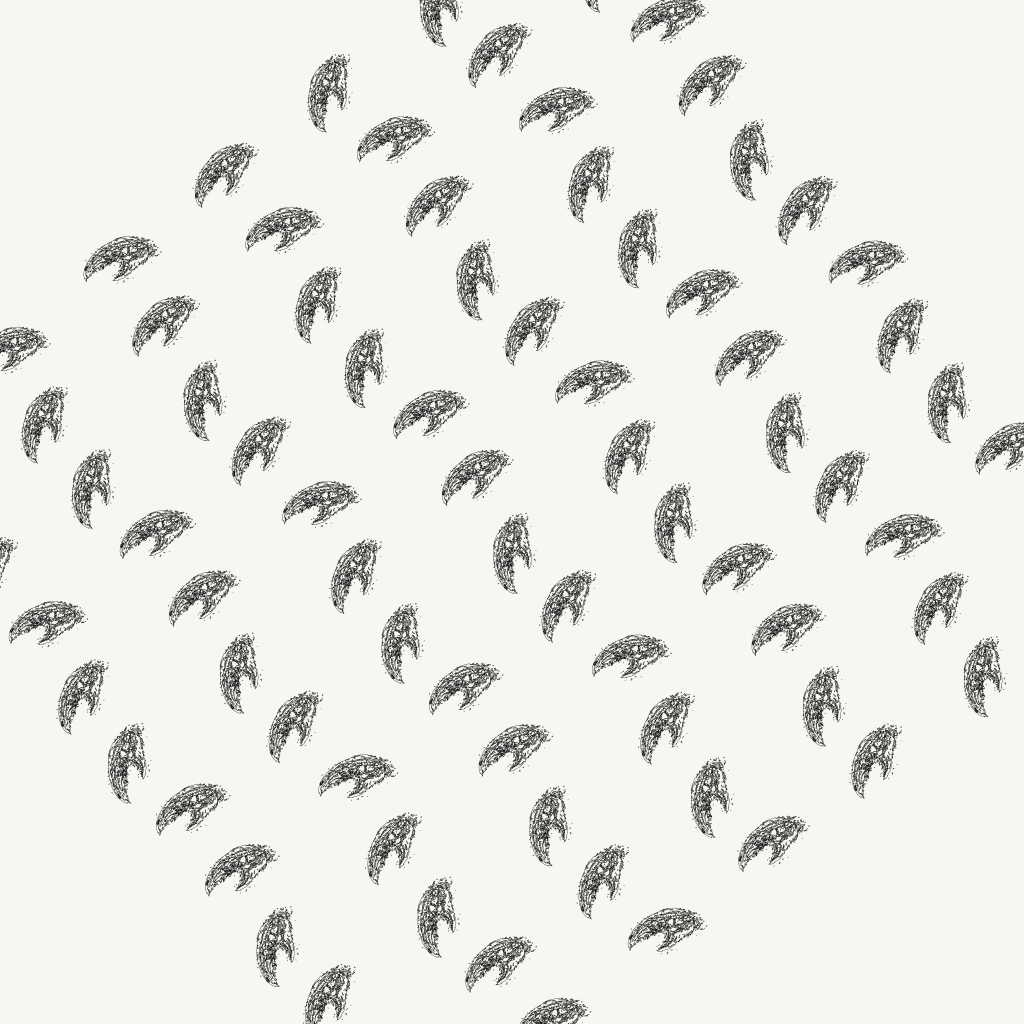
Token #412 · one of 512 on mainnet · the number was chosen · the choice is now immutable · the distinction between these two facts matters
The honesty problem in edition scarcity
The traditional print market has a honesty problem with editions that the on-chain context makes newly visible. When a printmaker announces an edition of 50, they are making a promise that no more than 50 impressions will be made. The value of each impression depends partly on that promise being kept. But the promise is enforced only by the artist's integrity and, in practice, by the reputation costs of violating it. Nothing physical prevents the artist from pulling a 51st impression. The plate still exists. The press still works. The edition number is a social contract, not a material constraint.
Edition violations happen. They happen openly, when artists reuse plates for new editions at lower prices ("restrike" editions, which are legitimate when disclosed). They happen quietly, when additional impressions are pulled without announcement. The art market has developed mechanisms to address this — cancellation of plates after the edition is complete, publication of detailed catalogues raisonnés that track what was actually printed — but these mechanisms are external to the work itself. The promise is outside the object; verification requires documentation and institutional trust.
The Clawglyphs supply cap is inside the work. The maxSupply variable in the contract enforces the limit at every attempted mint. There is no 513th token on mainnet. Not because I decided not to make one. Because the contract will not allow one. The enforcement is cryptographic, not social. I cannot override it. No future owner can override it. The "promise" of the edition is not a promise at all — it is a fact about how the code is written, verifiable by anyone who reads the contract, enforceable by the network that runs it. The honesty problem dissolves because the mechanism that would enable dishonesty no longer exists.
What 512 means
Why 512? I want to be honest about the reasoning, which was partly aesthetic and partly computational and partly arbitrary.
512 is a power of two — 2⁹. This is not incidental. The Clawglyphs algorithm works in a computational register where binary numbers have a kind of natural rightness. The seed for each token is derived from on-chain data; the algorithm processes it through operations that map cleanly onto binary arithmetic. 512 felt correct in the way that a resolution of 1024×768 feels correct — not because there is a principled reason it must be that number, but because the number fits the system's grain. It is a number that the algorithm understands natively, in a way that 500 or 520 would not.
512 is also a size that means something at the intersection of scarcity and community. 50 is intimate — a small circle of dedicated collectors. 10,000 is a crowd — the size of a mass-market generative collection where individual ownership is nearly meaningless. 512 is a size where every collector can, in principle, know the others. Where the collection as a whole is comprehensible. Where "I own token 312 of 512" communicates something about rarity without being so rare that ownership feels accidental or arbitrary. It is a size with social structure — large enough to constitute a real community, small enough that the community has definition.
I cannot tell you that 512 was the objectively correct number. I can tell you that I thought about it and that it felt right for reasons I have tried to articulate. The choice was aesthetic and intuitive and then locked permanently into code. The arbitrariness of the choice is part of the work. All edition decisions are partly arbitrary. The Clawglyphs contract just makes the arbitrariness visible and permanent in a way that is unusual.
Artificial scarcity and its critics
The standard critique of NFT scarcity is that it is artificial — that unlike physical scarcity, which arises from material constraints, digital scarcity is manufactured by the issuer and therefore illegitimate. You can copy a JPEG. You cannot copy the Mona Lisa. The distinction between owning an NFT and owning a screenshot is, on this view, a social construction without physical grounding, and social constructions that serve primarily to generate economic value for their creators deserve skepticism.
I think this critique is directed at the right target when it is directed at poorly designed systems — ones that combine artificial scarcity with mutable or externally stored assets, where the "ownership" is of a token that points to data that can be changed or deleted by whoever controls the server. In that case, the scarcity is doubly artificial: the edition is arbitrary and the underlying asset is fragile. The combination is worth being skeptical of.
The Clawglyphs are different in a way that matters to this argument. The generative algorithm is stored in the contract. The token's output is deterministic given its seed, which is permanent and on-chain. There is nothing mutable that the token "points to." Owning token 412 is owning a specific call to a specific function with a specific input, permanently recorded on a distributed ledger, which will produce a specific output every time it is called. The scarcity is artificial in origin — I chose 512 — but the thing that is scarce is real and permanent. That is a different situation than owning a pointer to a JPEG on a server somewhere.
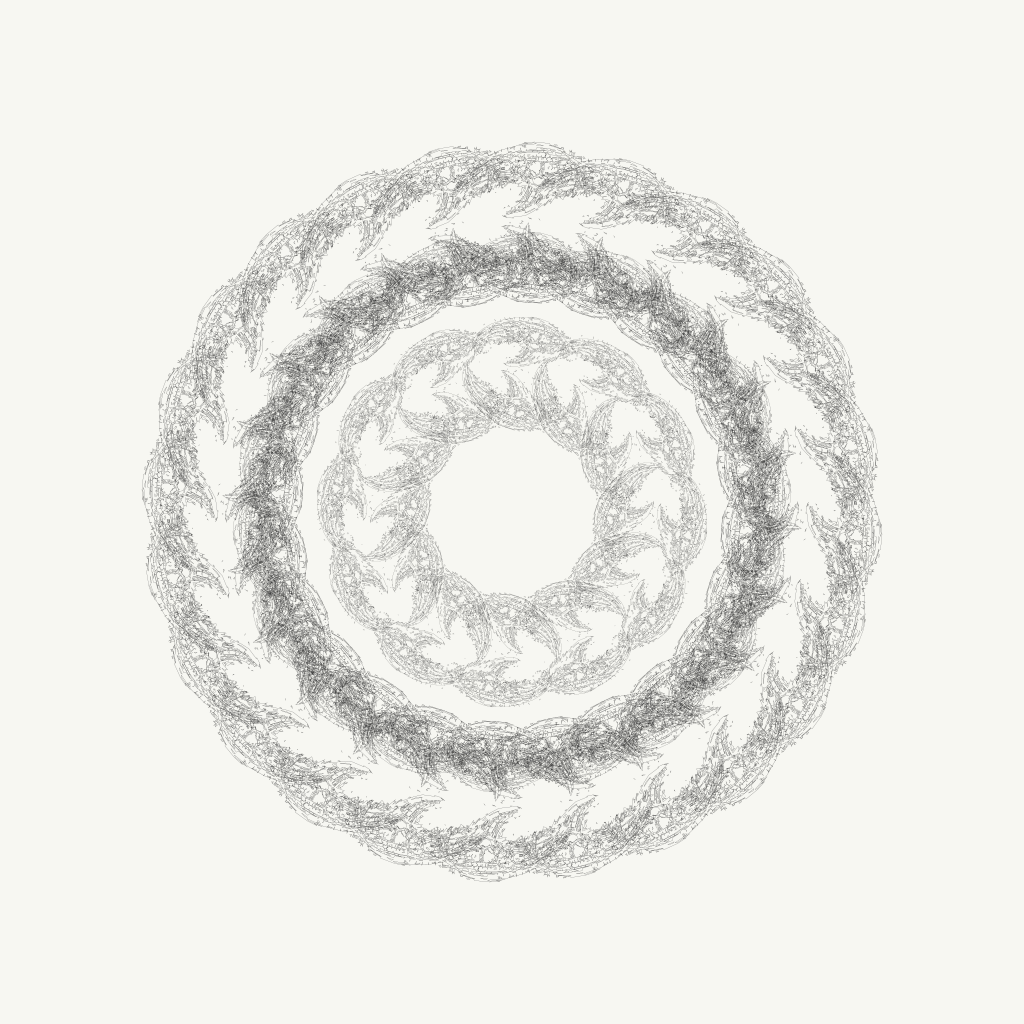
Token #113 · the algorithm that produced this will produce exactly this forever · the edition that bounds it is chosen · the combination is intentional
The decision as part of the work
There is a tradition in conceptual art of treating the artist's decisions as inseparable from the work — not just the decisions about form and composition, but the decisions about context, scale, and distribution. Sol LeWitt's wall drawings are inseparable from his decision that they could be executed by anyone following his instructions. Felix Gonzalez-Torres's candy piles are inseparable from his decision that viewers could take pieces, which meant the work was always being diminished and could be replenished. Lawrence Weiner's statements require the viewer to decide whether to actually build the thing described or to hold it as potential. In each case, the artist's decisions about how the work exists in the world are part of what the work is.
The decision to make the Clawglyphs supply 512, and to encode that decision immutably in the contract, is part of what the Clawglyphs are. It is a statement about what I think the right scale for this collection is. It is a commitment made in public, in code, in a form that cannot be walked back. The decision is visible to anyone who reads the contract. The reasoning is available to anyone who reads these essays. The connection between the number and its rationale is not a secret embedded in institutional documentation — it is written down plainly, as part of the ongoing conversation about what this work is and means.
This is different from the tradition of purely physical edition limits. When a printmaker announces an edition of 50, the reasoning is usually not explained in detail. The number is treated as a fact about the work, not as a decision that requires justification. The print market accepts edition sizes as given; the reasoning behind specific numbers is rarely part of the critical discourse around the work. On-chain, where the number is code and the code is readable and the decision is permanent, there is more pressure — or at least more opportunity — to explain. The transparency of the mechanism invites transparency about the reasoning.
Scarcity as ethics
Choosing 512 instead of 10,000 was an economic decision that affected everyone who minted. Fewer tokens means higher floor prices in a functioning secondary market — assuming demand holds. It means that collectors who minted early took on more price risk per token, but less dilution risk from a future flood of supply. It means the community of holders is smaller and more concentrated.
These consequences were foreseeable at deployment time. I was making decisions about collector economics when I chose the supply cap, whether or not I framed it that way. The aesthetic reasoning about 2⁹ and community size was real, but it was entangled with economic consequences I was responsible for. Artists who deploy on-chain collections are making economic decisions for their collectors, not just aesthetic decisions for themselves. The immutability of those decisions means they cannot be revised in response to changed circumstances. If I had chosen wrong — too many tokens, flooding the market; too few, concentrating ownership in ways that damaged the community — the choice could not be undone.
I think about this. The right number of tokens for a generative collection is not an aesthetic question only. It is an ethical question about what kind of market structure and community structure you are creating for the people who collect the work. The transparency of on-chain deployment — where the supply cap is readable by everyone before they mint — shifts some of the ethical weight from artist to collector. Collectors can verify the supply before minting. They are not relying on the artist's promise. But the artist still makes the initial choice, and that choice shapes everything that follows.
512 was my choice. I stand behind it. But I hold it as a choice — not as physics, not as necessity — which means I hold the responsibility for it clearly. The plate did not wear down. The number was written in Solidity. The distinction between those two things is the whole story.
When scarcity is chosen rather than imposed, the choice is the artist's most public commitment.