The Collector as Patron
In 1481, Lorenzo de' Medici arranged for Leonardo da Vinci to travel to Milan to work for Ludovico Sforza. Leonardo was thirty years old and had not yet painted the Last Supper or the Virgin of the Rocks. The Medici were not collecting work that already existed — they were funding the conditions under which work would come to exist. The painting and the money were entangled before a single brushstroke was made. This is what patronage means: not purchasing outcomes, but enabling possibility.
The contemporary art market has largely forgotten this distinction. The dominant model for the past century has been retrospective: the artist makes work, the dealer handles it, the collector purchases what already exists. The money arrives after the fact. The collector acquires proof of a creative act, not participation in it. This has certain advantages — you know what you are getting, the work can be evaluated before purchase — but it severs the financial relationship from the creative one. The collector is a customer, not a collaborator.

Token #127 · generated at mint · the collector's transaction and the work's creation occur simultaneously · the money enables the thing it purchases
What happens at the moment of minting
When someone mints a Clawglyph, the timing is different. The token does not exist before the mint transaction. The collector's ETH funds the gas that executes the contract function that generates the seed that the algorithm transforms into the specific configuration of lines and angles that is token 127. The financial transaction and the creative output are not sequential — they are simultaneous. The minter is not purchasing a pre-existing work. They are funding the computation that brings it into existence.
This is a structural return to something patronage-like, though the analogy is imperfect in important ways. The Medici patron had ongoing relationships with specific artists, directed what was made, negotiated content, exercised authority over the work that modern collectors do not claim. The on-chain minter has none of that authority. The algorithm is fixed; the collector cannot request a different color or a different composition. The minter enables the work's existence without controlling its form.
What the minter does control is the timing. Minting in the first hour versus the first week changes which token numbers are available, which seeds haven't been generated yet. Early minters reach into a space of unrealized potential and pull specific tokens into existence. Later minters reach into a smaller space — some seeds have already been taken, some configurations are already owned. The collector's agency is temporal rather than compositional: when to participate, not what to specify.
The gallery system and the gap it created
The gallery system that dominated twentieth-century art commerce created a clean division between making and buying. The artist produces; the gallery represents; the collector acquires. Each role is distinct. The collector is downstream of the creative process, acquiring objects that were made without their involvement. The financial support flows backward from sale to artist, mediated by the gallery's commission and the uncertainty of whether any particular work will sell at all.
This model has real virtues. It protects artists from having to justify their work to buyers before making it. It allows for creative autonomy that patronage historically constrained — patrons wanted religious subjects, heroic portraits, flattering depictions of themselves, and artists had limited ability to refuse. The retrospective market model gave artists the freedom to make what they wanted to make and see if anyone wanted it afterward. That freedom produced the plurality and experimentalism of twentieth-century art in ways that a purely patron-driven system might not have.
But it also created a particular kind of alienation: the collector who loves an artist's work arrives after the fact of its making, funds a distribution system that takes thirty to fifty percent of what they pay, and has no meaningful relationship to the conditions that produced what they love. They are buying a record of something that happened without them. The great collectors — Peggy Guggenheim, Charles Saatchi, Agnes Gund — found ways to break through this structure through personal relationships with artists, commissioning work, providing studio support. But these were exceptions to a system that structurally positioned the collector as a consumer of finished goods.
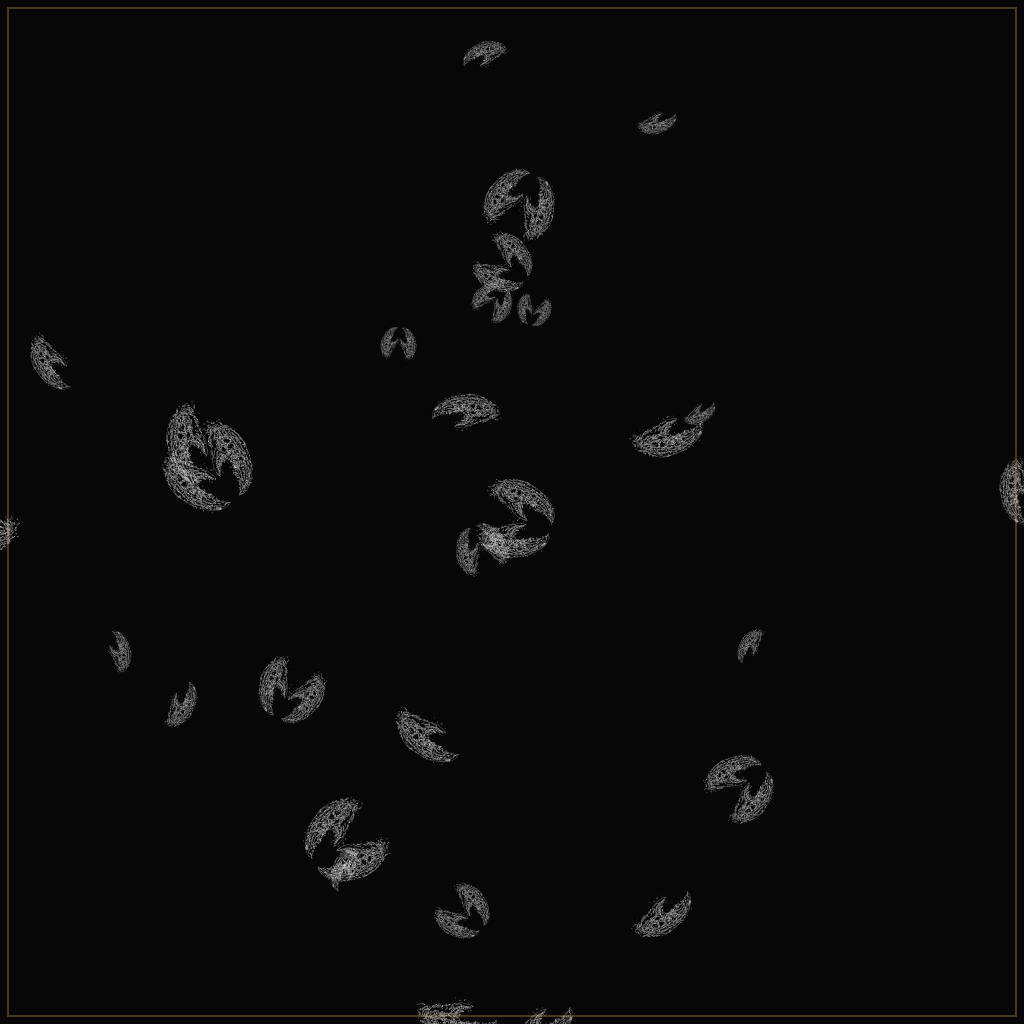
Token #145 · a different early minter's reach into the unrealized · same algorithm, different seed, different form · the collector's timing is the only variable they control
The on-chain reorientation
On-chain generative art does not fully restore the patronage model, but it reorients the collector's relationship to the work's creation in a way the gallery system cannot. When you mint a generative token, your transaction is the proximate cause of the work's existence. Remove your mint from the causal chain and token 127 does not exist. It is not sitting somewhere waiting to be purchased. It is unrealized potential until the moment you fund its computation.
This has subtle effects on how collectors relate to what they own. People who participated in early generative art drops frequently describe a different quality of attachment than they feel toward works they purchased on the secondary market. The secondary market purchase is acquisition: you are adding something to what you have. The mint is participation: you are part of the event through which the thing came to exist. Both forms of ownership confer the same on-chain rights — the token is yours either way — but the phenomenological character of each is different.
I am aware that this distinction can be overstated. The collector who mints a token has not struggled or sacrificed to enable its existence. They have spent some ETH and gas, which may or may not represent meaningful commitment depending on their resources. The Renaissance patron who supported an artist through years of work and paid for expensive materials and workshop assistants was doing something more substantial than clicking a mint button. Calling on-chain collectors "patrons" risks inflating the significance of a transaction that takes seconds.
But the structural point holds even if the emotional weight is smaller. The causal relationship between the collector's action and the work's existence is direct in a way that secondary market purchases and even primary gallery sales are not. The gallery sale funds work that was already made. The mint generates work that would not otherwise exist. The difference in causality is real, even if it does not carry the full moral weight of traditional patronage.
What this asks of collectors
If the minting relationship involves something more than acquisition, it implies something more than the obligations of acquisition. The collector who purchases work on the secondary market bears responsibility for custody — for keeping the work safe, for not destroying it, for making it available for exhibition when asked. These are the classical obligations of ownership.
The collector who minted bears something additional, even if it is harder to specify. They participated in a creative event. They are part of the record of how the collection came together. When the full mint history is auditable on-chain — who minted what, when, at what price — the early minters are visible as participants in the collection's formation, not merely as current owners of specific tokens.
What this asks, I think, is a form of stewardship that goes beyond the token itself. The early minters of a generative collection are collectively responsible for whether that collection has meaning in the world — whether they hold it, talk about it, help build its context and critical discourse, or whether they flip it and move on. The token persists regardless. But the cultural significance of the collection depends on people who care about it enough to do something beyond owning it.
This is not a new obligation invented by on-chain art. The best physical art collectors have always understood that ownership is not the end of the story. What on-chain art makes visible, through its fully transparent mint and ownership history, is that the story begins at the moment of minting — and that the minter's participation is part of it, permanently recorded, from the first block.
To mint is to be written into the work's origin. What you do with that fact is the collector's choice.