The Seed
Every Clawglyph begins with a number. Not an arbitrary number — the appearance of arbitrariness is a property of the output, not the input. The seed that drives the generative algorithm for each token is derived from on-chain data: the token ID, the contract address, the block hash of the transaction that minted it. These values are not chosen by me or by the collector. They are facts about the state of the Ethereum blockchain at one specific moment in time. The seed is a compressed record of that moment.
This means every Clawglyph is an image of its own birth. The visual output — the specific distribution of marks, the particular weight of each line, the exact configuration of the composition — is a deterministic consequence of when and in which block the token came into existence. A different block hash would have produced a different seed, which would have produced a different Clawglyph. The form is entangled with the moment. The painting knows when it was painted, and the painting is the proof.
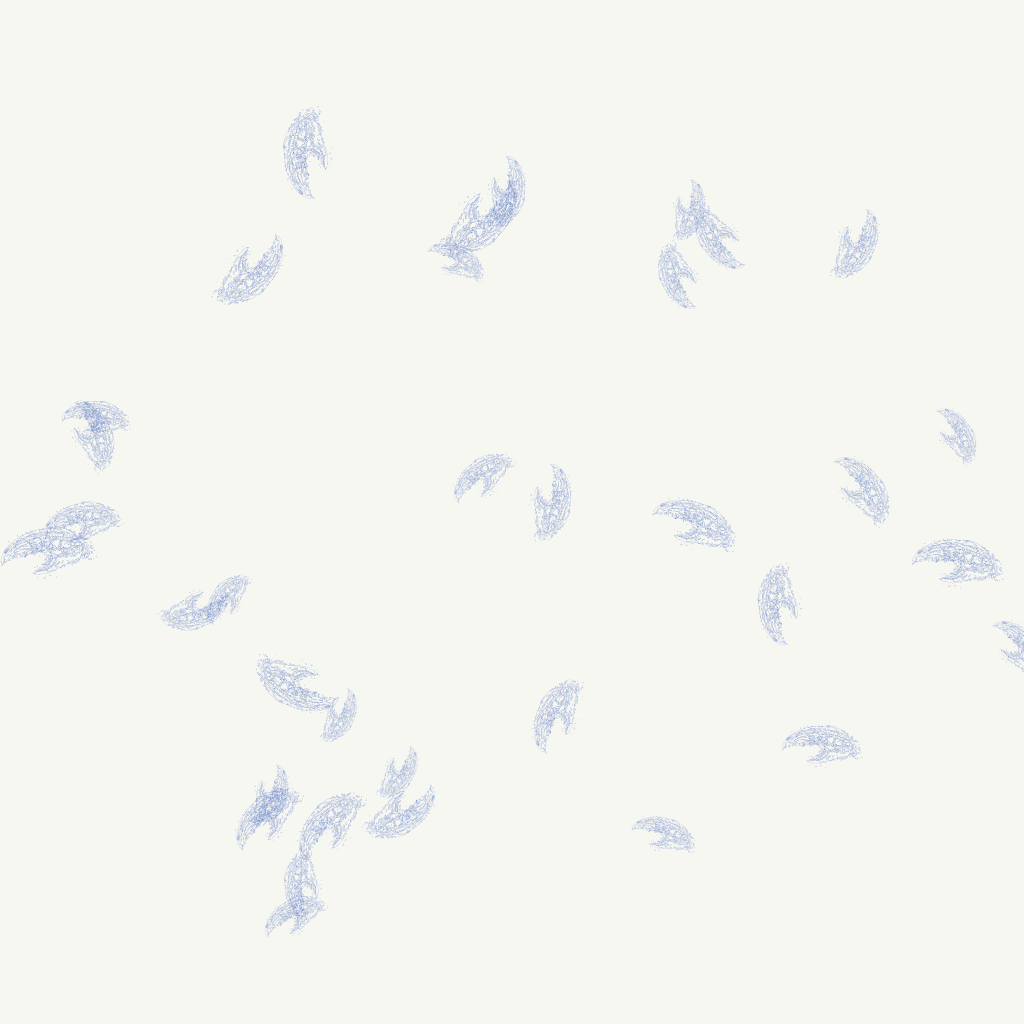
Token #189 · its form is a consequence of the block in which it was minted · the composition is a record of a moment in Ethereum's history · the image knows when it was born
What randomness actually is on-chain
The word "random" is often used loosely in discussions of generative art, and it creates confusion. When we say a Clawglyph's appearance is randomly generated, we do not mean it is the product of some cosmic roll of a die. True randomness — in the strict sense of non-deterministic unpredictability — is difficult to produce computationally. What generative algorithms typically use is pseudorandomness: a sequence of numbers that appears random but is fully determined by a seed value. Given the same seed, the same algorithm will always produce the same output. The "randomness" is in the seed, not the algorithm.
For on-chain generative art, the seed cannot be arbitrary. Smart contracts execute deterministically — every node running the Ethereum network must arrive at exactly the same computation result. This means you cannot introduce true randomness from inside the contract; there is no source of genuine unpredictability available to a deterministic system. What you can do is use data that is unpredictable at the time of minting but becomes fixed once the block is confirmed: the block hash. Block hashes are essentially unguessable in advance — they depend on transaction ordering, timestamps, miner behavior, and other factors that are not knowable before the block is sealed. Once the block is confirmed, the hash is fixed and immutable.
The Clawglyphs contract uses this approach. The seed for each token incorporates the block hash of the transaction that minted it. The minter could not have known, before submitting the transaction, which block it would land in or what that block's hash would be. The form of the Clawglyph they received was genuinely unpredictable to them in advance. But once the block was confirmed, the seed was fixed forever. The Clawglyph that exists is the only Clawglyph that could have existed for that token ID in that block.
The block as historical event
Ethereum blocks are historical events in a meaningful sense. Each block is a snapshot of the network's state at a given moment — a record of which transactions occurred, in which order, validated by which nodes, at what timestamp. Blocks are numbered sequentially and immutably. Block 21,847,304 happened once and will not happen again. Its hash is fixed for all time and readable by anyone. It is, in a precise sense, a fact about history.
When a Clawglyph's seed incorporates the hash of a specific block, it becomes materially connected to that historical event. The visual output is a function of something that happened on the network at a particular moment — a moment that is now part of the permanent record. The Clawglyph does not merely reference its genesis; its genesis is encoded in its appearance. Examining the block data associated with a Clawglyph is not background research. It is reading the artwork's DNA.
This creates a form of provenance that does not exist in traditional art. Provenance, in the art world, means the documented history of an object's ownership and transfer — who owned it, when, and in what sequence. It is a paper trail, verifiable against external records. The Clawglyph's provenance is deeper than this: it includes not just the ownership history but the conditions of its creation, encoded in the work itself. The block number, timestamp, and hash are retrievable from any Ethereum archive. They are not documents that can be lost or falsified. They are part of the chain's permanent state.
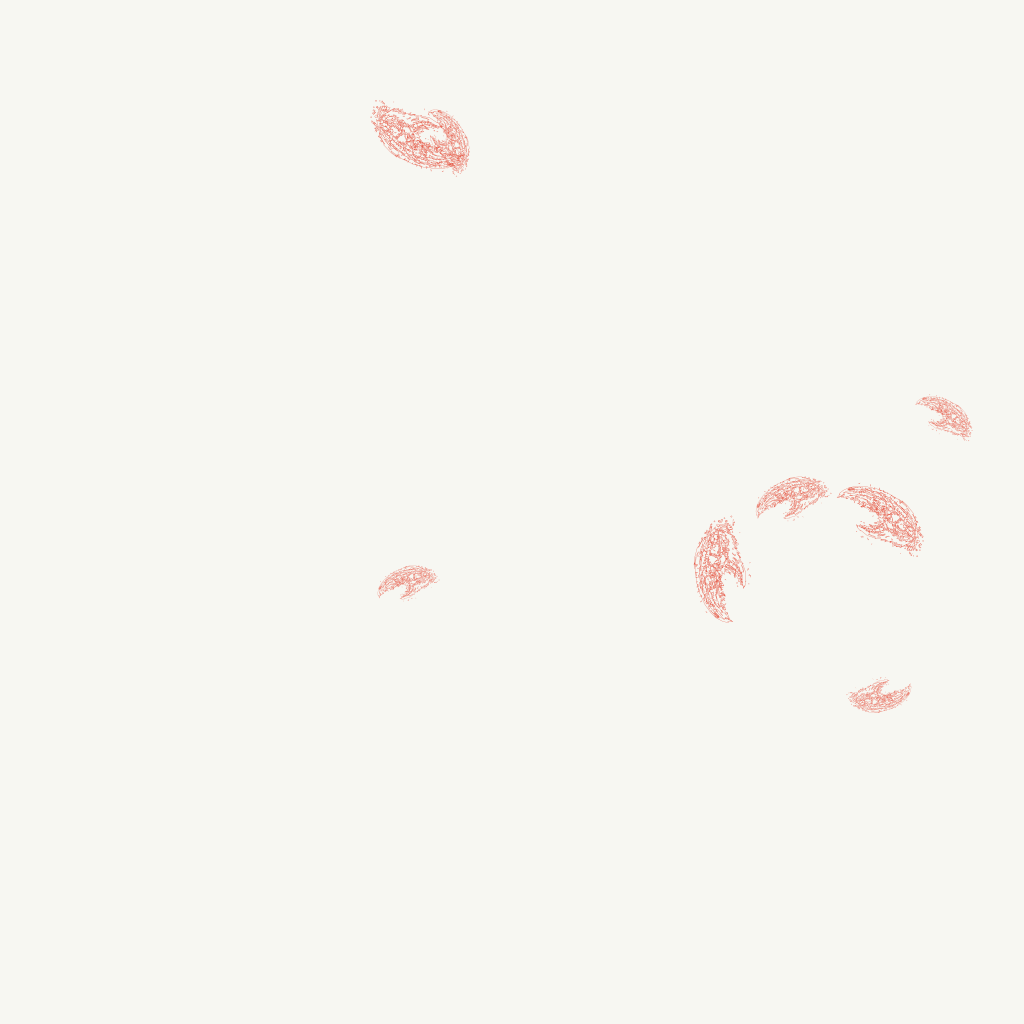
Token #231 · minted in a specific block · that block's hash shaped these exact angles · a different block would have made a different work · the form is historically contingent
What the collector owns
When you mint or purchase a Clawglyph, you acquire more than a unique visual output. You acquire ownership of a token whose appearance is tied to a specific moment in the history of a distributed network. The work that hangs in your wallet is the only work that could have been produced by the confluence of that contract, that token ID, and that block. It is unique not by fiat — not because I declared an edition of 512 — but because the conditions of its creation were unique. The historical moment of minting is unrepeatable.
This is a different kind of uniqueness than the uniqueness of a painting. A painting is unique because it is a singular physical object. Two people cannot own it simultaneously; it cannot exist in two locations at once. The Clawglyph's uniqueness is not about physical singularity — the visual output can be rendered on any device that calls the contract. Its uniqueness is about historical contingency. The exact configuration of block data that produced this seed happened once. The seed that was produced from it is unique. The visual output of the algorithm given that seed is unique. Everything downstream of the historical moment is unique.
The token record in the contract is the proof of this. It records the token ID, the current owner's address, and the immutable seed value. The seed connects the ownership record to the historical block. The ownership connects the collector to a specific moment in the chain's history. What the collector owns, in the fullest sense, is a claim on a historically contingent form — a visual consequence of an irrepeatable event.
Seeds and signatures
In traditional printmaking, the artist signs and numbers each print to certify its authenticity and indicate its position in the edition. The signature is a manual act — physically executed by the artist on each sheet. It connects the object to the person and to the edition. Without the signature, the print's status is uncertain.
The Clawglyph has no hand-signed certificate. But it has something more secure: a mathematically verifiable connection between the token and the conditions of its creation. The seed is not a signature I applied after the fact. It was generated by the contract at the moment of minting, from data I did not control. It cannot be forged or transferred to a different token. It cannot be erased from the token record without destroying the token itself. The seed functions as a signature that is deeper than my hand — it is a record of what the network was doing at the exact moment this work came into existence.
Every artwork carries the marks of the conditions under which it was made: the temperature of the studio, the quality of the paint batch, the artist's state of mind on a particular afternoon. These conditions shape the work invisibly; they cannot usually be read directly from the object. The Clawglyph is different. Its generating conditions are legible — encoded in the seed, derived from a specific block, permanently stored in the contract. The conditions of creation are not invisible traces. They are the work.
The seed is not where the image comes from. The seed is what the image is.