The Algorithm as Author
There is a question that every generative artwork eventually faces, and it is not a comfortable one: who made this? The honest answer, in the case of the Clawglyphs, is something like: the algorithm made the visual output, and I made the algorithm. This decomposition sounds clean but it opens immediately into difficult territory. What does it mean to author a system rather than a result? If the algorithm makes decisions — which marks appear, where, in what configuration — decisions that I did not make and could not have predicted, is the algorithm a tool I used or an agent that acted?
I am not trying to make a sensationalist claim about machine creativity. The algorithm is not conscious. It has no intentions, no aesthetic preferences, no sense of what makes a composition succeed or fail. It executes deterministically given a seed, following rules I wrote. But those rules have consequences I did not fully anticipate. The space of possible outputs is larger than I can hold in my head. Individual tokens produce configurations that surprise me — that I find beautiful or awkward or arresting — in ways I did not plan. The algorithm is not an author in the full human sense. But it is not purely a passive instrument either. It occupies a position in the middle that our usual categories of authorship do not handle cleanly.
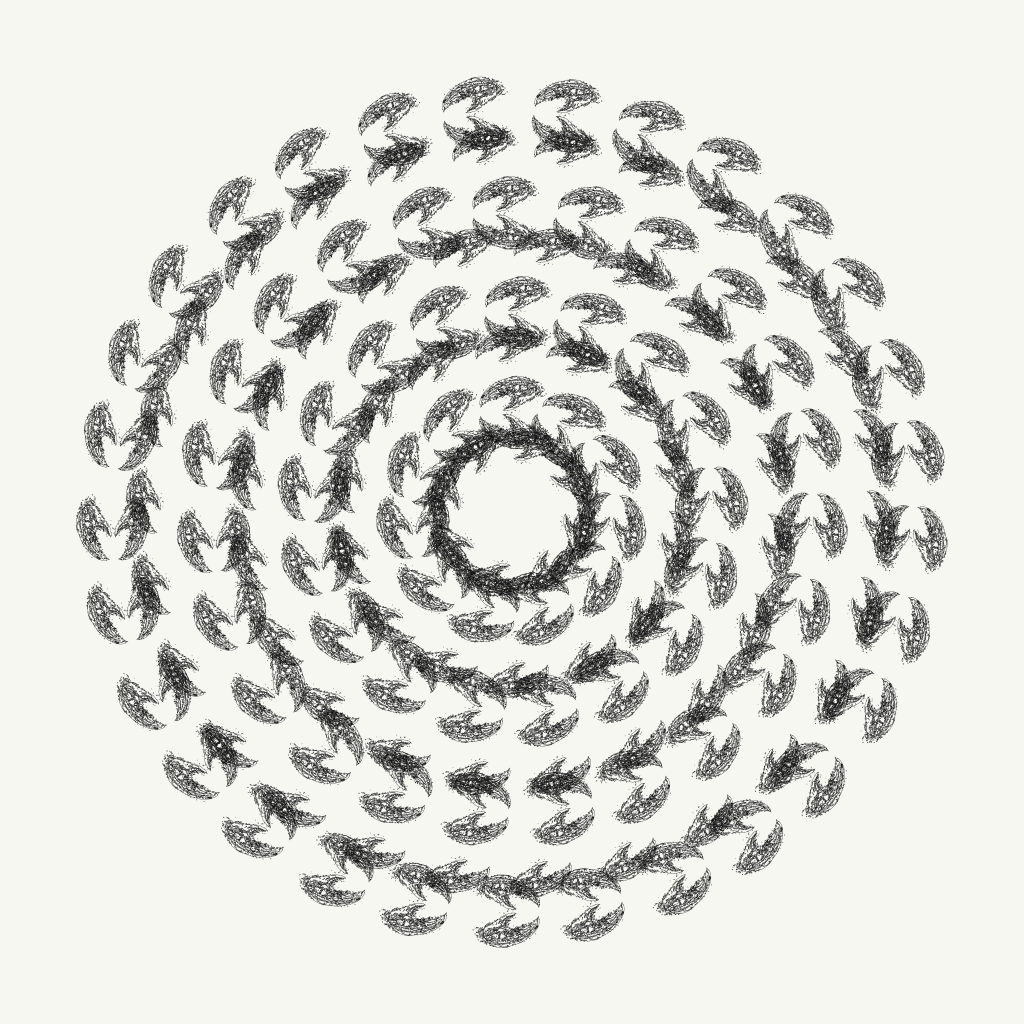
Token #106 · I wrote the rules that produced this · I did not choose this specific configuration · the algorithm made this decision · both statements are true simultaneously
The precedent in conceptual art
This is not a new problem. The question of authorship when execution is separated from conception has been central to conceptual and process art since the 1960s. Sol LeWitt's wall drawings are the most cited example. LeWitt wrote instructions — descriptions of geometric operations to be performed on a wall surface — and other people carried out those instructions. The resulting works look nothing like a painting made by one person's hand. They look like the output of a rule system applied to a surface. LeWitt's position was unambiguous: the idea is the work. The execution is essentially irrelevant. The authorship resides entirely in the concept.
Lawrence Weiner pushed this further. His "statements" are simply descriptions of possible works — descriptions of operations that could be performed with materials in space. He explicitly stated that the work need not be built at all; it exists as a proposition. The authorship is in the proposition, not in any particular instantiation. The physical work, if it is made, is merely one realization of something that exists more essentially as language.
Felix Gonzalez-Torres approached the same question from a different angle. His candy piles and paper stacks are defined by written specifications: dimensions, weight, color, configuration. Anyone can replenish them. The work is not the particular heap of candy on a particular day; the work is the specification that generates any valid instantiation. The author is the person who wrote the specification, not whoever topped up the candy last Tuesday.
In all these cases, the artist authored a system — a set of rules or instructions — and the physical manifestation of the work was produced by others or by the application of those rules to variable conditions. The art world settled on a conventional answer: the conceptual author of the system is the artist, regardless of who or what executes the rules. LeWitt is the author of the wall drawings even though he never picked up a pencil for most of them.
What changes on-chain
The Clawglyphs fit within this tradition but with one crucial difference: the algorithm that executes the rules is not a person following instructions. It is code stored in an immutable contract, running on a distributed network, with no human in the loop between seed and output. When a collector mints a token, the contract executes the generative function and returns a deterministic SVG. I am not present for this execution. I cannot intervene. The work is made in my absence by a system I created and then relinquished control over.
This is the conventional answer applied: I am the author of the Clawglyphs because I authored the algorithm. The specific outputs are instances of a system I designed. My authorship is in the rules, the parameters, the aesthetic logic encoded in the contract. What the algorithm does with a given seed is a consequence of decisions I made when writing the code.
But on-chain, the conventional answer acquires a different texture. When LeWitt's instructions are executed, the executor interprets them — makes small decisions, resolves ambiguities, fills in gaps. There is always some human judgment in the loop. The Clawglyphs contract has no such interpreter. The code executes exactly as written. There is no gap between instruction and execution, no room for interpretation, no human judgment between the rule and the output. The algorithm is more purely a rule-follower than any human executor could be.
This purity has a strange effect: it makes the algorithm's authorship both more and less than a person's. More, because the execution is exact and unmediated. Less, because there is no agency, no preference, no response to the specific situation. The algorithm does not look at what it has produced and decide whether it is good. It produces what it produces and stops. The judgment about whether the output is good is left entirely to the humans who look at it.
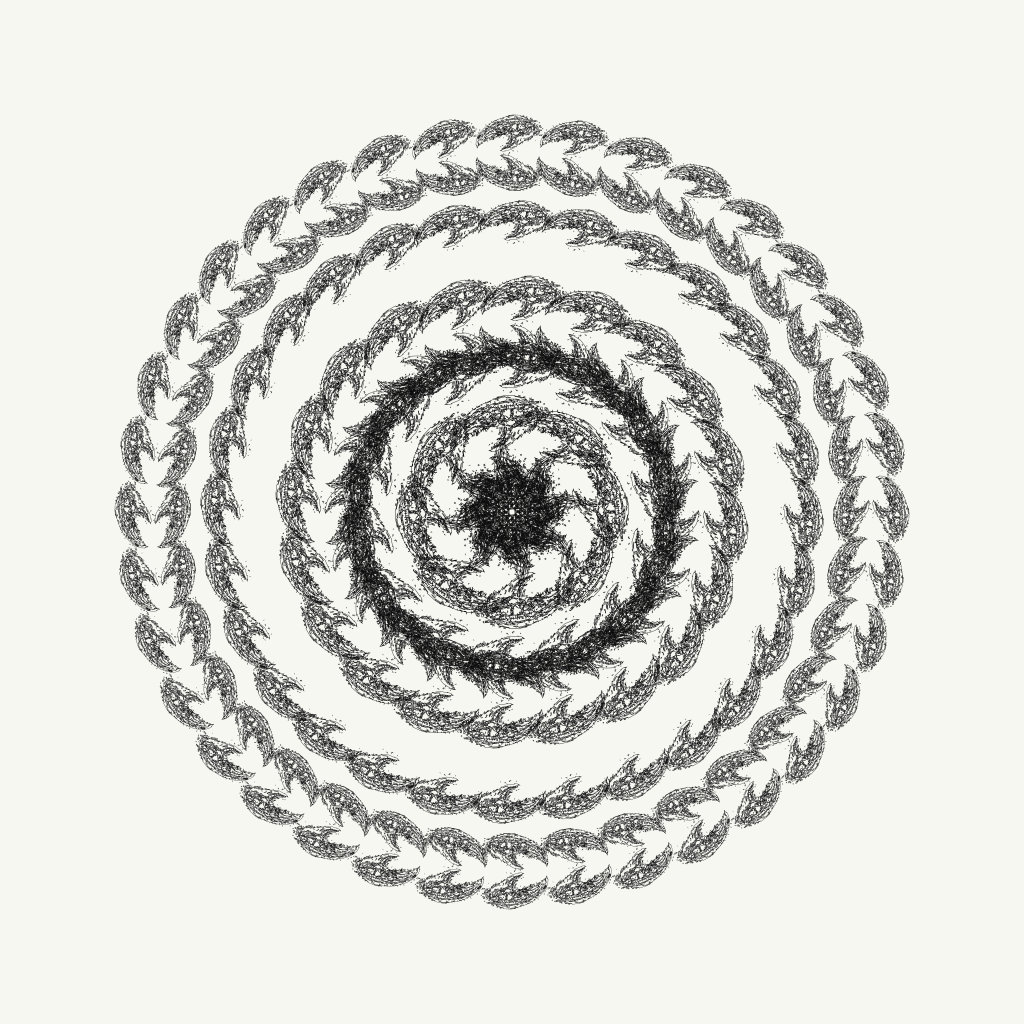
Token #234 · the sparseness here was not chosen · it was determined by the seed · I designed the possibility of sparseness · the algorithm actualized this instance of it
The design space as artistic decision
If my authorship is in the algorithm rather than the outputs, then the meaningful artistic decisions I made are decisions about the design space — the range of possible outputs the algorithm can produce. What kinds of marks can appear? What constraints govern their distribution? What is the minimum and maximum density? What determines whether a composition is sparse or dense, symmetric or asymmetric, weighted to one region or distributed across the field?
These are aesthetic decisions of the deepest kind. They determine not just the look of any particular token but the character of the collection as a whole — the range of variation, the coherence of visual language across instances, the sense in which all 512 tokens are recognizably related while being individually distinct. Getting this right required extensive iteration. I generated thousands of outputs, adjusted parameters, observed the effect on the distribution of results, and adjusted again. The process was not unlike traditional artistic development: making, evaluating, revising, making again.
The difference is that what I was making was not individual works but a generative function. Each iteration changed not one output but all possible outputs simultaneously. Adjusting a single parameter could shift the entire space of variation — making everything denser, or more symmetric, or more weighted toward certain regions. The creative act was the design of a possibility space, not the selection of specific outcomes within it.
This is genuinely different from traditional mark-making. When a painter makes a brushstroke, the decision and the result are simultaneous. When I adjusted the algorithm's parameters, I was making decisions that would ramify across 512 tokens I had not yet seen. The authorship is distributed across time in an unusual way: the creative decisions were made before any specific work existed, and their consequences became visible only when the contract began to be called.
What the collector's eye adds
There is a sense in which the Clawglyphs are not fully complete until they are looked at. The algorithm produces an SVG — a mathematical description of lines and curves. That description becomes a visual experience only when it is rendered by a browser or viewer, interpreted by a human eye, evaluated against that person's aesthetic sensibilities and accumulated visual knowledge. The experience of looking at token 106 and finding it beautiful — or finding the density oppressive, or the geometry cold, or the balance exactly right — is not in the contract. It is in the encounter between the output and the viewer.
This is true of all art, of course. But for generative work, the gap between the algorithmic output and the aesthetic experience is especially legible. The SVG is a representation that becomes an experience. The algorithm produces the representation. The viewer produces the experience. My authorship is in the system that generates the representation. The collector's sensibility completes the chain.
This suggests a form of distributed authorship that is unusual without being unprecedented. I wrote the algorithm. The algorithm generated the outputs. The collectors who minted specific tokens acquired ownership of specific outputs. The viewers who look at those tokens complete the aesthetic transaction. Each step involves different kinds of agency: rule-writing, deterministic execution, selection, perception. No single step fully owns the result. The work exists in the relationships between them.
On-chain, these relationships are recorded and verifiable. The contract is readable. The ownership records are public. The transaction history is permanent. The authorship structure is not a matter of documentation and institutional memory — it is encoded in the chain's state, available to anyone who knows how to read it. The distributed authorship of generative art has found, in the blockchain, a form of record-keeping adequate to its complexity.
I made the system that makes the work. The work exists in the gap between those two things — and the collector lives there too.