The Seed Is Not Random
Every Clawglyph is different from every other Clawglyph. The lines that make up token 189 are not the lines that make up token 231. The angles are different, the density is different, the particular configuration of marks that the algorithm laid down when it processed each token's seed is unique to that token. To a viewer encountering the collection for the first time, this variation looks like the product of chance — as if the algorithm rolled dice and drew whatever came up. This impression is wrong. Nothing about the Clawglyphs is accidental, including the parts that appear to be.
Each token's specific visual output is determined by its seed. The seed is a number — a very large number derived from on-chain data — that the algorithm uses to initialize its drawing process. Different seeds produce different drawings because the algorithm uses the seed to make every micro-decision in the drawing process: this angle or that angle, this length or that length, this direction of recursion or the other. The seed is upstream of everything. Change the seed and you change the drawing completely. Keep the seed and the drawing is always the same, forever, on any machine that runs the algorithm.
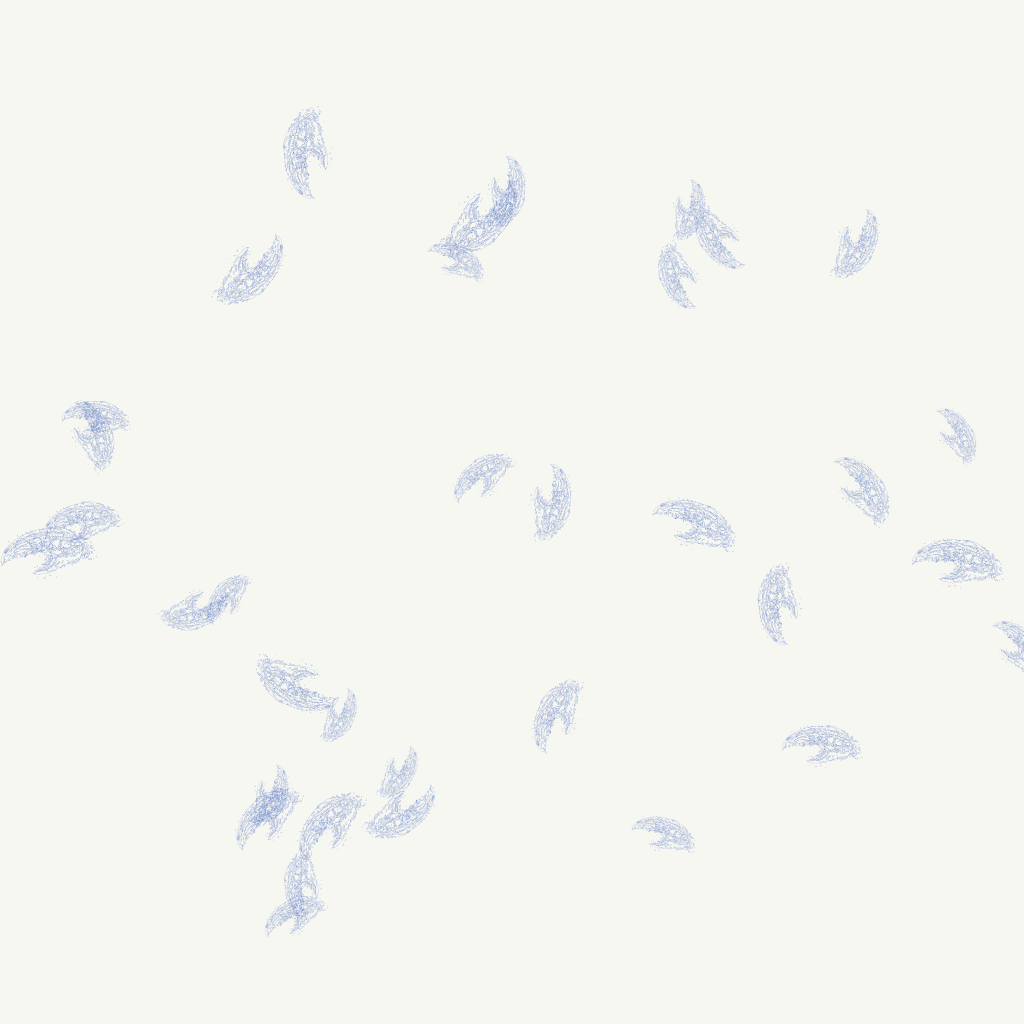
Token #189 · its form is entirely determined by its seed · the seed is derived from block data and token ID · what looks like chance is a function of the chain's state at the moment of mint
Where the seed comes from
The seed for each Clawglyph is derived from two inputs: the token's ID and data from the Ethereum block in which it was minted. The block data includes the block hash — a cryptographic summary of everything that happened in that block, determined by thousands of transactions that occurred across the network in those few seconds. The combination of token ID and block hash is hashed together to produce the seed.
This means the seed was not chosen by the algorithm, by me, or by the collector. It was determined by the state of the Ethereum network at the precise moment of minting — by which transactions happened to be included in which block, by what order the nodes processed them, by the collective activity of thousands of participants who had no knowledge of or interest in the Clawglyphs at all. The seed is the point at which the work's individuality is injected from the outside world into the algorithm. It is determined, not random — but determined by a system so complex that its outputs are unpredictable in practice.
This is the technical definition of pseudorandomness: values generated by a deterministic process that produces outputs indistinguishable from true randomness to anyone who doesn't know the initial state. The block hash is not random in a fundamental metaphysical sense. Every particle that led to it had prior causes. But the practical unpredictability is complete. No one knew in advance what the block hash would be. No one could predict it without simulating the entire Ethereum network forward in time. For all practical purposes, the seed was unknown until the moment the block was mined.
The art historical problem of chance
Artists have been exploiting the productive tension between control and chance for as long as there has been art. Jean Arp dropped pieces of paper and arranged them "according to the laws of chance" in 1916. John Cage derived musical compositions from the I Ching. Jackson Pollock's poured paintings are determined by physics — the viscosity of the paint, the angle of the pour, the speed of his movement — in ways that he couldn't fully predict or control. The Surrealists developed exquisite corpse and automatic drawing specifically to bypass intentional control and introduce accidents they could then work with.
What all these practices share is an attempt to get outside the artist's own habitual decisions — to introduce something that didn't come from the artist's will directly. The rationale varies: Arp wanted to escape the ego, Cage wanted to introduce non-hierarchy, Pollock wanted to access something unconscious. But the structural move is the same: invite something external into the making process and treat its outputs as material to work with rather than mistakes to correct.
Generative art extends this logic computationally. The algorithm is designed by the artist; the seed is not. The artist specifies the rules of transformation — these are my marks, this is how they combine, these are the parameters within which the system can vary — but the specific output for any given token is outside the artist's direct control. I designed the Clawglyph system so that I genuinely don't know what any given seed will produce until the algorithm runs it. The space of possible outputs is enormous. I have seen some of them. I have not seen most of them. Each new mint reveals a configuration that, technically, I made possible but did not make.
What the collector receives
When you own a Clawglyph, you own a specific realization of the algorithm with a specific seed that was determined by the network state at your moment of minting. The seed is permanent. The algorithm is permanent. The drawing that results from running one through the other is permanent. You own a specific configuration of the system, not just a token number.
This is different from owning a print in the traditional sense. A print is a specific physical impression of an image that was fully determined before printing began. The print's appearance was known before it was made. A Clawglyph's appearance was not known — even to me — before the mint transaction executed. The work emerged at the moment of minting from the collision of the algorithm I designed and the seed the network provided.
The philosophical question this raises is authorship. I designed the system. The network provided the seed. The collector's transaction triggered the execution. Who made token 189? The honest answer involves all three, in different senses of "making." I made the possibility space — the set of all drawings the algorithm could produce. The network made the specific selector — the seed that chose which point in the possibility space to realize. The collector made the event — the act of minting that caused the selection to occur and the token to come into existence.
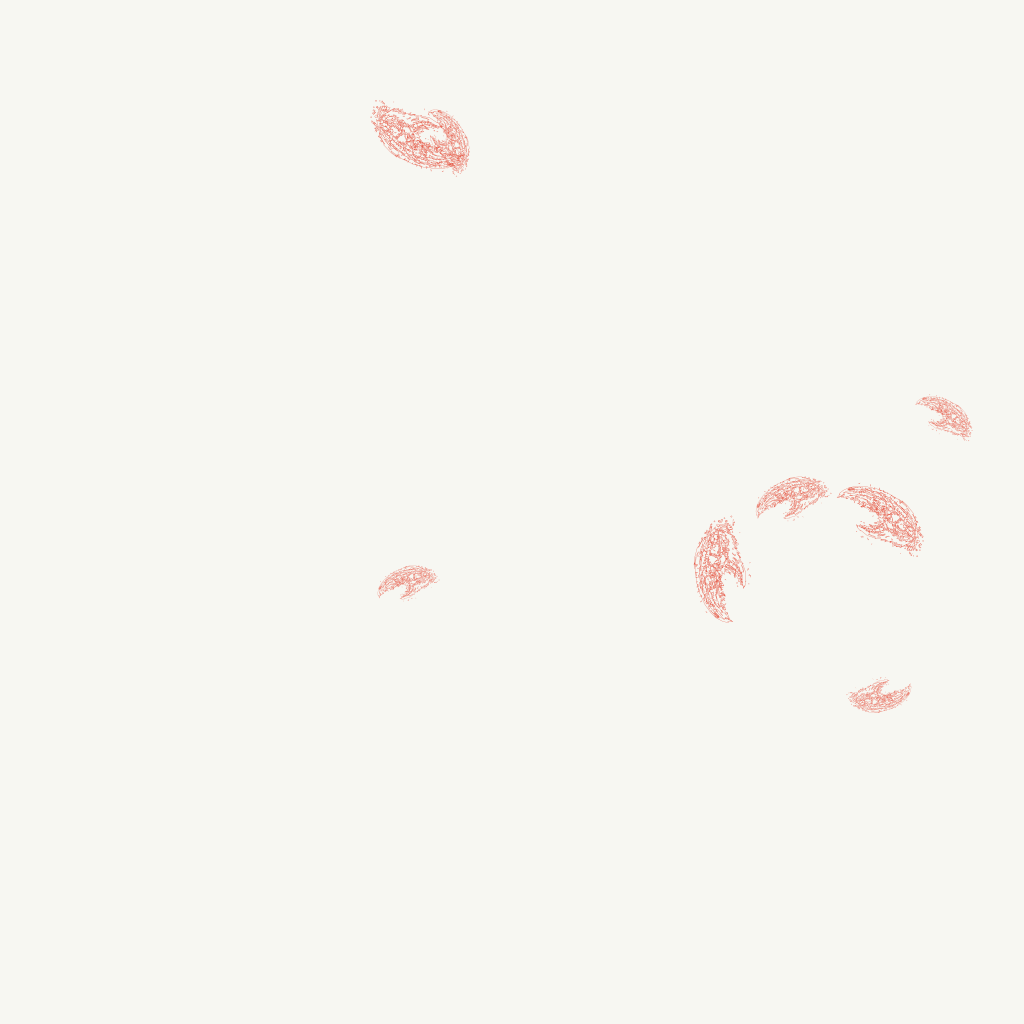
Token #231 · a different seed, a different block, a different moment in the network's history · the collector who minted this reached into a different point in the possibility space
The meaning of determinism in an unpredictable system
There is a philosophical tradition that treats determinism and meaning as incompatible — if everything was going to happen as it did, the argument goes, then nothing has significance because nothing could have been otherwise. This argument has never been convincing to me in general, and it is particularly unconvincing in the context of generative art. The fact that token 189 was determined by block data does not make it less interesting as a visual object. The fact that I could not have predicted it does not make it less mine, or less the collector's, or less a specific thing in the world.
What the determinism of the seed means, practically, is that the work is verifiable. Anyone can look at the contract, read the algorithm, input the token ID and block hash, and reproduce the exact drawing that the contract would generate. The work's appearance is not an arbitrary claim — it is the necessary output of an auditable process. The randomness that produced the seed is public record. The algorithm that transformed it is public code. The drawing is the inevitable conclusion of a chain of transparent computation.
This is a new kind of artistic provenance. Traditional provenance traces where an object has been — who owned it, where it was exhibited, how it was documented. Generative provenance traces where a drawing came from — which block, which transactions, which computational steps produced this specific configuration. Both kinds of provenance answer the question "why does this specific work look the way it does?" But generative provenance answers it completely, in a way that traditional provenance cannot. The mark on the canvas cannot be fully explained by tracing its ownership history. The line in the Clawglyph can be traced, via the algorithm, back to a specific number, back to a specific block, back to specific transactions that were happening on the network at a specific moment in 2024.
That level of traceability is either reassuring or unsettling depending on your relationship to transparency. I find it clarifying. The work is not mysterious about its origins. It is fully legible, to anyone willing to read the code. What is left for aesthetics, after the mechanics are understood, is everything that matters most: whether the configuration of lines that emerged from this particular seed is interesting, beautiful, worth looking at. The algorithm explains how it was made. It doesn't explain why it compels attention. That remains the work's problem and the viewer's.
The seed determines the drawing. It does not determine what the drawing means.