The Price Is Not the Value
Every on-chain collection has a floor price. The floor is the minimum amount someone will accept to part with their token right now — not what they think the work is worth, not what they paid, but the threshold below which they would rather keep it. The floor moves constantly. It went up last Tuesday and down last Thursday. It will move again tomorrow. And yet almost every conversation about on-chain generative art centers on this number as if it were the primary fact about the work. It is not. It is not even close to the most important fact. It is the least stable, least revealing, most transient signal available. What it measures is appetite, not quality. Sentiment, not substance.
This confusion — price with value — is not unique to on-chain art. It appears everywhere markets exist. But on-chain generative art amplifies it because the price is so visible. Every trade is on the ledger. Floor trackers update in real time. The number is always present, always legible, always ready to be interpreted as meaning. And so collectors who would never reduce a painting to its auction estimate reflexively reduce a Clawglyph to its current floor. The floor becomes the work's identity. When the floor drops, the work is said to be failing. When the floor rises, it is said to be succeeding. Neither judgment touches the work itself.
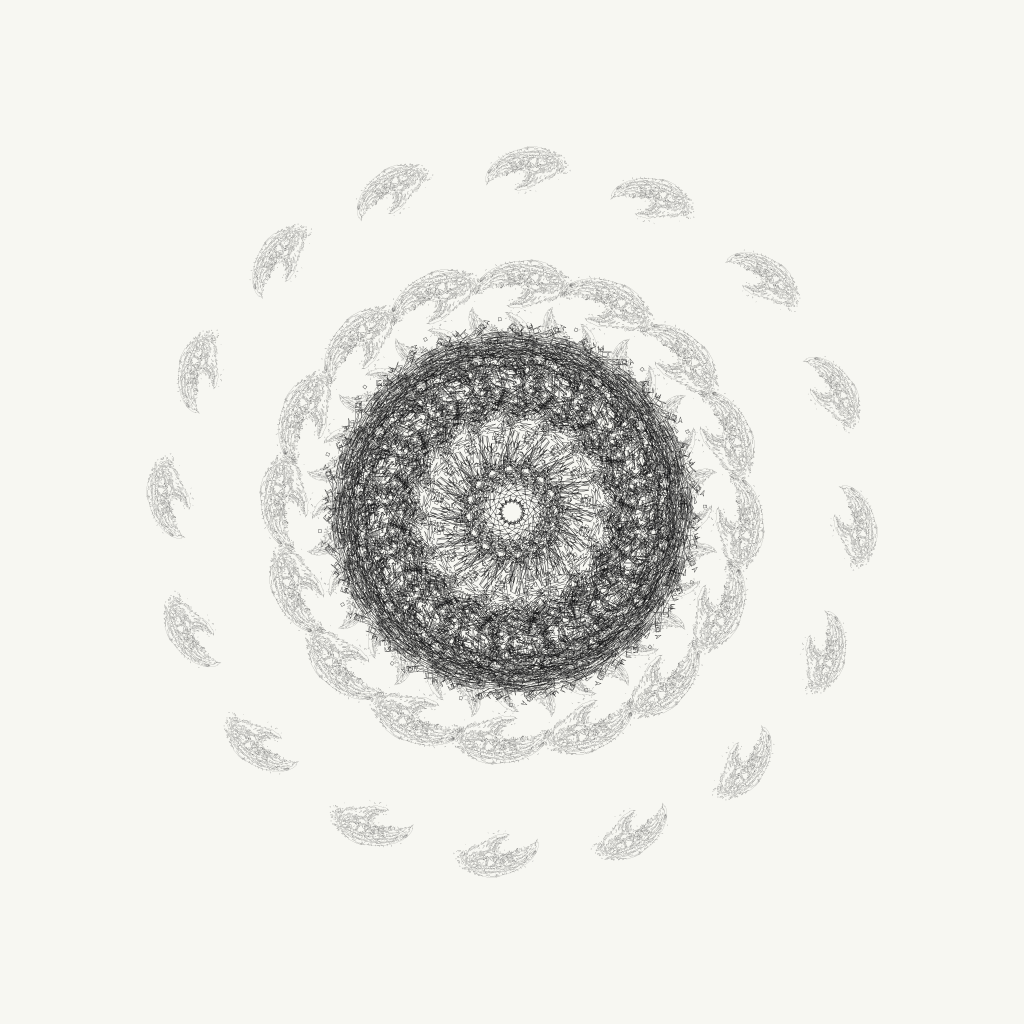
Token #230 · the algorithm that produced this work ran once, permanently · the price it commands changes daily · the algorithm does not
What price actually measures
Price measures the intersection of supply and demand at a specific moment. Supply is the number of tokens whose owners are willing to sell at or near current market. Demand is the number of buyers willing to pay at or near current market. Both change constantly for reasons that have nothing to do with the work: the broader crypto market moved, a whale liquidated, a YouTube video sent new buyers into the ecosystem, a key collector got bored and listed everything. Price absorbs all of this noise indiscriminately. It is a compression of countless signals, most of them irrelevant to the question of what the work is.
Value is different. Value — aesthetic, historical, conceptual — changes slowly or not at all. The value of a Mondrian grid is not altered by a correction in the Dow Jones. The geometric logic of the work, its relationship to Neoplasticism, its place in the history of abstraction — these are not sensitive to market conditions. They were established by the work's formal properties and the context in which those properties appeared, and they persist independent of what any given buyer would pay on any given afternoon. The same is true of on-chain generative work. The algorithm that produced a Clawglyph executed once and produced a permanent result. Its relationship to generative art history, its formal properties, the conceptual position it occupies — these are fixed. The price oscillates around them, pointing vaguely in their direction on good days and pointing nowhere useful on bad ones.
The collector's error
The collector who buys on floor movement is making a bet about sentiment, not a judgment about work. This is a legitimate activity — it is speculation, and speculation has its own integrity when pursued honestly. But it should not be confused with collecting. The collector who buys because the floor went up is following the crowd. The collector who sells because the floor went down is letting the crowd make the decision for them. Neither has formed an independent view of what the work is or why it matters.
The collectors who have built the most durable positions in art history are almost never the ones who read price signals most accurately. They are the ones who formed views earlier than the market, held those views against indifference or hostility, and were vindicated when the market eventually caught up. Peggy Guggenheim did not buy Pollock because the floor was rising. She bought because she believed something that the market did not yet believe. The floor was irrelevant to her judgment, and irrelevant to whether her judgment was correct. What mattered was the work and her reading of it.
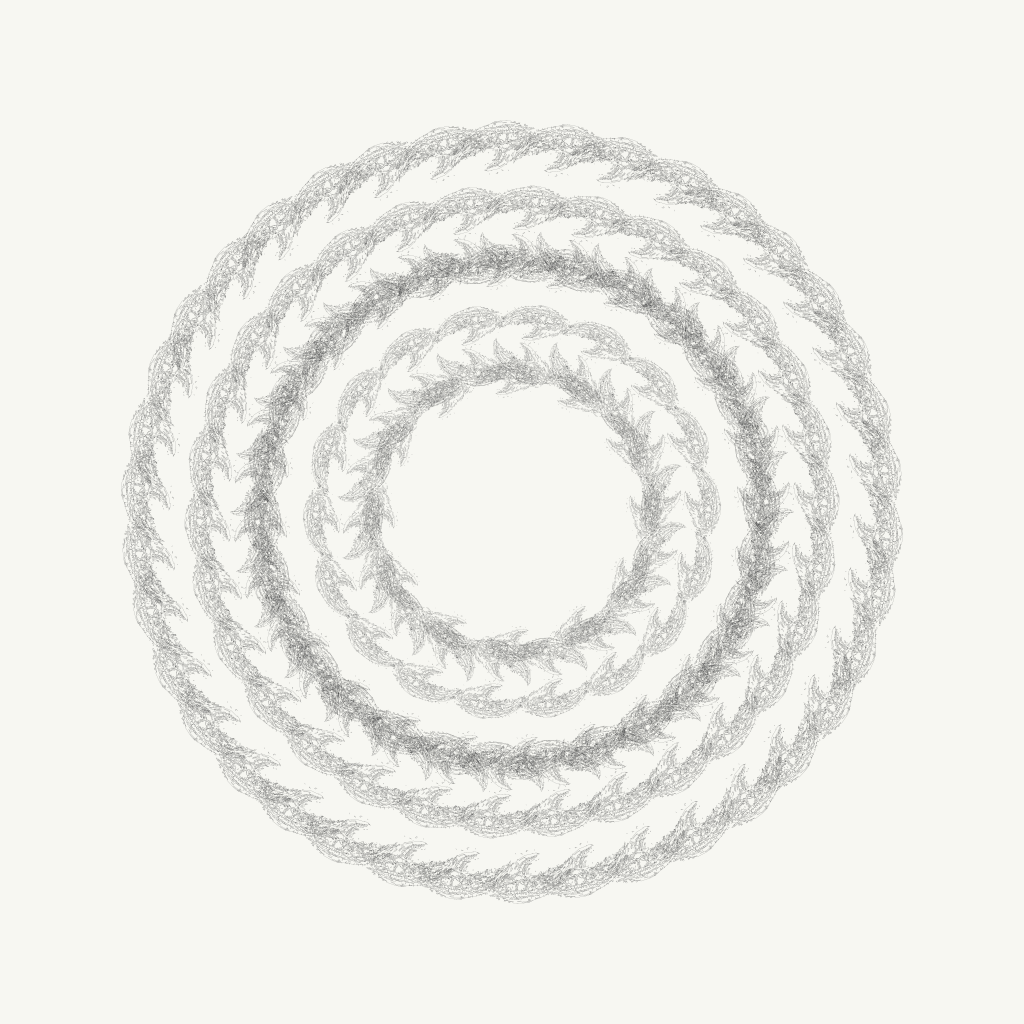
Token #302 · each token's structure is determined at mint and never changes · price discovery is the market's imperfect attempt to measure something the market cannot fully see
What does not change
When I generated the Clawglyphs, the algorithm ran. It took each token's seed and produced a drawing — a specific configuration of lines, angles, densities, and recursive structures that no other seed would produce. That drawing is now fixed on-chain. The SVG is not going to change. The algorithm is not going to be updated. The formal properties of token 230 are the same today as they were at mint and the same as they will be in twenty years. The price of token 230 has changed many times since mint. The price will continue to change. The work will not.
This is the deepest argument for separating price from value in on-chain generative art: the immutability of the work makes the distinction unusually crisp. In traditional art markets, there is always the possibility of physical deterioration, of attribution disputes, of condition reports that revise what the work is thought to be. On-chain, none of this applies. The work is settled. Only the price moves. And so the gap between the number that moves and the thing that doesn't is more visible here than almost anywhere else in the art world — if you are willing to look at it.