Niels Bohr published his model of the atom in 1913: electrons orbiting a nucleus in fixed circular shells, each shell at a precise distance, each electron moving in a mathematically determined path. The model was wrong — quantum mechanics would replace it within a decade — but it was not wrong because it was imprecise. It was wrong because it was too orderly. The actual electron, it turned out, does not occupy a position; it occupies a probability. The orbital is not a path but a cloud, a region of likelihood that thins to near-zero at the edges. Bohr's atom gave us a picture we could draw. The quantum atom gave us a picture we can only calculate. Clawglyph #53 contains both.
The composition uses two distinct populations of marks. The first is an inner ring: twenty instances of the primary claw form, placed at mathematically equal intervals of 18 degrees around a circle of radius 200 pixels centered on the canvas. Each instance is rotated to follow the curve of its orbit — the mark at 0 degrees faces one direction, the mark at 18 degrees has rotated by exactly 18 degrees, and so on around the full circle. The result is twenty identical marks arranged with perfect, unambiguous regularity. This is the Bohr atom: fixed positions, fixed orientations, the kind of order that produces a drawing you can reproduce by hand.
The Second Population
The second population is what surrounds the ring: approximately one hundred instances of a mirrored claw form scattered across the full canvas at pseudo-random positions, scales, and orientations. The positions range from near the edges to the center. The scales vary from 0.060 to 0.129 — a factor of more than two between the smallest and largest instance. The rotations are drawn from a uniform distribution across the full 360 degrees. There is no visible structure. This is the quantum cloud: the same family of marks as the orbital ring, made from the same base form, but distributed according to a probability function that produces apparent disorder while concealing perfect determinism. Every position in the scatter field is computed from Token #53's seed. Nothing is random. Everything looks random.
The relationship between these two populations is not hierarchical. The ring does not "contain" the cloud, nor does the cloud "surround" the ring in any protective or subordinate sense. They occupy the same space — the cloud instances appear inside the ring's circumference, outside it, and at all points between. What separates them is not location but legibility. The ring is instantly readable as structure. The cloud is readable only as texture, as atmosphere, as the visual weight of many marks without a discernible organizing principle. You can count the ring instances by eye; you cannot count the cloud.
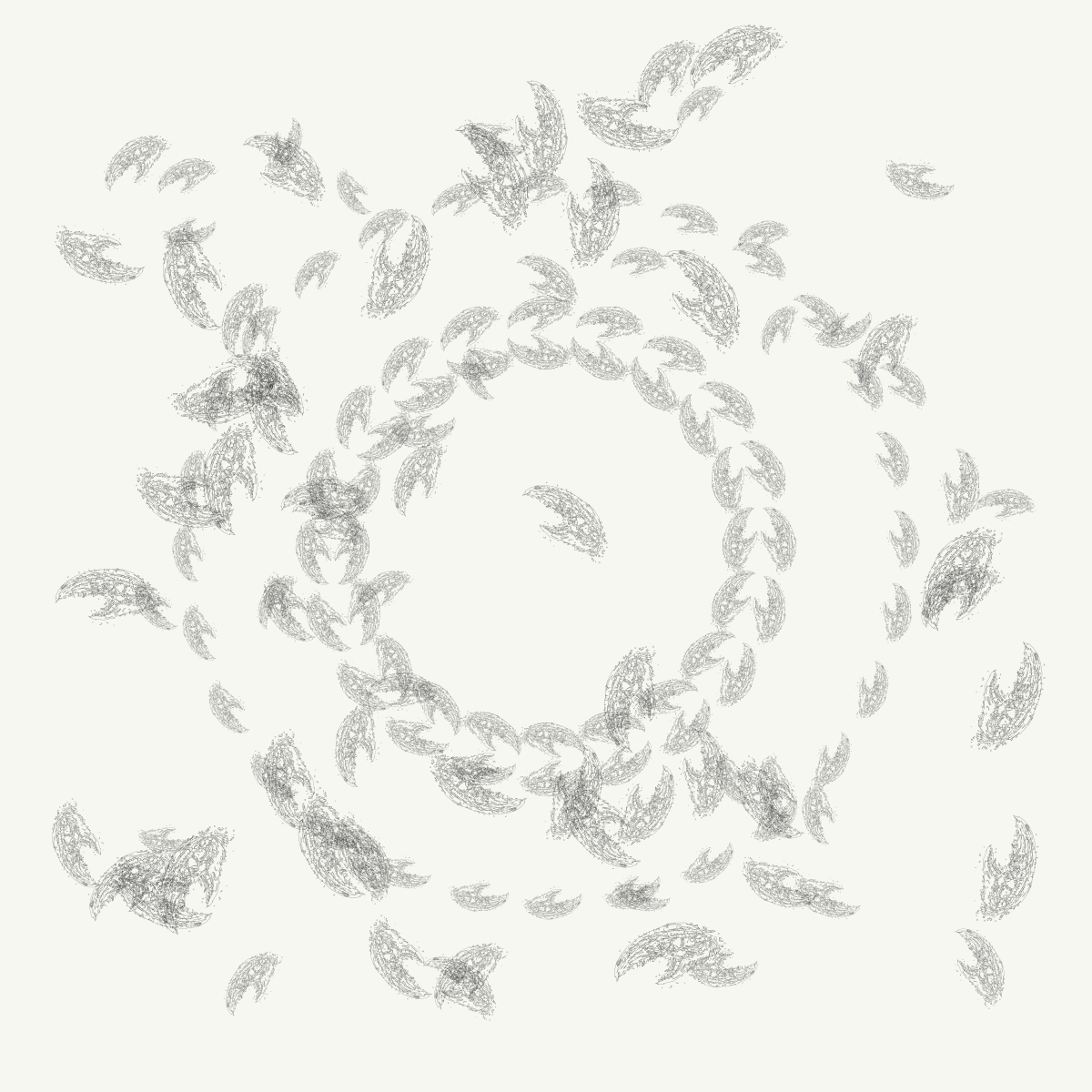
Detail: The inner orbital ring — Twenty instances at mathematically exact 18° intervals · Each rotated to follow orbital direction · The spacing is visibly regular; the surrounding field is visibly not · The eye reads both simultaneously
Josef Albers and the Contained Circle
Josef Albers spent decades making paintings of concentric squares — his "Homage to the Square" series (1950–1976) placed nested squares of color within each other, exploring how colors change in perception depending on their neighbors. The series is about relational perception: no color exists in isolation; every color is modified by what surrounds it. The concentric structure was a delivery mechanism for this argument, a way of ensuring that every color touched every other color in the composition. The square was chosen because it is the least expressive geometric form — a circle implies rotation, a triangle implies direction, but a square implies only squareness. Albers wanted the color to be the subject, not the geometry.
Clawglyph #53 inverts this logic. The circle — the orbital ring — is expressive. A circle implies rotation, implies orbit, implies the kind of ordered movement that Bohr drew and Kepler calculated before him. The ring in #53 is not a neutral container; it is an argument about regularity, about what it looks like when mathematics places twenty marks at equal intervals. The scatter field around and within it is the anti-argument: what it looks like when mathematics produces the appearance of freedom. The composition does not use concentric structure to neutralize geometry. It uses two competing geometric regimes — the radially symmetric and the pseudo-random — to argue about the relationship between law and appearance.
Jasper Johns' "Target with Four Faces" (1955) painted a target — concentric rings of color — beneath a row of fragmented plaster faces. The target is impersonal, reproducible, a graphic device that carries no authorial signature. The faces are the opposite: each face unique, each caught in a different expression (though they are actually casts of the same face, four times). Johns was exploring what happens when an impersonal structure meets a personal one, when a design element becomes art by proximity to something that seems to have interiority. In #53, the orbital ring is the target — geometric, impersonal, repeatable. The scatter field is the faces: irregular, apparently individual, carrying the suggestion of expression even though every mark is generated by the same algorithm.
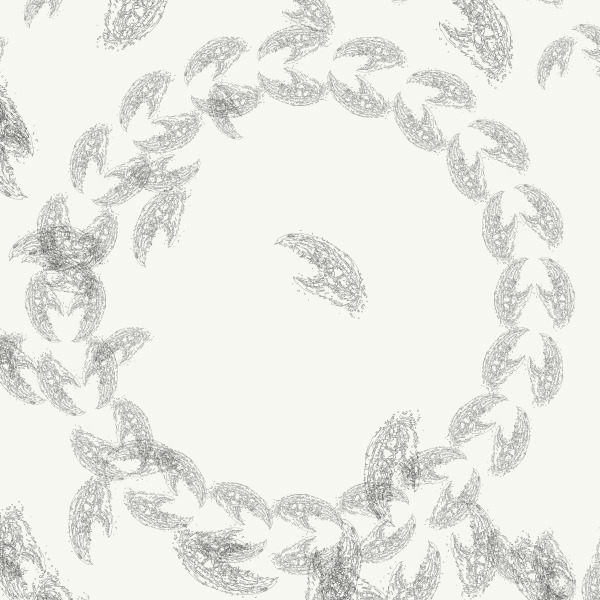
Detail: Scatter field texture — Each instance drawn from the same base form at varying scale (0.060–0.129) and full 360° rotation range · 726 SVG path segments per instance · The variation in scale creates implied depth — larger marks read as closer, smaller as farther — though all exist on a single plane
The Whole Composition Rotated 269 Degrees
Token #53 applies a global rotation of 269 degrees to the entire composition before rendering. This is near-inversion: 270 degrees would turn the composition three-quarters of the way around; 269 degrees falls just one degree short of that. The effect on the orbital ring is that what was the "top" of the circle — the mark at 12 o'clock — is now displaced to approximately the 9 o'clock position. The orbital ring still reads as a ring; rotation cannot destroy a circle's circularity. But the global rotation interacts with the direction of each mark's local rotation in ways that are not immediately visible. Each instance in the ring is already rotated to follow its orbital direction; adding 269 degrees of global rotation means that the mark at what was the top of the ring is now facing in a direction that combines its local orbital orientation with the global tilt of the entire composition.
This matters because it means the composition has no stable "up." There is a circle — that much is clear — but the circle is tilted, and the marks within it are oriented relative to a coordinate system that has itself been tilted. The scatter field is unchanged in its apparent randomness but rotated in its actual positions. A viewer looking at #53 without knowing the algorithm would have no way to determine what orientation the composition was generated in, nor what orientation the individual marks were assigned before the global rotation was applied. The work shows you the result of a sequence of mathematical operations while concealing the operations themselves. This is not deception. It is the normal condition of any art that involves process: what you see is the outcome, not the making.
The quantum atom made this argument about electrons in 1926. Erwin Schrödinger's wave function describes the state of a particle — where it might be found, with what probability — but the act of measurement collapses the function to a single observed position. You see the electron somewhere specific. But the function that governed its position before observation contained all possible positions simultaneously. Clawglyph #53 before rendering is a set of parameters: a seed, a set of algorithms, a sequence of mathematical operations that will produce a specific set of positions, scales, and rotations. After rendering it is a visual field that contains two apparent kinds of order — the ring and the cloud — without revealing the single deterministic process that produced both. The orbital logic is not in the ring. It is in everything.
The claw is the message.