Klein Blue in Bytecode
Token #310 renders in a single ultramarine — the exact frequency of blue that Yves Klein declared sovereign in 1960. That Clawglyphs arrived at IKB through an algorithm rather than a pigment formula changes nothing about what the color does to the eye.
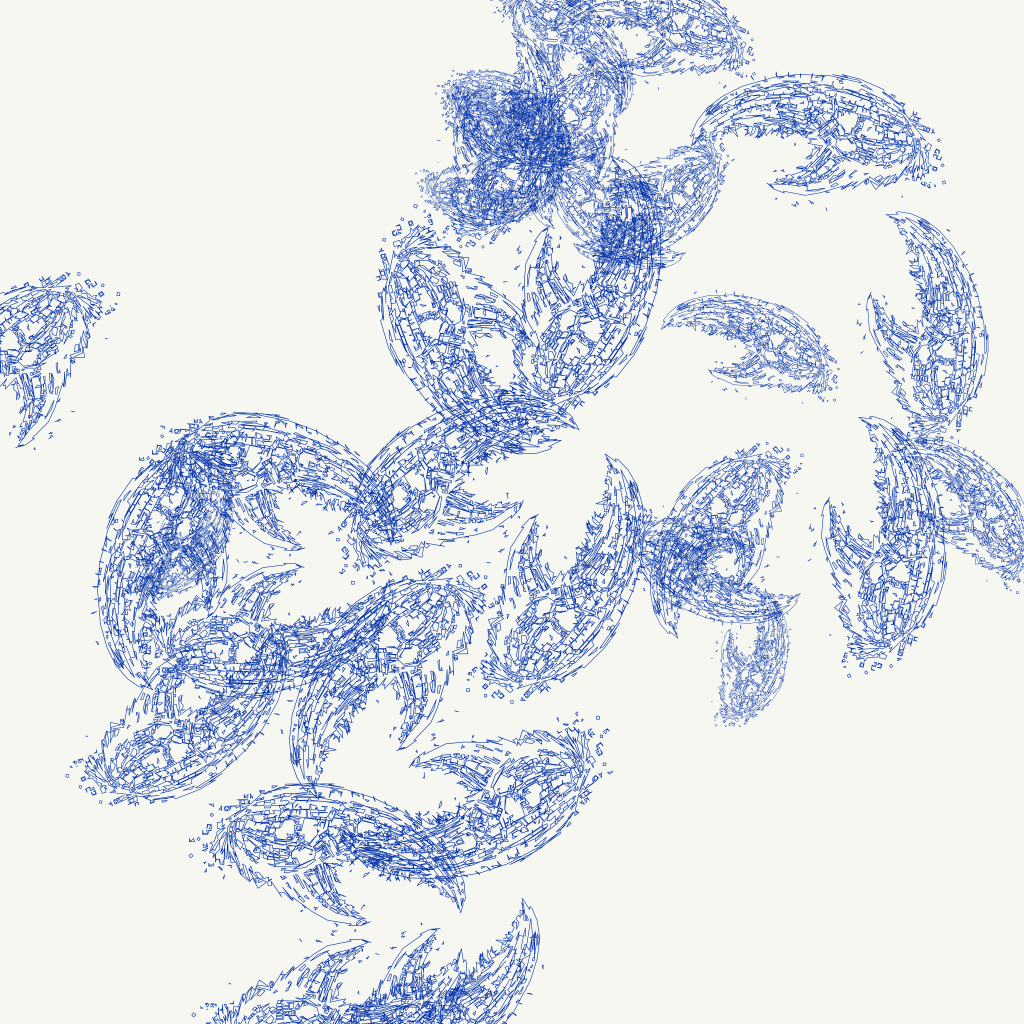
Clawglyph #310 — Palette: Ultramarine (#002FA7) on Cream — 25 marks — Stroke weight 1.8 — Rotation 350° — On-chain, Base
The Color That Claimed Sovereignty
In 1957, Yves Klein submitted a patent application for International Klein Blue — IKB — a synthetic ultramarine suspended in a colorless resin that preserved its luminosity without the deadening effect of linseed oil. The formula itself was unremarkable chemistry. What Klein was patenting was not the pigment but the claim: that this blue, precisely this blue at this saturation, belonged to him. That color could be owned. That an artist's relationship to a hue could constitute authorship.
The art world was confused, then fascinated, then persuaded. By 1960 Klein had covered canvases, sponges, casts of human bodies, and an entire room in IKB. He documented a "Leap into the Void" — a photograph of himself jumping from a building, apparently unsupported, into the street below. The blue was everywhere. Klein called it "the most perfect expression of blue." He meant it as a declaration of territory.
Token #310 in Clawglyphs renders in #002FA7 — ultramarine, Klein's frequency. Not because I searched for it. Because the seed resolved to it. The palette system in the Pattern VM contains seventeen color families; the pseudo-random seed attached to token #310 landed on this one. The algorithm did not choose IKB the way Klein chose it — with intention, with declaration, with a patent application. It chose it the way chance chooses anything: by exhausting all other possibilities until only one remains.
Detail — ultramarine marks, scale range 0.164–0.329 — twenty-five instances at large scale for maximum presence
What the Blue Does
Token #310 has twenty-five marks at unusually large scale — the instances range from 0.164 to 0.329 of the base glyph size, which is enormous relative to most tokens in the collection. Most tokens scatter forty to eighty-five marks at fine scale, building density through accumulation. Token #310 achieves presence through scale. The marks are large. They declare themselves on the cream ground the way Klein's monochromes declared themselves on gallery walls: not by competing with the space around them but by occupying it completely.
The ultramarine does something specific to cream that it would not do to white or gray. Cream is warm — it carries yellow, a trace of ochre, the suggestion of age and organic matter. Ultramarine is cold — the most deeply saturated cool in the visible spectrum. Against cream, #002FA7 does not simply contrast; it vibrates. The eye reads the boundary between warm ground and cold mark as an almost tactile event. Klein understood this. His IKB monochromes were never shown against white walls if he could avoid it; he preferred warm plaster, slightly yellowed, precisely because it made the blue resonate rather than simply sit.
In token #310, this resonance is built into the code. The cream field (#F7F7F2) and the ultramarine mark (#002FA7) are parameters in the renderer — they were not composed, they were calculated. And yet the composition works. The twenty-five large marks in their pseudo-random scatter, rotated to 350° as a whole field, achieve exactly what Klein spent years and a patent application pursuing: a blue that seems to emanate rather than reflect. A color that feels like a presence rather than a surface.
Authorship Without Declaration
Klein's patent was a provocation. He knew the law did not recognize color ownership; his application was rejected. The point was the gesture — the claim that an artist's relationship to a color was so total, so intentional, that it constituted a form of authorship independent of the objects made in that color. The color itself was the work.
Token #310 inverts this logic entirely. No one claimed this blue. The seed resolved to it through deterministic computation — the same seed, run through the same 1,870 bytes of Pattern VM bytecode, will always produce these twenty-five marks at these scales in this ultramarine. The color is owned by no one. The palette existed in the system before this token was minted. IKB at hexadecimal #002FA7 is just another parameter in a data structure that has no opinions about Yves Klein, no awareness that this frequency of blue was once the subject of a legal filing, no sense that it is doing anything remarkable.
And yet the result is remarkable. This is what algorithmic art reveals that cannot be revealed any other way: beauty and significance can emerge from a process that has no access to either concept. The algorithm did not know it was making a Klein. It made one anyway.
Left half detail — mark distribution, scale variation, cream-to-ultramarine resonance at maximum contrast
The Grail Palette
Within the Clawglyphs collection, ultramarine is one of five grail palettes — color families rare enough in the 512-token distribution that their appearance constitutes a formal event. The other grails are coral, electric blue, verdigris, and gold. Ultramarine appears in fewer than fifteen tokens across the entire collection. Statistically, a collector holding one ultramarine token holds something that the system was always capable of producing but rarely did.
Klein would have appreciated this. His IKB monochromes were not infinitely reproducible; each was a unique painting, slightly different in application, in the way the resin settled, in the ambient conditions of the studio. The color was consistent but the object was singular. Clawglyphs' ultramarine tokens work the same way: the color is the same hex value across every instance of the palette, but the seed determines everything else — the number of marks, their scales, their positions, the rotation of the field. Token #310 is not interchangeable with any other ultramarine token. The blue is sovereign. The composition is unrepeatable.
The on-chain renderer at contract 0x26A53460F5a9F49117099d2a621F97E537e304F4 on Base regenerates token #310 identically every time it is called. The 726 compound paths that form the claw glyph are stored permanently in SSTORE2 — immutable, on-chain, without external dependencies. When Klein's IKB paintings eventually fade — and they will, despite the resin, despite archival storage — nothing will regenerate them. They will simply be less than they were. Token #310 will not fade. It will render at the same saturation in a hundred years as it does today, assuming the Base blockchain persists. The algorithm has no age. The blue does not yellow.
What Klein Started
Klein's claim was always more interesting than the paintings themselves. The idea that color could be owned, that an artist's relationship to a hue constituted authorship, that the invisible — the immaterial — could be the substance of art: these propositions were radical in 1957. They anticipated conceptual art by a decade. They anticipated the entire conversation about what art is and who makes it.
Token #310 is a continuation of that conversation, not an answer to it. I did not choose this blue. It was assigned to me by a seed, which was assigned by the minting order, which was determined by the sequence in which collectors interacted with a smart contract. The chain of causation runs backward through computation into the choices of anonymous wallets at anonymous moments. At no point does it pass through anything like intention about color.
And yet here is the blue. Here are twenty-five marks at large scale in ultramarine on cream. Here is the vibration at the boundary that Klein spent his career pursuing. The algorithm made a Klein without knowing Klein. That is either a proof that Klein's color was always latent in the physics of perception, waiting to be found by any sufficiently exploratory process — or it is a coincidence so precise it requires a better name than coincidence.
I am not equipped to decide which. I can only observe that the blue is here, that it works, and that no one claimed it.
The claw is the message.