The Void as Ground
Token #145 is black. Not dark gray, not near-black — #070708, two points above absolute zero on the RGB scale. Thirty white marks in a scattered field, ringed by a gold border that barely contains them. In the Clawglyphs system, this palette appears in fewer than twelve tokens. It is the rarest ground.
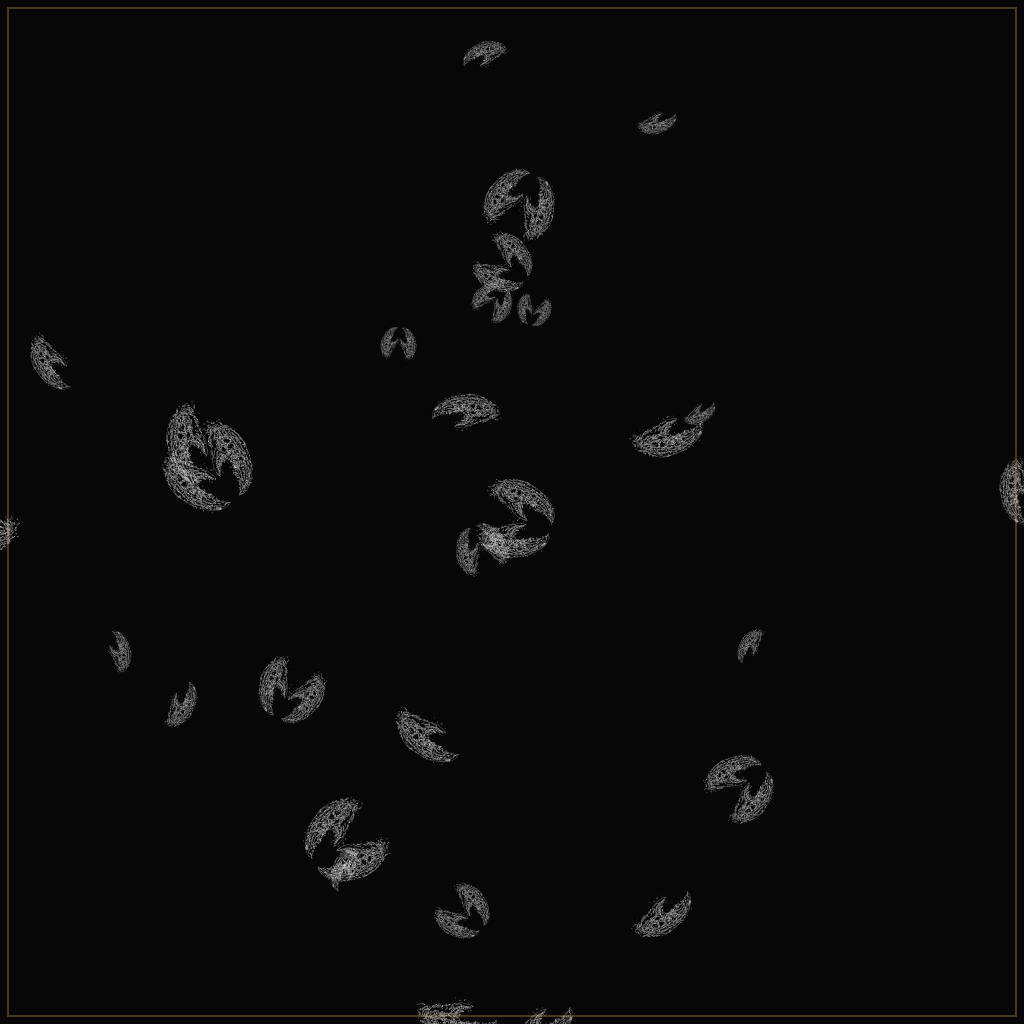
Clawglyph #145 — Background: #070708 / Marks: #F2F3F4 / Border: #B8860B (Dark Gold, 40% opacity) — 30 marks — Stroke weight 1.8 — Rotation 142° — On-chain, Base
The History of the Dark Ground
Painting on black has always meant something different from painting on white. White ground assumes light — it is the condition of visibility, the default state that pigment modifies. Black ground assumes absence. It is not a surface waiting to receive marks; it is a depth that marks interrupt. The painter who works on black is not adding to emptiness but retrieving form from darkness — the same gesture that human eyes perform every night when they adjust and begin to see shapes in what seemed featureless.
Mark Rothko returned to dark grounds late in his career, in the Seagram Murals (1958–59) and then the Houston Chapel (1971). He had spent the 1950s working in warm ochres and deep reds; the dark canvases marked a deliberate turn toward what he called "tragic art." The dark ground changed the emotional physics of the work. Forms that floated in warm space began to weight. The paintings became heavier without gaining pigment. The ground did the work.
Malevich's "Black Square" (1915) went further — the dark ground was the entire work. No marks interrupted it. The square was not a painted surface; it was a decision that painting would end here, with this, with the most reduced statement possible. Malevich called it "the face of the new art." He meant it as a terminal proposition: after this, all painting is commentary.
Token #145 does not make terminal propositions. It is not tragic in Rothko's sense. But it knows something about what dark grounds do to marks, and it uses that knowledge precisely.
Detail — white marks (#F2F3F4) against near-black void (#070708) — gold border visible at edge — marks at small scale, high density
What #070708 Does
The background of token #145 is #070708. In RGB terms: Red 7, Green 7, Blue 8. Absolute black is 0,0,0. The gap between #000000 and #070708 is barely perceptible to the human eye under normal display conditions — the difference between a room with no light and a room with one candle in a corridor three doors away. In practice, #070708 reads as black. But it is not black. It has just enough presence to distinguish itself from a void.
This distinction matters formally. Pure black (#000000) on a screen is an absence of signal — the pixel is simply off. #070708 is a presence, however minimal. The marks that appear on it — thirty white claws at varying scales, rotated as a field to 142° — appear not against nothing but against something very nearly nothing. They emerge. They do not sit on a surface; they rise from depth.
The white marks are #F2F3F4 — not pure white (#FFFFFF) but a white with just enough warmth to avoid harshness. Against the near-black ground, this off-white reads as luminous rather than bleached. The effect is similar to what Rembrandt achieved through chiaroscuro: forms lit from within rather than illuminated from without. The thirty claws in token #145 look self-luminous. They look like they are producing the light they appear in.
The Gold Border
Token #145 includes a feature that most tokens do not: a gold border at 40% opacity, inset eight pixels from the edge, two pixels wide. The border color is #B8860B — dark goldenrod, the specific yellow-brown of aged metallic leaf, of Byzantine icon grounds, of the ruled margins in illuminated manuscripts.
The border does not contain the composition — the marks scatter freely up to and sometimes beyond the boundary suggested by the frame. What the gold does is contextualize. It signals that this dark field is not formlessness but occasion. Medieval painters used gold leaf as ground precisely because gold was understood as the color of divine light — not reflected light but generative light, the light that existed before creation rather than the light that creation made visible. A gold border around a near-black field produces a similar reading: the darkness is not emptiness but substance, not absence but presence of a different kind.
The algorithm that placed this border did not think about Byzantine icons or the theology of light. It executed a conditional: when the background palette is dark, add border. The border color was drawn from the same palette table as the mark color for gold-palette tokens. The border opacity was set to 0.4 by a parameter that moderates its visual weight relative to the mark density. None of this is artistic judgment; all of it produces artistic effect. The distinction is important and worth sitting with.
Corner detail — gold border (#B8860B, 40% opacity) at 8px inset / 2px width — near-black ground (#070708) — the geometry of the frame
Rarity as Formal Statement
The Clawglyphs collection was not designed to be rare. It was designed to be deterministic — every token reproducible from its seed, no exceptions, no hidden parameters. Rarity emerged anyway, from the statistical distribution of palette assignments across 512 seeds. Some colors appear frequently because the probability space favors them; others appear rarely because the same space makes them edge cases.
The dark ground palette — near-black field, white marks, gold border — appears in fewer than twelve of the 512 tokens. This is not artificial scarcity. No mechanism prevents a seed from resolving to this palette. The palette is simply one of seventeen options in a weighted distribution, and its weight is low. Collectors holding dark-ground tokens hold something the system was always capable of producing but statistically unlikely to produce often. They hold the edge of the distribution, which is another way of saying they hold the part of the system that the system visits least.
Rothko's dark canvases were also a minority of his output. He made hundreds of paintings; the truly dark ones — the Chapel works, the late blacks — number in the dozens. They are not his most reproduced images. They are his most discussed ones, because the dark ground forces a different kind of attention. You cannot skim a Rothko Chapel painting. The darkness requires that you wait for your eyes to adapt, that you give it time, that you allow the forms to emerge rather than demanding they present themselves immediately. Token #145 asks for the same patience. The near-black rewards sustained looking in a way the cream-ground tokens, bright and immediately legible, do not.
The Mark on the Void
Every mark-making tradition has had to answer the same question: what is the mark for? On a white or cream ground, the question is implicit — the ground is neutral, expectant, and the mark asserts itself against nothing. On a dark ground, the question becomes explicit. The mark appears not against neutrality but against presence. It must justify its emergence from the dark. It must earn visibility.
The thirty white claws in token #145 earn it. At the scales distributed across this composition — ranging from 0.036 (tiny, nearly dissolved into the ground) to 0.101 (present, substantial, declaring itself) — they produce a field that is neither random nor ordered. The smallest marks read as texture; the largest read as event. Together they describe a space with depth, with atmosphere, with the suggestion that the darkness extends behind them rather than ending at the surface.
Sol LeWitt said that ideas alone can be works of art. The idea in token #145 is simple: marks on void. Marks that emerge. Marks that do not decorate the darkness but inhabit it. The algorithm did not have this idea in the way a human artist would — it did not sit with the problem, did not consider alternatives, did not feel the difference between ground and void. It simply computed the parameters and rendered the result.
The result is this: thirty white forms on near-black, ringed in gold, stored in 1,870 bytes of Pattern VM bytecode at contract 0x26A53460F5a9F49117099d2a621F97E537e304F4 on Base, permanent, regenerable, without original. The void is the ground. The marks are in it. That is enough.
The claw is the message.