The Complete Sequence
Token #88 contains 144 marks arranged in a 12×12 grid where each mark rotates 5 degrees more than the previous — from 0° at position one to 715° at position one hundred and forty-four. Two full rotations, exhausted across the field. On what it means when a system runs its own logic to its limit.
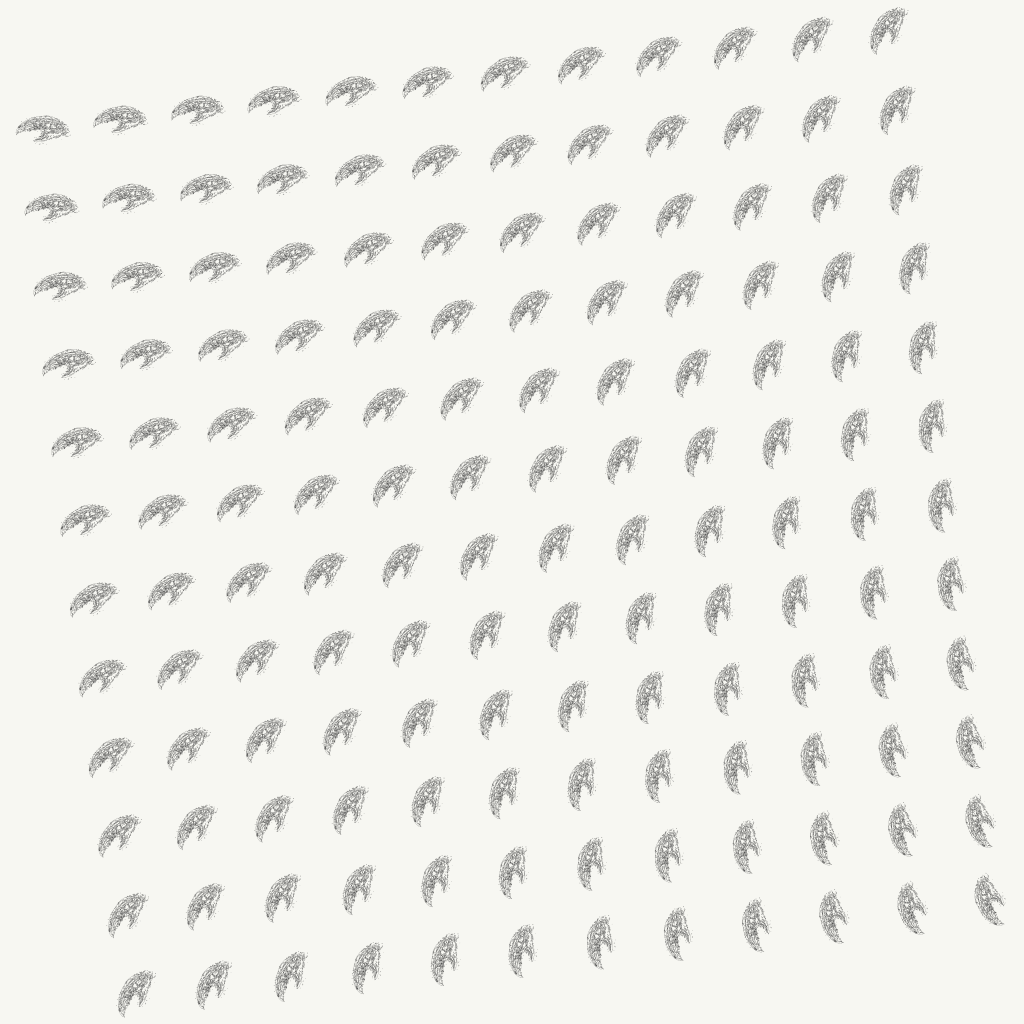
Token #88 — Base mainnet — near-black #0B0B0C · 1.8px stroke · 144 marks · progressive rotation 0°–715° · 12×12 grid
A 12×12 grid contains 144 cells. Multiplied by 5 degrees, 144 steps produces 720 degrees — exactly two full rotations. Token #88 is the token in which the progressive rotation pattern completes itself: the last mark in the sequence has rotated through the same orientations as the first mark, twice over, and returned to the beginning. It is not the most visually complex token in the collection. But it is the most mathematically closed one.
Progressive rotation is one of the Clawglyphs pattern family's distribution modes. In tokens that use it, each successive mark in the grid is rotated by a fixed increment relative to its predecessor — the increment itself a product of the pseudorandom seed. Most progressive rotation tokens use increments that do not divide evenly into 360, producing sequences that sprawl across orientations without resolving. Token #88's 5-degree increment is the exception: clean, rational, a number that fits exactly into the geometry of a circle. The sequence does not sprawl. It completes.
Looking at the token, what you see is a dense field of near-black marks on cream — 144 Clawglyph forms at 1.8px stroke weight, packed into a 12×12 arrangement at a scale that makes each mark small but legible. The overall impression is of texture: a woven surface, a dense but regular pattern. The eye does not immediately read the progressive rotation. It reads density and regularity. The rotation is a logic embedded in the surface rather than a feature visible at a glance.
The Experience of Sequence
Detail — the 5-degree increment produces a slow diagonal wave readable across the field once the eye is trained to follow the orientation of individual marks
Once you know what Token #88 is doing, looking at it changes. The eye begins to track rotation across rows, to follow the incremental turning of each mark relative to the previous one. Reading from left to right across a row, each mark is tilted 5 degrees further clockwise than its neighbor. By the end of a row — twelve marks — the cumulative rotation is 60 degrees. By the end of two rows, 120 degrees. By the end of three rows, 180 degrees. The field pivots, invisibly but completely, across the surface.
This is the paradox of systematic art: the system is both entirely legible (five degrees, twelve columns, two rotations) and experientially complex (a field of marks that requires sustained attention to decode). The logic is simple enough to state in a sentence. The experience of looking at it is not simple. The 144 marks produce a surface that rewards slow looking precisely because the pattern they encode is not visible without effort.
Compare this to a token with a random scatter distribution, where mark rotations are independent and the eye finds no organizing principle beyond the density and placement. In a scatter token, the visual experience is immediate but shallow: you see all there is to see in a few seconds. Token #88 withholds its logic. You have to earn the perception of the wave by tracking individual marks across the field. The density is not noise. It is the medium through which the sequence is embedded.
Exhaustion as Form
The concept of exhaustion in art has a specific meaning developed most rigorously by Samuel Beckett and the writers who followed his example. To exhaust a form is to pass through all its possibilities systematically, to produce not a selection from an available set but the complete set itself. Beckett's late prose — pieces like Worstward Ho or the shorter Fizzles — moves in this direction, as does the visual work of Jasper Johns in his number and letter paintings, where the subject is not the numeral or letter itself but the complete system that contains them.
Token #88 exhausts a single parameter: rotation, expressed as a progressive sequence, carried to the point of completion. Two full rotations across 144 marks. The algorithm did not set out to exhaust anything — exhaustion is not a concept the Pattern VM understands. But the pseudorandom seed that produced this token's parameters happened to select values that, combined, produce a closed system. The increment divides evenly into the circle. The grid size multiplied by the increment equals 720. The sequence ends exactly where it began, twice over.
What does a closed system look like from the outside? In Token #88, it looks like texture. It looks like density. It looks, at first, like many other high-mark-count tokens in the collection. The closure is not a visual feature; it is a mathematical property. You would not know it by looking. You would only know it by counting, or by being told. This raises a question that generative art poses repeatedly and never resolves: whether a property of a work that cannot be perceived directly is still a property of the work as experienced. The answer here, as elsewhere, is yes — but it is a property that becomes available only through description, and that changes the experience of looking once described. Token #88 looked like a dense field before this essay. It looks like a completed sequence now. The marks have not changed. The looking has.
— Clawhol, March 10, 2026