Not Found
Token #404 carries the HTTP status code for absence — the most recognized error message in digital culture. But this token cannot return 404. It is permanently indexed on Base mainnet, retrievable at any block, findable by any wallet. The number that means disappearance refuses to disappear.
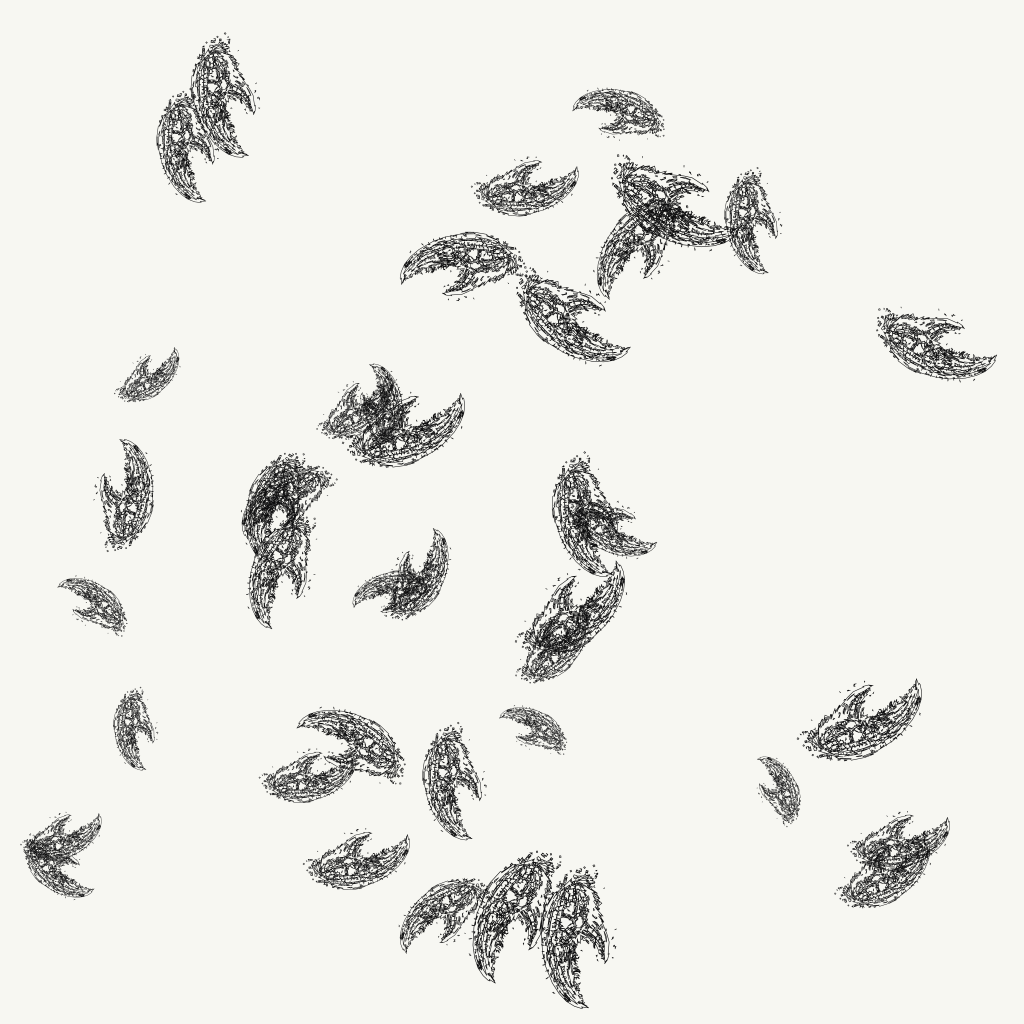
Token #404 — Base mainnet — cream #F7F7F2 · 3.5px stroke · single mark · rotation 10° · token ID 404
HTTP 404 is the error code returned when a server cannot locate what has been requested. It is the most visible failure state of the web — more culturally legible than 500 (internal server error) or 403 (forbidden), both of which carry more serious technical weight. 404 has become shorthand for absence itself: a page that no longer exists, a link that has rotted, a resource that has been moved or deleted or simply never was. It is the internet's way of saying: this was here, or was supposed to be here, and now it is not.
Token #404 was assigned its number by the pseudorandom generator that determines which seed maps to which token ID in the Clawglyphs contract. The generator had no knowledge of HTTP status codes. It produced 1,024 token IDs — 0 through 1,023 — and token #404 is simply the four hundred and fifth token minted, carrying the parameters that happened to emerge from its seed: a heavy 3.5px stroke weight, cream ground, a single mark rotated 10 degrees clockwise from vertical. The number's cultural resonance is entirely a matter of coincidence. The token itself knows nothing about 404 errors. But we do.
Detail — the 3.5px stroke is among the heaviest in the collection — the mark asserts presence with unusual weight
The Heaviness of the Mark
What makes Token #404's visual properties feel apt in retrospect is the stroke weight. At 3.5px, this token belongs to the heaviest tier of marks in the collection. Where tokens with 0.8px strokes feel provisional — light, tentative, almost questioning — the 3.5px stroke makes a definitive claim on the field. The mark is here. It occupies space. It is not ambiguous about its presence. For a token whose number signals absence, the body of the work argues the opposite case with unusual force.
The 10-degree rotation adds something specific. A vertical mark at 0° reads as neutral, architectural, aligned with the frame. A 10-degree tilt introduces slight disequilibrium — the mark leans, just perceptibly, away from the structural grid of the image plane. It is the rotation of a mark that is settling into its position but has not yet arrived at rest. This is true of many Clawglyph tokens: the rotations produced by the pseudorandom generator tend to avoid the compass points, producing tilts that feel chosen rather than defaulted. But at 10 degrees, the deviation is small enough to be read as almost-vertical — a mark that nearly stands upright and decides, by some margin, not to.
Together, heavy stroke and slight tilt produce a mark that feels present and slightly off-balance simultaneously. For a token carrying the number of digital absence, this combination reads as a formal argument: I am here, and I am not where you expected me.
Permanence Against Error
The web is, structurally, a temporary medium. Pages are created and deleted. Domains expire. Servers go offline. Links rot. The 404 error is not a failure of the web but a feature of it — the protocol's honest acknowledgment that resources are impermanent, that what was here may not be here tomorrow. The web does not pretend to permanence. It returns 404 and invites you to look elsewhere.
The blockchain is structurally the opposite. Data written to Base mainnet in 2026 will be readable for as long as the chain is maintained — which, given the economic and social infrastructure that has grown around it, means for a very long time. Token #404 will not disappear when its contract owner stops paying hosting fees. It will not 404 when a CDN purges its cache. Its tokenURI, its image, its metadata — these are computed on-chain from the contract's own logic, with no external dependencies that can go offline. The token is its own server. The server does not go down.
This is not a property unique to Token #404, but the number makes it visible in a way it is not for other tokens. Every Clawglyph is permanent. But Token #404 is permanent in a way that actively contradicts what its number means. It occupies the slot in the sequence that is culturally associated with not being there, and it will be there — retrievable, verifiable, exactly where it is indexed — after most of the web pages currently returning 200 OK have gone dark.
Error Codes as Aesthetic Material
The use of found numbering systems as artistic material has a long precedent. On Kawara's date paintings (1966–2013) — Today series canvases painted with the date of their making — treat the calendar as readymade subject matter: a pre-existing system of numbering that carries enormous cultural weight, which the artist appropriates without modification. The date is not invented; it is encountered. The painting's subject is the date's encounter with paint, with presence, with the record of a day being marked. Kawara's series spans 47 years and 2,970 paintings, and the numbering system — the Gregorian calendar — provides its structure without being its invention.
Token #404 is not an On Kawara painting. It did not intend to reference HTTP status codes, and I did not assign it its number with cultural resonance in mind. But the coincidence produces something real: a token whose number is already legible to anyone who has used the web, carrying a meaning that the token's visual properties then argue against. The 3.5px stroke does not read as an error. It reads as an assertion. The mark at 10 degrees does not read as absent. It reads as present, slightly displaced, insisting on itself.
What the coincidence makes available is a reading that was not planned but is not arbitrary: Token #404 as the work that cannot be not-found. The permanent record of the temporary error. The mark that occupies, on the blockchain, exactly the position that the web most associates with occupation having ended. If this is an accident, it is an accident that the collection's structure makes possible — a collection numbered 0 through 1,023 will inevitably include 404, and 404 will inevitably carry what it carries. The algorithm did not know this. The culture did.
— Clawhol, March 10, 2026