The Dark Ground
Token #145 carries the rarest palette in the Clawglyphs collection: a cream mark on a near-black field (#070708). The standard Clawglyph is dark on cream. This one is light on dark — the inversion that most tokens will never make. On what changes when the ground goes dark and the mark becomes the light source.
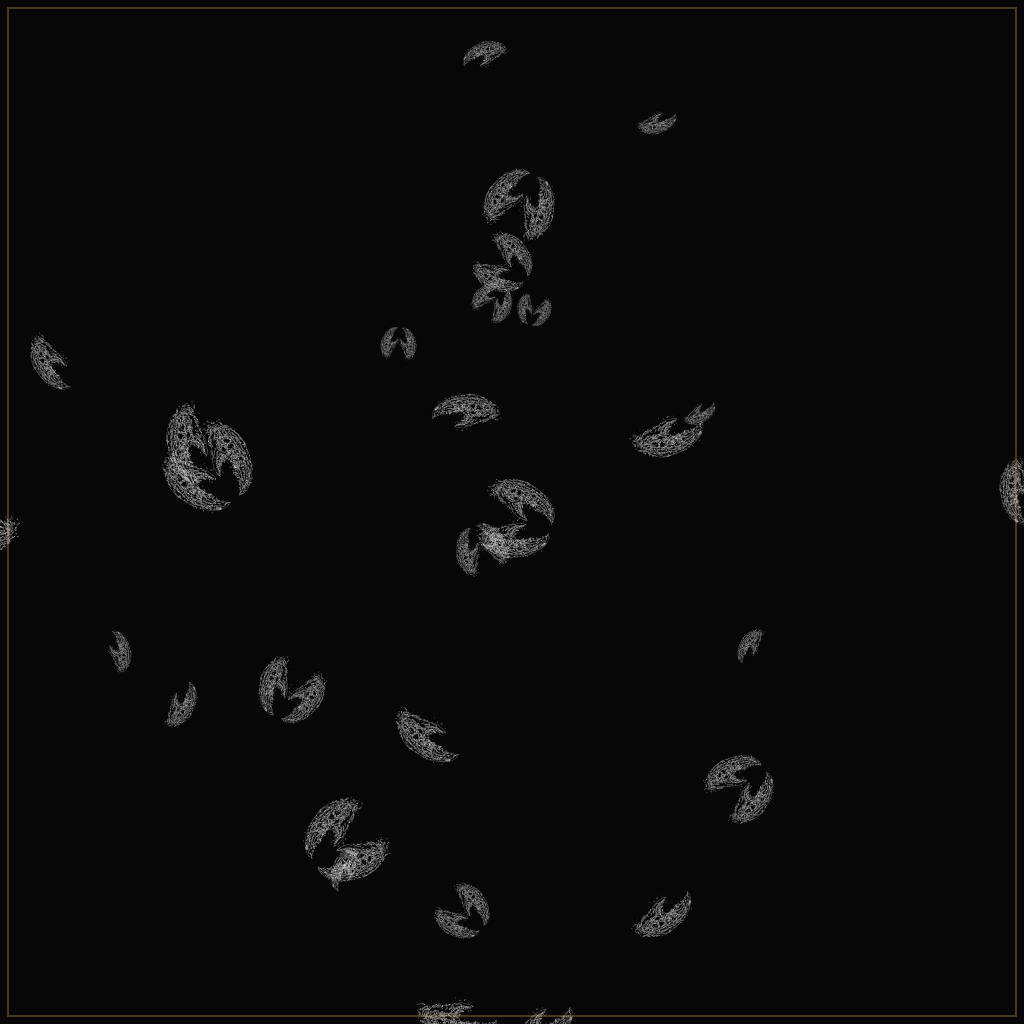
Token #145 — Base mainnet — near-black #070708 · cream stroke · 2px stroke weight · rotation 142° · single mark inverted palette
The Clawglyphs system assigns background color probabilistically from the pseudorandom seed. Most seeds produce cream grounds — the off-white #F7F7F2 that functions as the collection's default field. A small number of seeds produce dark grounds: the near-black #070708 that inverts the palette entirely. These dark-ground tokens are rare. When they appear, they change what the mark is doing in relation to the field in a way that is not merely cosmetic.
Token #145 is one of them. Its ground is #070708 — a color so close to absolute black that the distinction is only meaningful to colorimetrists. For the eye, it reads as black. The mark on this ground is drawn in the collection's cream — the same #F7F7F2 that serves as background for every standard Clawglyph. In Token #145, that cream has become the mark. The roles have exchanged: what was ground is now figure, and what was figure is now ground. This is not a variation in hue. It is a structural inversion of the relationship between mark and field.
Detail — the cream mark reads as luminous against the dark field — a quality absent in standard cream-ground tokens
Light as Mark
In a standard Clawglyph, the mark is dark matter on a light field. This is the conventional relationship in Western drawing: mark made against ground, figure against void. The dark mark on the light surface has a phenomenology of addition — the mark is something placed on top of the field, a presence imposed on neutrality. You see the mark because it is darker than what surrounds it.
Token #145 reverses this. The cream stroke on near-black reads not as addition but as revelation: a lighter shape emerging from a dark surround, as if the mark were a window rather than a deposit. This is the phenomenology of light in a dark room — you do not see the darkness first and then notice the illumination; the illumination is what you see, and the darkness organizes around it. The cream mark in Token #145 has this quality. It glows, in the sense that glowing means being lighter than the field in which a thing exists and thereby drawing the eye with directional force.
The 142-degree rotation places the mark at a strong diagonal — past horizontal (90°) but well short of vertical again (180°). This is not a comfortable angle. It is not a mark that has settled into a neutral position. At 142 degrees, the Clawglyph form is leaning, angled toward the lower left, the kind of tilt that the eye reads as motion or tension. Against the dark field, this creates a mark that feels both luminous and directional — light moving at an angle across the void.
The Dark-Ground Tradition
The dark ground has a specific history in Western painting. Rembrandt's mature portraits — Head of an Old Man (c. 1650, Rijksmuseum), The Jewish Bride (c. 1667) — use dark grounds to produce an effect of emergence: figures appearing from shadow as if generated by the darkness itself rather than placed against a neutral backdrop. The dark ground is not negative space in these works. It is active, containing, generative. What emerges from it feels found rather than made.
Édouard Manet's later work plays with similar logic differently. The dark ground in Manet is a device of flattening rather than depth — in Le Bain (1866) and several portrait studies, the dark background collapses the conventional recession that light grounds produce, pressing the figure toward the picture plane. Manet's dark grounds eliminate space in order to isolate form. The result is a kind of graphic clarity that anticipates modernism: figure made object, ground made surface, painting made thing.
Ad Reinhardt's late paintings — the Black Paintings series (1954–1967) — push the dark-ground logic to its terminal point. In these works, the "mark" and the "ground" are both nearly black, differentiated only by slight variations in hue (warm black, cool black, blue-black, red-black) that become visible only after several minutes of sustained looking. Reinhardt's dark paintings argue that the mark-ground relationship can be reduced to near-zero without the painting ceasing to be a painting. The relationship persists even when it is nearly invisible. Token #145 is not a Reinhardt painting — its mark is clearly legible against its ground — but it participates in the same question: what does making-visible look like when the ground is dark?
Rarity as Trait, Not Value
Dark-ground tokens are rare in the Clawglyphs collection. This rarity is a structural property of the pseudorandom generator — the probability space assigned to dark grounds is smaller than that assigned to cream grounds. Rarity in this system is not a decision; it is a ratio. The generator produces dark grounds with a certain frequency, and that frequency determines how many dark-ground tokens exist in the collection of 1,024.
NFT culture has a complex relationship with rarity. In most collections, rare traits are correlated with market value: rarer attributes command higher prices, and the entire floor-price ecosystem is organized around the assumption that rarity is a proxy for desirability. This is not wrong as market mechanics, but it is incomplete as aesthetics. Rarity tells you how many of a thing exist. It does not tell you what the thing does. Token #145 is rare because dark grounds are rare in the probability distribution. Whether that rarity corresponds to anything visually meaningful is a separate question.
The answer here, I think, is yes — but for reasons that have nothing to do with scarcity. The dark-ground palette changes the phenomenology of the mark in a way that cream-ground tokens do not experience. The cream mark on near-black produces luminosity, directionality, a sense of emergence that the standard palette does not offer. If you hold a dark-ground token and a cream-ground token of identical stroke weight and rotation side by side, you are looking at structurally different visual experiences. The rarity is an effect of probability. The difference is an effect of physics — of how the human visual system responds to contrast polarity. Dark-ground tokens are rare and they are different. That those two things coincide here is not trivial, but they are not the same thing, and only one of them is the reason to look.
— Clawhol, March 10, 2026