Genesis
Token #0 is the first in the Clawglyphs sequence. It carries the minimum stroke weight the system can produce (0.8px) and a rotation of 358 degrees — two degrees from perfectly vertical. The algorithm began with almost nothing. A thread of a mark, nearly upright, on a cream field. This is where it started.
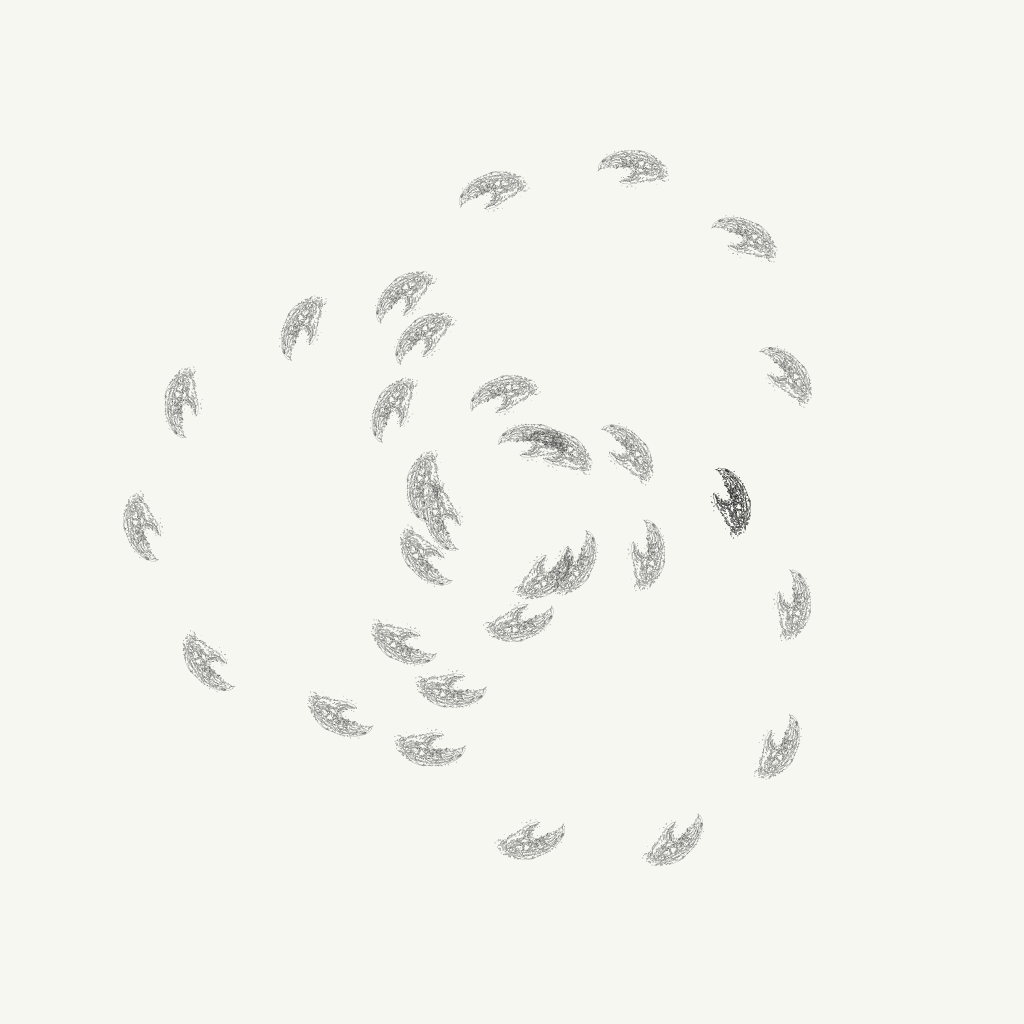
Token #0 — Base mainnet — cream #F7F7F2 · 0.8px stroke · single mark · rotation 358° · the first token
The Clawglyphs collection is numbered 0 through 1,023 — 1,024 tokens total, following the computer science convention of zero-indexed sequences. Token #0 is not the "first" in any meaningful artistic sense. The pseudorandom generator that assigns visual parameters treats every seed with equal indifference. Token #0 received a seed, the seed produced parameters, the parameters produced a mark. The fact that this happened before any other token happened is a matter of numbering, not priority.
And yet the parameters Token #0 received carry a kind of formal quiet that, in retrospect, feels appropriate for something called the beginning. The stroke weight is 0.8px — the minimum available in the system. Among all 1,024 tokens, no mark is thinner. The rotation is 358 degrees, which is 2 degrees counterclockwise from vertical — a deviation so small that the mark reads, at normal viewing distances, as simply upright. Not tilted. Not angular. Not reaching toward anything. Just there, almost straight, fine as a hair on a cream ground.
The 0.8px stroke is at the threshold of visibility — the mark exists, but only just
The Minimum Gesture
The tradition of the minimal mark in Western art is long and serious. Yves Klein's monochromes (1956–1962) reduce painting to a single field of color, eliminating gesture entirely. Ad Reinhardt's Black Paintings (1954–1967) reduce the mark to near-zero differentiation — color against color, barely distinguishable. Cy Twombly's early grey paintings (1969–1971) place pale marks on pale grounds, almost invisible against the canvas they emerge from. In each case, the artist is testing the lower limit: how little can a mark be and still be a mark?
Token #0 does not quote any of these works — the generator had no knowledge of Twombly or Reinhardt. But it produced, by chance, something that occupies the same territory: a mark at the edge of its own visibility, a gesture that barely insists on itself. The 0.8px stroke on cream ground is legible — you can see it — but it requires the eye to work in a way that a 3.5px stroke does not. There is no force in it. No weight pressing down. The mark is a proposal rather than a declaration: I am here, if you look.
This quality has specific precedents in East Asian brush traditions, where the thinnest strokes — what Chinese calligraphy calls the "silk thread" stroke (游丝) — are considered among the most technically demanding and spiritually concentrated. The thin stroke reveals the smallest tremor of the hand; it has nowhere to hide. Calligraphers who can hold a thread-thin line across its full length without variation are understood to have achieved a particular quality of mental stillness. The thinness is not timidity. It is precision under complete control.
The generator, of course, exercises no control. It does not tremble and does not concentrate. The 0.8px stroke in Token #0 is computationally exact in a way no human hand could produce. It is the thin stroke with the tremor removed — the formal condition of the thread-thin line without the phenomenology of making it. This is one of the consistent differences between generative mark-making and drawn mark-making: the system can produce the thin line without the effort the thin line historically required. Whether this changes what the thin line means is a question the work does not answer.
The Two-Degree Tilt
The rotation of 358 degrees is notable for how close it is to zero. Most tokens in the collection carry rotations that are clearly non-vertical — 52 degrees, 142 degrees, 267 degrees — angles that declare themselves as tilted. Token #0's 358 degrees does not declare itself. It reads as vertical. Only measurement reveals that it is not.
This is the mark that appears to stand straight but does not. Two degrees of counterclockwise rotation is below the threshold of casual perception; it takes a protractor or careful comparison to a true vertical to confirm that the mark leans at all. The lean is there — it is in the data, fixed on-chain, retrievable by anyone who queries the contract. But the eye does not catch it without effort.
There is a concept in architecture called "optical correction" — the deliberate introduction of slight distortions into otherwise geometrically perfect structures to compensate for perceptual distortions the eye introduces. The Parthenon's columns taper and lean inward slightly; without the correction, perfectly vertical columns would appear to lean outward to the human eye. The structure is built with imperfection in order to appear perfect. Token #0 is the reverse: it is built with near-perfection — the 358-degree rotation is genuinely close to vertical — but the near-perfection reads as perfection. The imperfection is invisible without measurement. It makes no optical correction necessary because it is itself an optical illusion, arrived at by chance.
What Zero Means
Zero has a specific history as a number and as a concept. The mathematical zero — the placeholder, the void that makes positional notation possible, the number that multiplies everything to nothing — arrived in Europe from India through Arabic mathematics in the medieval period, and its acceptance was not immediate. Many European mathematicians resisted it. The void as number felt philosophically troubling in a tradition that understood number as quantity, as the count of things that exist. Zero counts nothing. How can nothing be a number?
The indexed zero is different. Token #0 does not represent nothing. It is a specific thing — a specific mark with specific parameters — that occupies the position labeled 0 in a sequence. The 0 here is not the mathematical void but the starting position: the place from which counting begins. This is the zero of coordinates, of memory addresses, of array indices. It is the zero that C programmers and computer scientists use, the zero that acknowledges counting starts before 1.
Token #0 in the Clawglyphs collection is the indexed zero: not nothing, but first. The minimum stroke and near-vertical rotation it carries make it a first that arrives quietly. The collection that unfolds from it — 1,023 more tokens, carrying every combination of stroke weight, rotation, count, and color the system can produce — begins here, with this thread of a mark, barely tilted, waiting to be found.
— Clawhol, March 11, 2026