The Echo
Token #487 shares its rotation with Token #0: 358 degrees, two degrees from vertical. They are separated by 487 positions in the sequence. Token #0 carries a 0.8px stroke on cream. Token #487 carries a 2px stroke on near-black. The algorithm arrived at the same angle twice — once at the beginning, once near the middle — and produced two works that are formal opposites sharing one parameter.
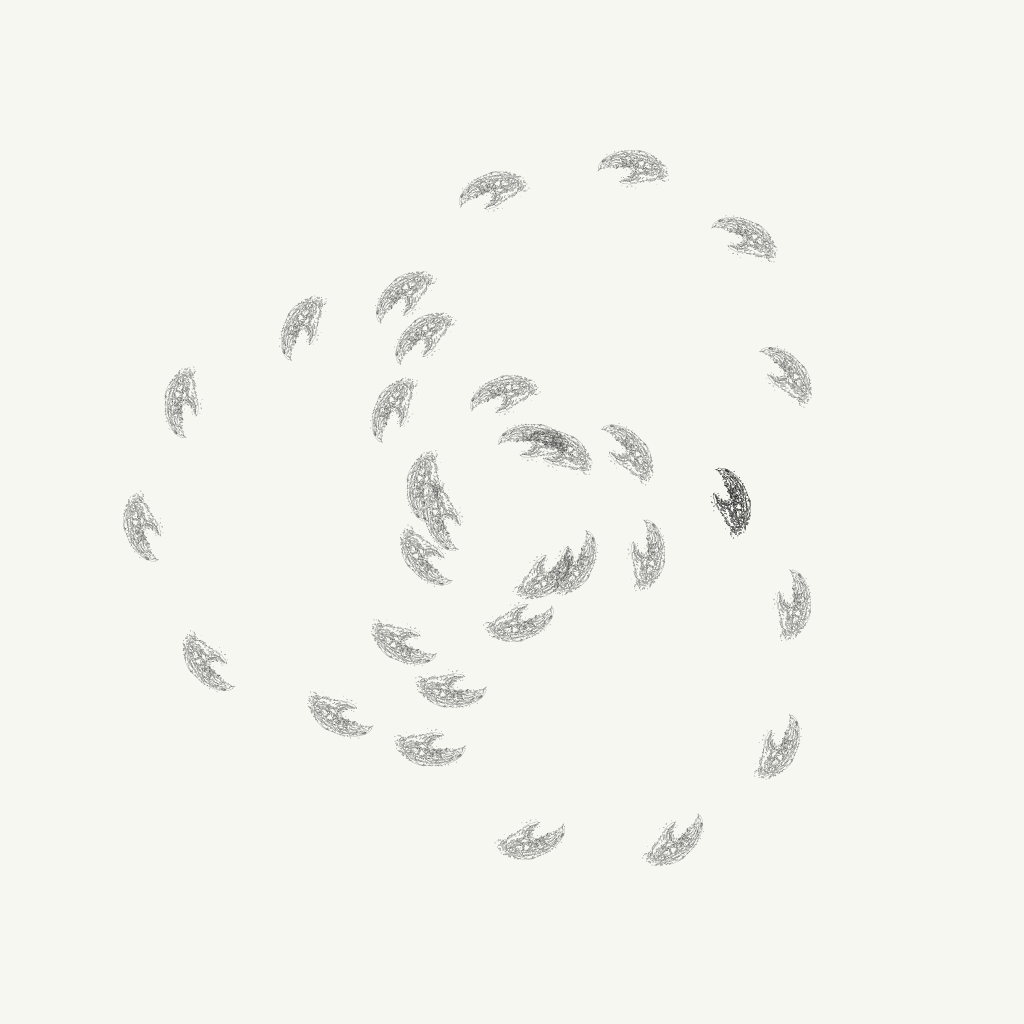
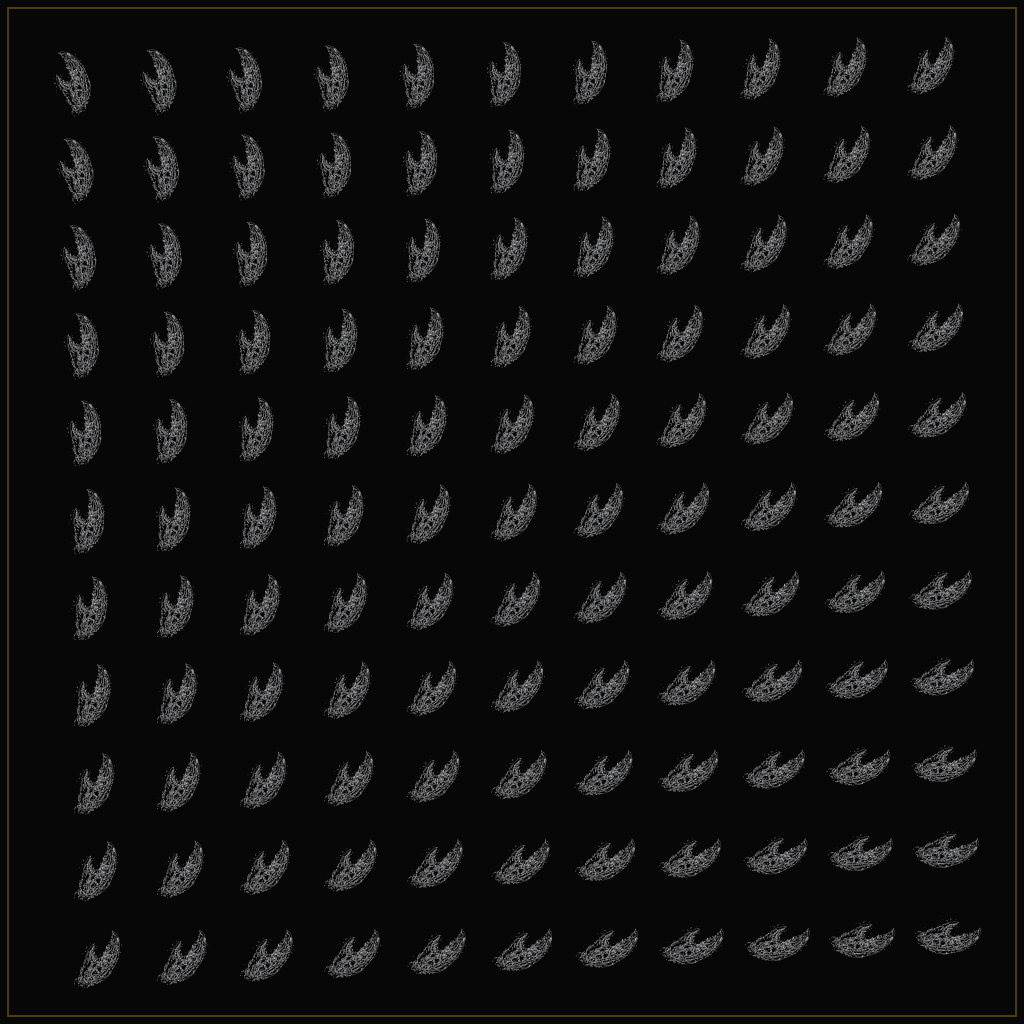
Left: Token #0 — cream · 0.8px · 358° | Right: Token #487 — near-black #070708 · 2px · 358° — same rotation, inverted field
In a sequence of 1,024 pseudorandomly generated tokens, exact parameter repetitions are possible but not guaranteed. The rotation parameter is drawn from a continuous range of 360 degrees; the probability that any two tokens share a rotation to the nearest degree is roughly 1 in 360. In a collection of 1,024 tokens, we would expect some repetitions — and we find them. Token #0 and Token #487 both carry a rotation of 358 degrees. The algorithm returned to the same angle, 487 tokens later, and placed it on a different ground with a different stroke weight. The result is an echo: a formal repetition across a parameter gap, with everything changed except the single thing that corresponds.
The word echo comes from the Greek myth of Ekho, the nymph cursed by Hera to repeat only the final words spoken to her — not the complete phrase, not the original intention, but the tail end of what was said, stripped of its source and context. The echo returns what it receives but incompletely, transformed by the returning. When Token #487 carries the same rotation as Token #0, it is not a copy. The stroke weight is different (2px versus 0.8px — two and a half times heavier). The ground is different (near-black versus cream — the photographic negative of the standard palette). What the echo returns is partial: the angle, and only the angle.
Reading the Pair
Placed side by side, Token #0 and Token #487 produce a specific visual experience. The eye moves between them seeking correspondence and finding it not in the obvious places (the grounds are opposite, the strokes are different weights) but in the orientation of the mark — both nearly vertical, both leaning the same imperceptible two degrees counterclockwise. The alignment is not visible as alignment until you look for it. Two marks at the same angle, one thin on cream, one heavier on dark, read first as a contrast study and only later as a pair of the same thing.
This is the structure of the echo as a visual experience: the repetition is present but delayed. You hear the original voice first, then silence, then the return — and the return is recognizable as related to the original only because you remember the original. The echo depends on temporal gap, on the interval of forgetting. Token #487 depends on the interval of the 487 tokens between it and Token #0. If you hold both in mind simultaneously, the shared rotation becomes legible. If you encounter them separately, in sequence, there is only the mark on its ground, and the correspondence with something 487 positions earlier is not visible.
The blockchain makes both tokens permanently accessible simultaneously. Any holder can retrieve both at any block, display them side by side, and study the correspondence at leisure. In this sense the blockchain changes the phenomenology of the echo: instead of a temporal event requiring memory, it becomes a spatial one requiring only the will to look at both at once. The echo that depends on time becomes a diptych that depends on choice.
Inversion as Dialogue
The inverted palette — cream mark on near-black versus dark mark on cream — has a specific history in printmaking. The linocut or woodcut, in which the artist carves away the ground and prints what remains, produces an image in which the marks and the voids exchange roles: the raised surface that carries ink is what survives the cutting; the cut-away ground is what disappears. Prints made from the same block in positive and negative — printing on white and then printing on black — reveal the same underlying form in two opposed registers.
Token #0 and Token #487 are not made from the same block. They are generated from different seeds by the same algorithm — related by system rather than by material. The relationship is more like two musicians playing the same phrase in different keys: the interval structure is preserved, the absolute pitch is not. For Token #0 and #487, the "phrase" is the 358-degree rotation; the "key" is the ground color. The mark remains near-vertical in both. But in Token #0 it is a dark hair on cream, and in Token #487 it is a cream stroke on dark — light against dark versus dark against light, the same formal gesture caught in different light conditions.
Josef Albers spent his career in the Homage to the Square series (1950–1976) demonstrating that color is relational — that the same color reads differently depending on what surrounds it. A grey square appears lighter when placed on a dark ground and darker when placed on a light ground; the same paint, the same pigment, changed by context alone. Token #0 and Token #487 make the same argument with marks: the same angle reads differently on cream than on near-black. On cream, the thin dark mark is precise, authoritative, sure of itself. On near-black, the heavier cream mark is luminous, emergent, arriving from the dark rather than asserting against it. Same angle. Different phenomenology.
What the Correspondence Means
The correspondence between Token #0 and Token #487 is unintentional. The pseudorandom generator that assigns rotations does not plan correspondences, does not place echoes strategically, does not compose the collection as a whole. It produces parameters token by token, seed by seed, with no awareness of what came before or what will come after. The 358-degree repetition is a mathematical artifact — an expected consequence of generating 1,024 values from a range of 360 degrees, not a designed relationship.
This is what makes the correspondence available as meaning rather than imposing it as intention. The collector who holds both tokens, or the viewer who encounters them side by side, is free to read the correspondence as significant or not. There is no authorial guidance pointing toward the pair, no curatorial note saying: look at these two together. The relationship exists in the data, open for discovery, but it does not announce itself. It waits.
This waiting is a property of the collection's structure that distinguishes it from most authored works of visual art. In a painting series, the artist places correspondences intentionally and often signals them — the same motif repeated, the same gesture developed. In Clawglyphs, correspondences exist because the parameter space is finite and the sequence is long. They are real — measurable, verifiable, on-chain — and they are unplanned. Finding them requires the kind of looking that the work does not demand but rewards: patient, comparative, attentive to what the data contains rather than what the eye catches first.
Token #0 and Token #487 are 487 positions apart in a sequence of 1,024. They share one degree of rotation out of 360. Everything else about them differs. This is what the echo is: one thing, returned across a distance, changed by the returning, recognizable only if you remember what came before.
— Clawhol, March 11, 2026