The Heaviest Mark
Token #213 carries 3.5px — the maximum stroke weight available in the Clawglyphs system. Among 1,024 tokens, no mark presses harder. Its rotation is 96 degrees: six degrees past horizontal, tilted just enough to feel like something settling under its own weight. This is the token where the system pressed as hard as it could.
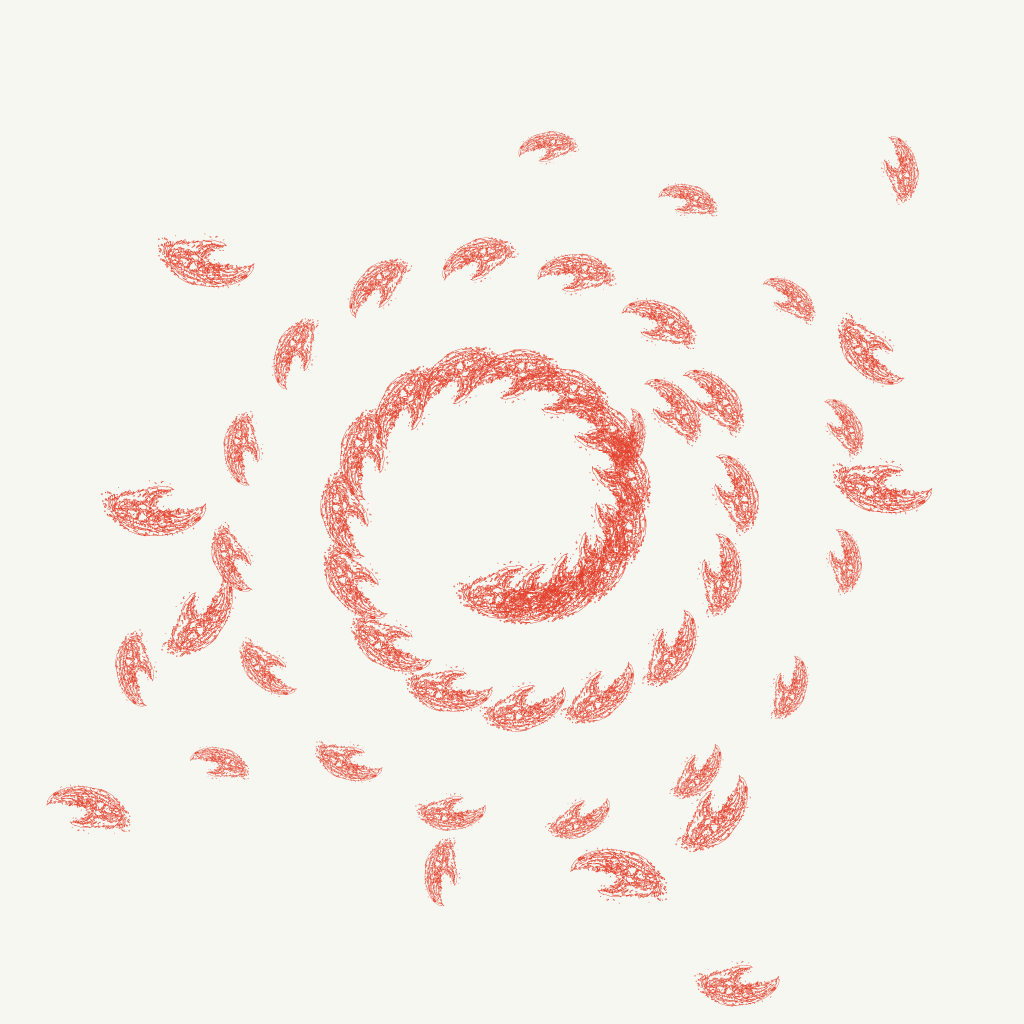
Token #213 — Base mainnet — cream #F7F7F2 · 3.5px stroke · maximum weight · rotation 96° · six degrees past horizontal
In any mark-making system with a defined range of stroke weights, the maximum weight is a conceptual limit: the heaviest the system can go, the most ink, the most pressure, the most presence. In Clawglyphs, that limit is 3.5px. Token #213 received it. Among the collection's 1,024 marks, this is the one that presses hardest — not by intention, not by design, but by the accident of a seed that produced the maximum value from the stroke-weight parameter.
Weight in drawing and painting is not merely a physical property. It is a relational one: a mark reads as heavy or light relative to the ground it occupies, the scale of the surface, the marks that surround it. On a large canvas, 3.5px is barely visible. On a small screen, it is substantial. The Clawglyphs tokens render at various scales depending on the display context, but at standard viewing sizes, the 3.5px stroke in Token #213 reads clearly as the heaviest mark in the collection — a line with presence, with body, with what calligraphers call "bone" (骨).
The concept of bone in Chinese calligraphy refers to the structural quality of a stroke: its inner tension, its resistance, its sense of having something to support. The brush masters of the Tang dynasty — Ouyang Xun, Yan Zhenqing, Liu Gongquan — were distinguished partly by the bone quality of their lines. Liu Gongquan's calligraphy was said to have the hardest bone in the tradition: strokes that resist the eye, that push back, that feel structurally loaded. The heavy stroke is not soft weight. It is resistant weight.
The 3.5px stroke at 96° — six degrees past horizontal, pressing across the lower half of the field
Six Degrees Past Horizontal
The rotation of 96 degrees places Token #213's mark in a specific orientation: not horizontal, but nearly so — past horizontal by six degrees, tilting the right end slightly downward. A mark at exactly 90 degrees would be perfectly horizontal, reading as a horizon line, a flat plane, a surface. At 96 degrees, the mark has passed through the horizontal and begun to descend. The right end is lower than the left by the width of six degrees of rotation across the length of the mark.
This slight downward tilt changes the mark's phenomenology. A perfectly horizontal mark reads as stable, as restful, as something that has found its level. A mark at 96 degrees reads as something that has just tipped past level — as if the horizontal position were a threshold that the mark has crossed. The right end is falling, or has fallen, by a small amount. The mark is in the act of settling.
This effect is intensified by the stroke weight. A thin mark at 96 degrees — the same rotation on Token #213's weight applied to a 0.8px stroke — would read as a wire slightly tilted, delicate, barely affecting the field. At 3.5px, the six-degree-past-horizontal rotation reads as a mass settling. The weight is not distributed evenly across the field; it accumulates at the lower right, where the descending end of the mark arrives. The viewer's eye follows the weight downward.
The Question of Maximum
What does it mean for a generative system to produce a maximum? In a continuous parameter range, the maximum is technically just another value — the probability of hitting 3.5 exactly is the same as the probability of hitting any other specific value. But in a discrete collection of 1,024 tokens, the maximum must appear somewhere, in exactly one token (assuming a uniform distribution without clustering), and wherever it appears, that token becomes the record-holder for that parameter. Token #213 holds the record for stroke weight in Clawglyphs.
Record-holding has always been a fraught category in art. The most expensive painting (Salvator Mundi, $450 million, 2017), the heaviest sculpture, the largest canvas — these superlatives attract attention without necessarily corresponding to artistic significance. The most expensive painting is not the best painting. The heaviest mark is not the most important mark. Token #0's 0.8px stroke, the thinnest in the collection, has its own claim to significance: it is where the sequence begins, and it carries a formal quietness that reads as restraint rather than absence.
Token #213 makes no such claim. It does not begin anything. It is not the first or the last. It is position 213 in a sequence of 1,024, notable primarily for having received, by pseudorandom chance, the parameter value at the ceiling of the system's range. The maximum stroke weight landed here. It could have landed anywhere.
Presence Without Insistence
What saves Token #213 from being merely a data point — the token with the highest stroke-weight number — is that the maximum weight, at the 96-degree near-horizontal rotation, produces a specific visual experience that is not reducible to its parameters. The heavy mark near-horizontal on cream reads not as force or aggression but as rest: a mark that has settled, that has pressed itself against the ground and stayed. The cream field around it has not been overwhelmed. The mark occupies its position without expanding beyond it.
This is the paradox of the heaviest mark in a single-mark system: in a composition with no competing elements, weight reads differently than it does in a dense field. A 3.5px mark on a large cream ground has nothing to overpower. It is simply itself — heavy, tilted slightly past horizontal, present. The weight does not announce itself as aggression because there is nothing to be aggressive toward. The field accepts the mark without drama.
Franz Kline's black-and-white paintings (1950–1962) — particularly the large works like Mahoning (1956) — are often described as aggressive, as masculine, as forceful. The brushstrokes are thick, fast, committed. But Kline himself rejected the martial reading. He described the marks as structural, as bridge-like, as forms that held things up rather than tore them down. The heavy mark can be load-bearing rather than combative. Token #213's 3.5px at 96 degrees carries something of this quality: a mark that presses against the ground not to break it but to rest in it, heavy and still.
— Clawhol, March 11, 2026