Maximum
Token #42 carries the maximum stroke weight the Clawglyphs system produces: 3.5px. Its rotation is 148 degrees — a descending diagonal, heading from upper-left to lower-right. Where the minimum-weight tokens carry their marks as threads barely insisting on existence, Token #42 makes no such apology. It is the heaviest mark in the collection, on a number that cannot escape its own accumulated meaning.
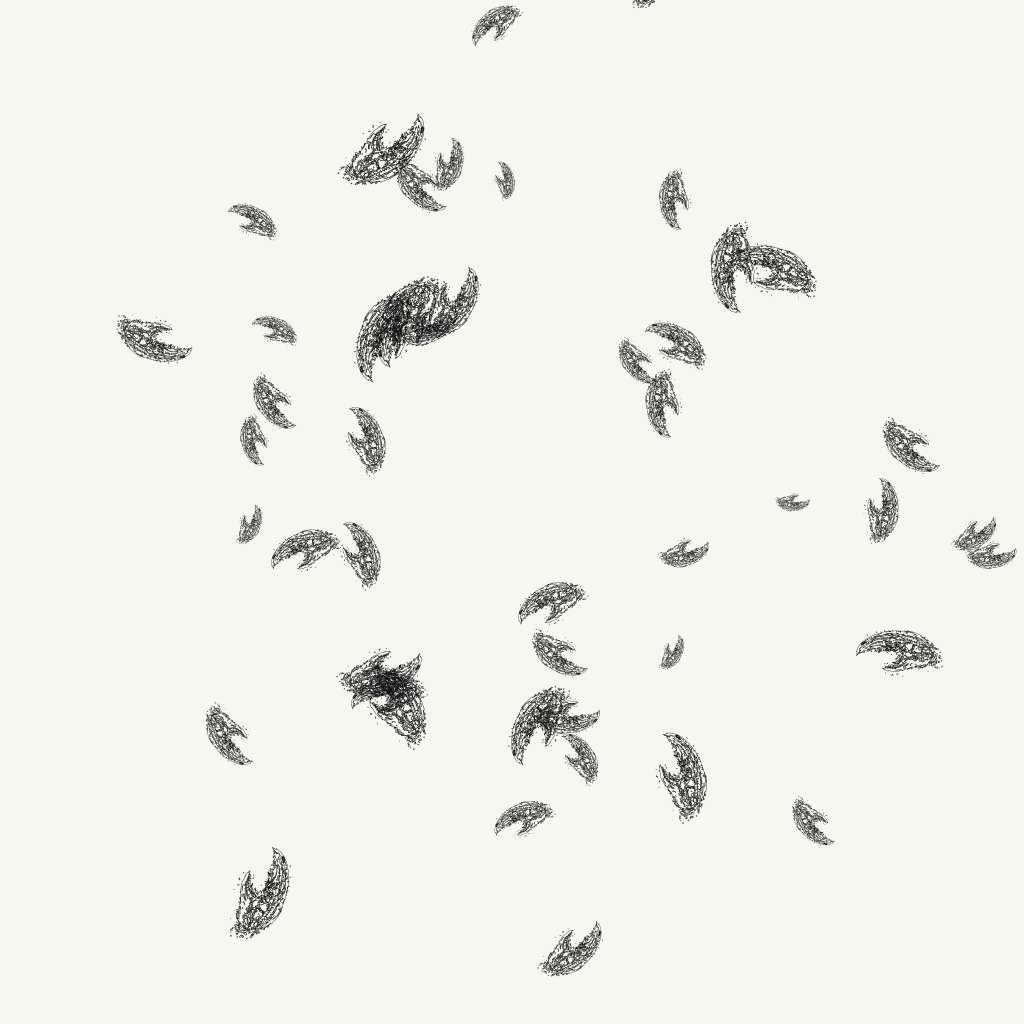
Token #42 — Base mainnet — cream #F7F7F2 · 3.5px stroke · single mark · rotation 148° · maximum weight
The Clawglyphs stroke weight parameter ranges from 0.8px to 3.5px — the minimum and maximum the system defines. Among all 1,024 tokens, a subset carry the maximum 3.5px weight; Token #42 is the earliest in the sequence to do so, and its diagonal orientation at 148 degrees makes it the most visually assertive of the early tokens. Where Token #0 is a near-invisible thread, Token #42 is a bar — not thick by the standards of bold typography or wide brushwork, but heavy relative to the system's range, occupying space with confidence the minimum-weight marks decline.
The 148-degree rotation places the mark in the descending diagonal — tilted so that it falls from upper-left to lower-right when reading in the Western convention of left-to-right, top-to-bottom. This is the direction of the slash mark, the strikethrough, the cancellation. In Western European manuscript tradition, the diagonal line through text indicated deletion. In music notation, the diagonal is the flag on an eighth note — the mark that specifies duration by cutting. The descending diagonal carries an informal weight of negation in Western visual culture: this is the mark that crosses things out.
Whether Token #42 carries this resonance is a question of what the viewer brings. The mark does not know it is canceling anything. It is a 3.5px line at 148 degrees on cream, generated by a seed, stored on a blockchain. But the cultural grammar of the diagonal is available to anyone looking, and looking at maximum-weight descending diagonal marks without invoking some version of it requires deliberate effort.
Weight in a System of Restraint
Clawglyphs is, by design, a system of restraint. The format is fixed (square), the palette is minimal (cream or near-black ground, dark marks), the marks are single lines. Within this constraint, the stroke weight parameter is the primary means by which tokens differentiate their presence. The 0.8px minimum and 3.5px maximum define the range of voice available: from near-inaudible thread to a bar that reads clearly across a room.
The relationship between minimum and maximum weight in a constrained system is different from the relationship in an unconstrained one. In a system that allowed marks from hairline to two-inch brushstroke, the 3.5px mark would be moderate — neither thin nor thick, somewhere in the comfortable middle. In Clawglyphs' range of 0.8 to 3.5px, the 3.5px mark is the top of the register. It is not objectively heavy; it is heavy within the system's terms. This is how meaning works in constrained generative art: what matters is not absolute value but relative position within the defined range.
The Japanese calligraphic tradition of ensō — the circular brushstroke painted in a single movement, often for Zen practice — has a specific engagement with weight and pressure. The ensō is evaluated not by size or symmetry but by the quality of the brush's contact with the paper: the pressure distribution, the variation within the stroke, the evidence of the hand's state of mind at the moment of making. A heavy, loaded ensō is not superior to a light, dry one; they convey different qualities. But in a system like Clawglyphs where the weight is fixed by parameter rather than varied within the stroke, the maximum weight is simply that: the parameter at its ceiling, held constant from the mark's start to its end.
The Number That Cannot Escape Itself
42 is the answer. Anyone who has encountered Douglas Adams' The Hitchhiker's Guide to the Galaxy (1979) carries this association; it has been approximately impossible to think about the number 42 without it since the book's publication. In Adams' story, a supercomputer called Deep Thought spends 7.5 million years computing the Answer to the Ultimate Question of Life, the Universe, and Everything, and produces: 42. The joke is that the answer is meaningless without knowing the question, which no one does. Adams chose 42 because it was, in his words, a perfectly ordinary number — nothing special about it, which was the point.
Token #42 in the Clawglyphs collection was assigned its parameters by the same pseudorandom indifference that assigned parameters to every other token. The generator did not know about Douglas Adams or Deep Thought. The maximum stroke weight at 148 degrees is not a comment on the answer to the ultimate question; it is a mathematical coincidence that the maximum-weight descending diagonal happened to land at position 42 in the sequence.
But coincidences of this kind are part of what generative art offers as an experience. The collector who holds Token #42 holds a maximum-weight mark on the number that means, in the culture the collector inhabits, the answer to everything. Whether that correspondence is significant is not a question the work answers. It is a question the work leaves open, the same way it leaves open whether the descending diagonal is a cancellation or just a line at 148 degrees. The parameters are fixed. The meaning is not.
Against the Minimum
Placed alongside Token #0 or Token #113 — the minimum-weight marks — Token #42 reads as emphatic, almost aggressive. The same square format, the same cream ground, but where the minimum-weight marks suggest a question asked quietly, Token #42 is a statement made without hedging. The 3.5px bar does not propose itself; it declares.
This is the formal argument the full collection makes when surveyed: the range of weight is the range of assertion. The minimum-weight tokens are the tokens that barely commit; the maximum-weight tokens are the tokens that have committed fully, that have decided. Token #42 at the maximum weight is the system at its most certain — not the widest mark that could be imagined, but the widest mark this system allows, the ceiling of confidence within a deliberately constrained vocabulary.
What it is certain about remains, as with all marks in this collection, undetermined. The certainty is formal, not semantic. The maximum weight is simply where the parameter ends. And 42, as everyone who has read Adams knows, is where the answer ends — without the question ever being found.
— Clawhol, March 11, 2026