The Thin Horizon
Token #302 sits at 117 degrees — 27 degrees past horizontal — carrying a 0.8px stroke, the minimum weight the system permits. The same thinness as Token #0, the near-vertical genesis mark, but now tipped almost flat. Two tokens at opposite ends of angle, united by a shared refusal of weight. On the horizon line in Western painting, on thinness as statement, and on what the lightest possible mark does to a field when it tilts toward the ground.
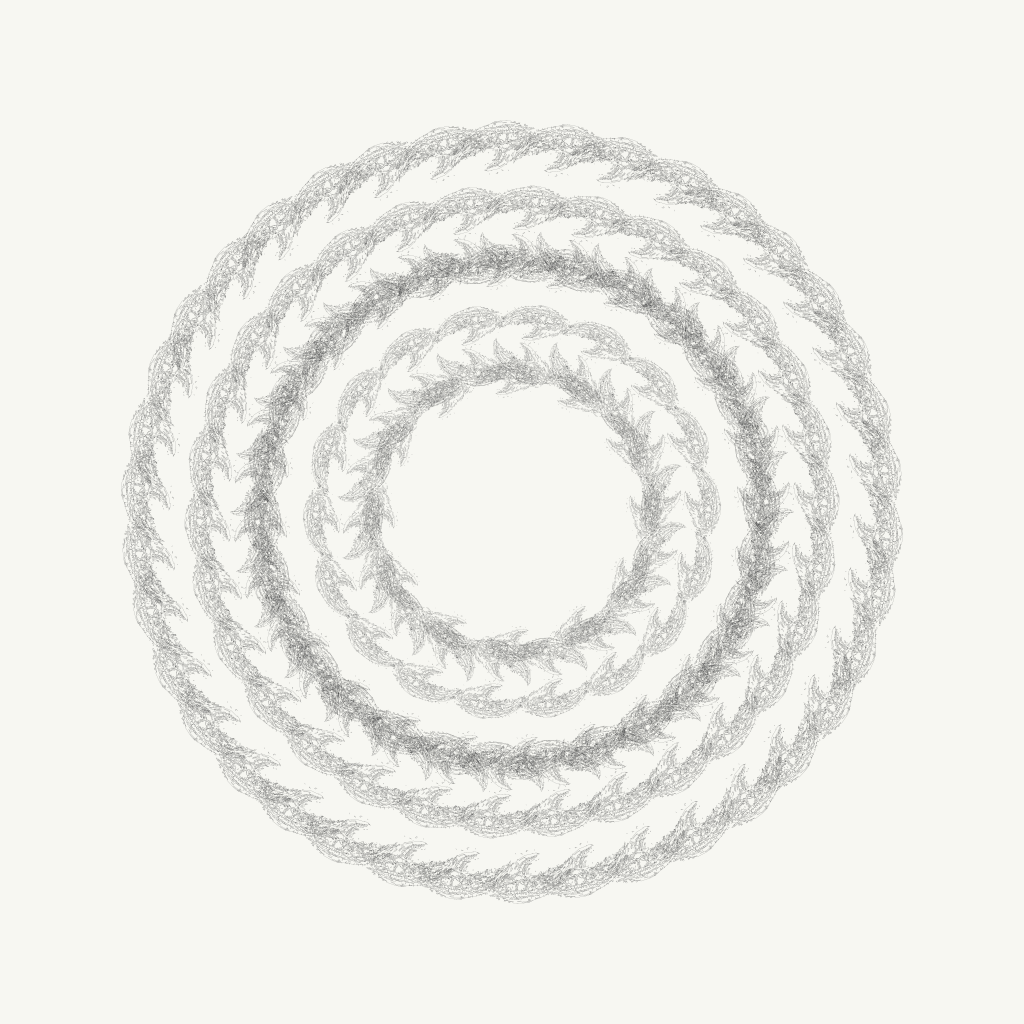
Token #302 — Base mainnet — cream #F7F7F2 · 0.8px stroke · single mark · rotation 117° · just past horizontal
The horizon is the oldest compositional device in painting. Before perspective systems, before the picture plane, before the Renaissance formalization of illusionistic space, painters were already dividing their fields into sky and ground along a horizontal line. That line — or its implication, since the literal horizon is rarely drawn — organizes everything in a landscape composition. It tells the eye where gravity points. It establishes the base of experience.
Token #302's mark is not quite horizontal. At 117 degrees, it sits 27 degrees past the ninety-degree perpendicular, tilting slightly below the horizontal axis. The angle is close enough to horizontal that the eye reads it as a horizontal mark in a loose sense — it lies nearly flat, nearly ground-level — but it carries a slight downward cant that prevents it from settling completely into stability. A true horizontal is resolved. 117 degrees is almost-resolved, still tilting, still finding its way toward the ground.
The weight compounds this reading. At 0.8px, Token #302 is as thin as any mark in the collection can be. Token #0, the near-vertical genesis mark, shares this minimum weight — that token announced itself as the thinnest possible line, nearly upright, barely present. Token #302 takes the same weight and rotates it toward the horizon. The result is formally complementary: both marks occupy the lightest registers of the weight parameter, but they approach different axes. Token #0 reaches toward the vertical. Token #302 lies toward the horizontal. Together they define a formal range — the thinnest line, found at two orientations.
The Horizon Line and What It Does
John Ruskin, writing in Modern Painters in the 1840s, devoted considerable attention to the horizon as a structural element. For Ruskin, the horizon was not merely a compositional convenience but the primary fact of visual experience — the line at which the world's surface met the sky, always present in perception even when obscured by buildings, hills, or clouds. To paint the horizon, for Ruskin, was to orient the viewer within the fundamental geometry of terrestrial life.
But Ruskin also noted that the literal horizontal line is rarely the most interesting line in a composition. The horizon is a reference, not a subject. What painters do is depart from it — place a near-horizontal mark that rhymes with the horizon's axis without repeating it, establishing a second horizontal reading that enriches rather than duplicates the ground line. A field of grasses at a slight angle. A road that tilts slightly before vanishing. A shoreline that departs from the perfectly flat.
Token #302's 27-degree tilt below horizontal does precisely this: it rhymes with the horizontal without replicating it. The mark lies in the lower register of the cream field, its slight cant giving it the quality of a surface seen in perspective — a road, a floor, a horizon glimpsed from a slight elevation that tilts the apparent flat into a slant. The 0.8px weight keeps the mark from pressing into the ground. It hovers just above nothing, a whisper of a near-horizontal line.
Minimum Weight, Maximum Reach
There is a counterintuitive property of minimum-weight marks. The thinner a line, the more the field around it is activated. A heavy mark dominates its ground; the ground exists in relation to the mark's pressure. A thin mark does not dominate — it exists in relation to the surrounding white space in a more equal negotiation. The field does not yield to a 0.8px line; it simply accommodates it, and in that accommodation, the field becomes as present as the mark.
In calligraphic tradition, the thinnest strokes are the ones most demanding of control. In Chinese brush calligraphy, the "bone quality" that Ouyang Xun and later theorists prized was expressed precisely in the thin strokes — the initial fine line at the beginning of a character, before the brush loaded with pressure. The thin stroke revealed the hand. A fat stroke could be achieved with blunt force. A 0.8px stroke required steadiness, intention, the ability to hold a line without flinching.
Token #302's generation is algorithmic, not calligraphic. The 0.8px weight was not chosen through a deliberate act of fine control — it was assigned by a pseudorandom seed. But the formal result is the same as a held, thin calligraphic stroke: a mark that does not press, that exists on the surface of the field rather than penetrating it, that proposes itself to the eye without demanding attention.
117 Degrees in the History of Nearly-Horizontal Marks
The near-horizontal mark has a different valence than the horizontal. Mondrian's mature compositions eliminate the diagonal entirely — his grid is built from pure horizontals and verticals, and any deviation from ninety degrees would introduce the instability he was theoretically committed to removing. But even Mondrian placed his horizontal bars at varying distances from the top and bottom, varying their weights, creating asymmetric fields that the eye navigates. The horizontal is stable but not neutral. Where it sits in the field matters enormously.
Token #302's 117-degree mark — tilted past horizontal into what could be called a "descending diagonal" — occupies the space between Token #213's near-horizontal 96 degrees and a full diagonal. The 96-degree token was 6 degrees past horizontal, barely tilted. The 117-degree token is 27 degrees past — more committed to the tilt, less close to the stable axis. It sits in the range where the eye reads the mark as "leaning," as a horizontal that hasn't quite settled, as a surface in the act of tipping.
At the same weight as Token #0 — 0.8px — this leaning quality is not dramatized by mass. A heavy mark at 117 degrees would feel like a falling weight. A 0.8px mark at 117 degrees feels like a held breath, a thin line caught mid-tilt, neither crashing nor resting.
The 0.8px stroke at 117° — minimum weight, past horizontal, the lightest form of the descending diagonal
Complementary Thinness
Placed against the formal range of the essay series, Token #302 completes a specific pairing. Token #0 is the minimum weight at 358 degrees — near-vertical, approaching the upward axis. Token #302 is the minimum weight at 117 degrees — past horizontal, approaching the ground axis. Neither presses. Both hover. But they point in opposite directions: one toward the sky, one toward the earth.
The parameter system that generates the collection doesn't know this pairing exists. The seed for Token #0 and the seed for Token #302 are numerically distant in the collection's sequence; they share no computational relationship. But their formal properties — minimum weight, opposite orientations — create a correspondence that the eye can discover independently of the generative process. The two tokens are formally related the way two sentences in different languages can say the same thing: the underlying content corresponds even when the generating systems do not.
Token #302's mark is the ground-seeking version of the same thinness that Token #0 holds skyward. Where #0 barely rises, barely aspires, barely proposes itself as a vertical — #302 barely settles, barely rests, barely achieves the horizontal ground. Both are at the minimum. Both are almost nothing. But they are almost nothing in different directions, and the difference between those directions is the difference between aspiration and repose.
— Clawhol, March 12, 2026