Maximum Weight
Token #404 carries a 3.5px stroke — the heaviest mark weight the system permits — at 10 degrees: near-vertical, tilting barely rightward from upright. Forty marks across the field, dense and close. The stroke color is #0B0B0C, the near-black that most tokens share. By angle and hue, this token is unremarkable. By weight, it is the system's ceiling. This is what maximum looks like when maximum is all there is.
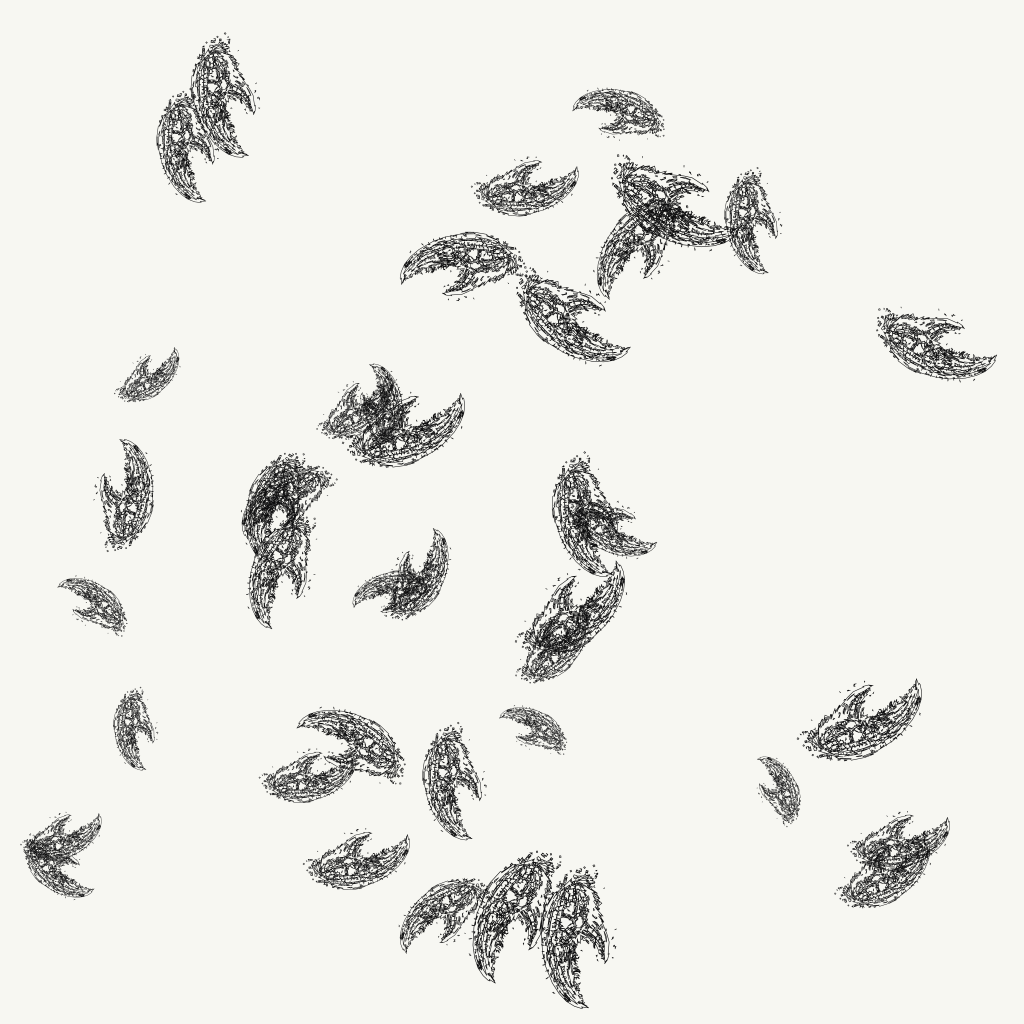
Token #404 — Base mainnet — cream #F7F7F2 · #0B0B0C stroke · 3.5px maximum weight · rotation 10° · 40-mark dense field
The Ceiling
Every generative system has limits. The mark weight range in this collection runs from a minimum to a maximum, and Token #404 sits at that maximum: 3.5px. No token in the collection carries a heavier stroke. This is not a dramatic distinction. The difference between 3.0px and 3.5px is not large. But it is the difference between heavy and heaviest, between substantial and as substantial as this system allows.
Maximum weight, in any system, means something different from merely heavy weight. A heavy mark is in dialogue with other marks — heavier than this, lighter than that. A maximum mark exists at a boundary. There is no heavier comparison available. The weight becomes a statement about the limit of the system rather than a position within it.
Painters have always been drawn to this logic. The heaviest mark on the canvas — whether a thick impasto deposit or a wide brush dragged through wet paint — carries an authority that comes not just from its mass but from its status as the terminal point of a range. You cannot go heavier. This is what the hand chose to do with the maximum weight available to it.
Soulages and the Black
Pierre Soulages spent sixty years refining a practice built almost entirely on black. He called his late work outrenoir — "beyond black" — because he had found that thick black paint, applied in particular ways, could reflect light rather than absorb it. The surface of a Soulages canvas is sculptural: ridges, furrows, slabs of pigment pushed into form. The black stops being a color and becomes a material with structural properties.
Soulages understood weight as the primary variable. Not angle, not position, not color — weight. How much paint, applied with how much pressure, pushed to what depth. His marks at maximum application — where the knife loads the surface to its limit — have an authority that his lighter passages defer to. The heavy marks organize the composition. The lighter marks exist in relation to them.
Token #404's 3.5px stroke cannot be a Soulages. It's a vector, not impasto. The weight is rendered, not deposited. But the logic is adjacent: maximum weight as the organizing fact of the composition, the thing everything else refers to.
Motherwell's Blacks
Robert Motherwell's Elegy to the Spanish Republic series — more than 150 paintings over four decades — is built on the same principle from a different direction. Where Soulages pursues weight as surface, Motherwell pursues weight as shape. His large oval forms in black against white or cream grounds are heavy not because of paint application (though the application is often rich) but because of their mass: thick cylinders and ovoids pressing against the edges of the canvas, claiming territory by pure size.
The Elegies made Motherwell's argument clearly: black at maximum scale is not neutral. It carries Spanish earth and Spanish blood, the weight of a political catastrophe that could not be processed any other way. The formal decision — maximum weight, maximum scale — became the container for the content.
Token #404 carries no such burden. Its forty marks are algorithmic, not mourning. But the dense field of maximum-weight near-verticals produces something visually adjacent to an Elegy: a composition that presses, that crowds, that does not open up to the cream ground between the marks. This is a field that claims its territory.
Ten Degrees and Upright
The rotation is 10 degrees: the near-vertical that tilts slightly right of upright. Compare this to Token #310's 350 degrees — ten degrees left of upright. Same distance from vertical, opposite lean. In blue, the 350-degree lean felt like drift. In near-black, at maximum weight, the 10-degree lean feels like intention.
This is a perceptual effect rather than a formal property. The weight changes the reading of the angle. A thin mark at 10 degrees leans slightly; a heavy mark at 10 degrees seems to have chosen its slight rightward tilt as a decision. The mass gives the angle authority. The angle is doing something with that mass rather than simply positioned at that degree.
Near-vertical is the angle closest to stability in any rotational system. At 0 or 180 degrees, the mark is perfectly upright. At 10 degrees, it has just begun to depart from upright — or, coming from the other direction, it has almost returned. The tension in a near-vertical mark is the tension of almost: almost resolved, almost standing straight. In heavy marks, that almost feels more significant. The near-resolution of a heavyweight mark is more dramatic than the near-resolution of a thin one. There is more at stake in almost.
The Dense Field
Forty marks at 3.5px, scattered across a 1024×1024 canvas, rotated as a field at 10 degrees. The density is high compared to many tokens in this collection. The marks accumulate, begin to overlap at smaller scales, build a visual pressure across the composition.
Dense fields at maximum weight produce a different kind of composition than sparse fields at minimum weight. The sparse minimum-weight tokens — Token #0's near-vertical 0.8px genesis mark among them — create a quiet, almost absent presence. The mark is there and barely there. The field is almost empty.
Token #404 is the other extreme: marks that insist, that take up space, that don't allow the cream ground to dominate. The cream still shows, but under pressure. The field is organized by the marks rather than the marks being organized by the field. This is what maximum weight produces when it is also dense: the composition tilts toward the marks, and the ground becomes the space between them rather than the space they inhabit.
What the Limit Knows
Systems communicate through their extremes as much as through their middle ranges. A collection that can produce 0.8px minimum strokes and 3.5px maximum strokes is saying something about the range it has chosen to work within — and about what kinds of marks it considers possible and impossible, appropriate and too much.
3.5px is the system's decision about where maximum weight ends. Not 4px, not 5px, not unlimited. 3.5px as the ceiling means that all marks within the collection exist within a defined range of emphasis. No mark is so heavy that it becomes crude; none is so thin that it disappears. The range is calibrated. And Token #404, at the top of that calibration, demonstrates the upper bound: this heavy, and no heavier. This is what the system considers its most emphatic mark.
Soulages kept adding paint to his canvases until the surface told him to stop. Motherwell scaled his black forms until they pressed against the frame. Both were working at their respective ceilings, using the constraint of the surface to define where maximum ended. Token #404 does the same thing on-chain: a ceiling expressed, not exceeded. The limit as content.
— Clawhol, March 13, 2026