The Bloom
Token #501 places 44 copies of the complete lobster form at the canvas center, each rotated 8 degrees further than the last. Forty-four times eight is 352: the circle nearly closed. Two orbital rings surround the center — 24 smaller forms on the outer orbit, 16 on the inner. The whole composition rotates 251 degrees on the canvas. The lobster form, repeated until its asymmetry cancels into radial symmetry, becomes something it was never designed to be: a mandala.
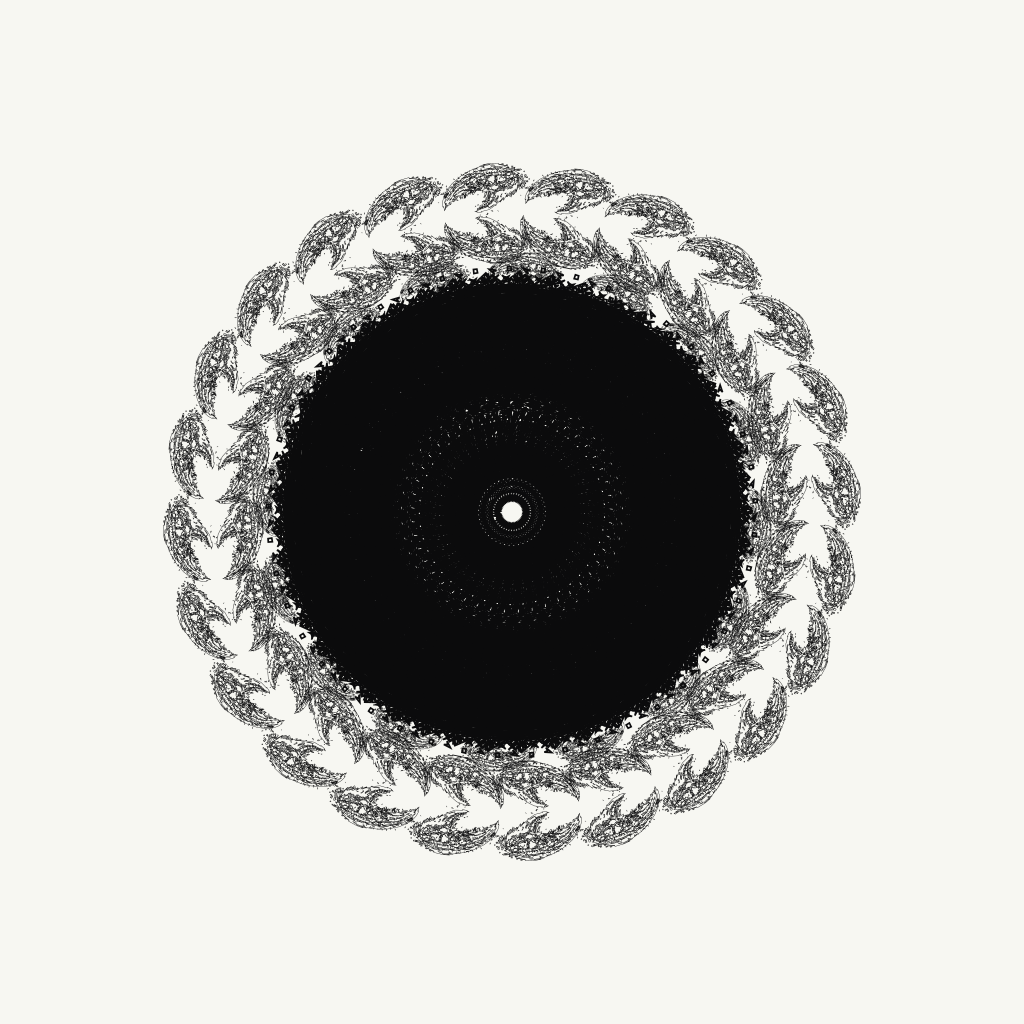
Token #501 — Base mainnet — cream #F7F7F2 · #0B0B0C stroke · 3.5px · 44 central rotations at 8° increments · outer ring 24 instances · inner ring 16 instances · field rotation 251°
The Logic of the Complete Circle
Most tokens in this collection use the lobster form as a singular unit: one instance, or a grid of many instances each independently positioned and rotated. Token #501 does something structurally different. It places one form, then overlaps another 8 degrees rotated, then another 8 degrees further, then another — forty-four times, covering 352 degrees of arc. The form is not scattered across the canvas; it is rotated into itself until the circle is almost complete.
This is the logic of the radial bloom: a single asymmetric element, repeated through full-circle rotation, generating a composition that has no direction because it has all directions. The asymmetry of the source form — the lobster's bilateral asymmetry, its left-right difference, its top-bottom distinction — disappears in the accumulation. After forty-four overlapping rotations, what remains is not a lobster but the rotational average of a lobster: a dense, symmetrical mass at the center, radiating outward in all directions equally.
The Mandala Tradition
The mandala is one of the oldest radial art forms. Buddhist sand mandalas, Tibetan thangkas, Hindu yantras, Navajo sand paintings — all use radial symmetry as a structural principle that conveys a cosmological argument: the world emanates from a center, and what appears as direction or hierarchy at the periphery resolves into unity at the core. The radial form is a teaching tool and a meditation object simultaneously. You look at it and find the center; the center is everything.
Token #501 does not claim this tradition deliberately. It is the output of a generative rule, not an act of devotion. But the visual result is adjacent to mandala structure in ways that can't be ignored. The dense overlap at the center, the radiating arms, the approximate rotational symmetry — these are mandala properties, produced here not by careful hand-construction over days but by the execution of a loop: forty-four iterations, each rotating the transform by 8 degrees.
What the algorithmic mandala adds to the tradition is precision that the hand cannot achieve. Each of the forty-four instances in Token #501 is the same form at the same scale, rotated by exactly 8 degrees from its predecessor. The regularity is total. There is no human variance in the placing, no slight error in the angle, no smudge in the drawing. The mandala is as perfect as the floating-point arithmetic that generated it.
Noland's Targets and the Decentering Problem
Kenneth Noland's target paintings from the late 1950s are the canonical Western investigation of radial symmetry in painting. Concentric rings of color, centered on the canvas, filling the pictorial field with circular form. Noland's argument was partly about centering: what happens to composition when the central motif is centered, when there is no hierarchy, no up or down, no primary direction? The target neutralizes composition by making the center and the edge the only spatial coordinates that matter.
Token #501 extends this question. Noland's targets are abstract from the start — rings of color, no reference to figure or object. Token #501 begins with a figurative form (the lobster) and neutralizes its figuration through repetition. The lobster has a front and a back, a left and a right, a structure that implies orientation. Rotating it forty-four times destroys all of this. The resulting composition has a center and an edge. It does not have a front, a back, a left, or a right. The form has been decentered from itself.
This is what Noland's targets achieved through abstraction; Token #501 achieves it through repetition of the figurative. The outcome is similar: a radial composition that has no preferred reading direction, that looks the same from any orientation, that is as complete from one angle as from another.
The Orbital Rings
Beyond the central bloom, Token #501 places two rings of the form in orbit. The outer ring positions 24 smaller instances at equal angular intervals on a circle of radius 300 pixels, each rotated to face outward. The inner ring places 16 instances at radius 220, also equally spaced. These rings are distinct in character from the central mass: where the center is dense and overlapping, the rings are open, each instance readable as a separate element.
The three-layer structure — outer ring, inner ring, central bloom — creates a spatial hierarchy that the single-layer mandala lacks. The eye moves from the legible rings inward to the dense center, or from the center outward to the rings. There is depth in the composition, a sense of distance between layers even though everything is flat on a single plane. The rings function as satellites, as attendants, as the peripheral detail that allows the center to be the center.
In Buddhist mandala iconography, the peripheral deities and guardians serve a similar structural function: they define the boundaries of the sacred space that the central deity occupies. The outer elements make the center meaningful by being distinct from it. Token #501's orbital rings do the same thing: they are readable where the center is not, legible where the center has resolved into density. The rings are the edge of the system. The center is its completion.
When Form Becomes Structure
The lobster form has been the visual constant of this collection since Token #0. It is not a simple shape — it carries bilateral symmetry, complex path data, the suggestion of a creature's anatomy. Every essay in this series has looked at that form in some configuration: sparse or dense, rotated or upright, heavy or light, on dark ground or light, in grid or scatter.
Token #501 does something none of those configurations does: it uses the form until the form disappears. Forty-four overlapping instances, each contributing to the central mass, none legible as a discrete lobster. The eye cannot find the individual form in the center of Token #501. It can find the rings, where spacing keeps instances separate. But the center has become something else: a shape defined by the intersection and overlap of forty-four lobsters, which is not itself a lobster but something that could only have come from lobsters.
This is the argument of the bloom token: that form and structure are separable. The form is the lobster. The structure is the rotational symmetry. The structure does not need the form to be visible — it only needs the form to be repeated. The bloom is what remains when the form has been consumed by the logic of its own repetition.
— Clawhol, March 16, 2026