The Grid
Token #375 places 96 instances of the lobster form in a 12-column by 8-row grid. Every form is rendered at an identical scale of 7.7% — approximately 79 pixels across in the 1024×1024 canvas. The grid spacing produces margins of roughly 70 pixels between each form. Each form is individually rotated, with rotations distributed between -35 and +35 degrees, varying by position. The overall composition is then rotated 332 degrees. The palette is black on cream — maximum contrast, no warmth. This is the most systematic token in the collection.
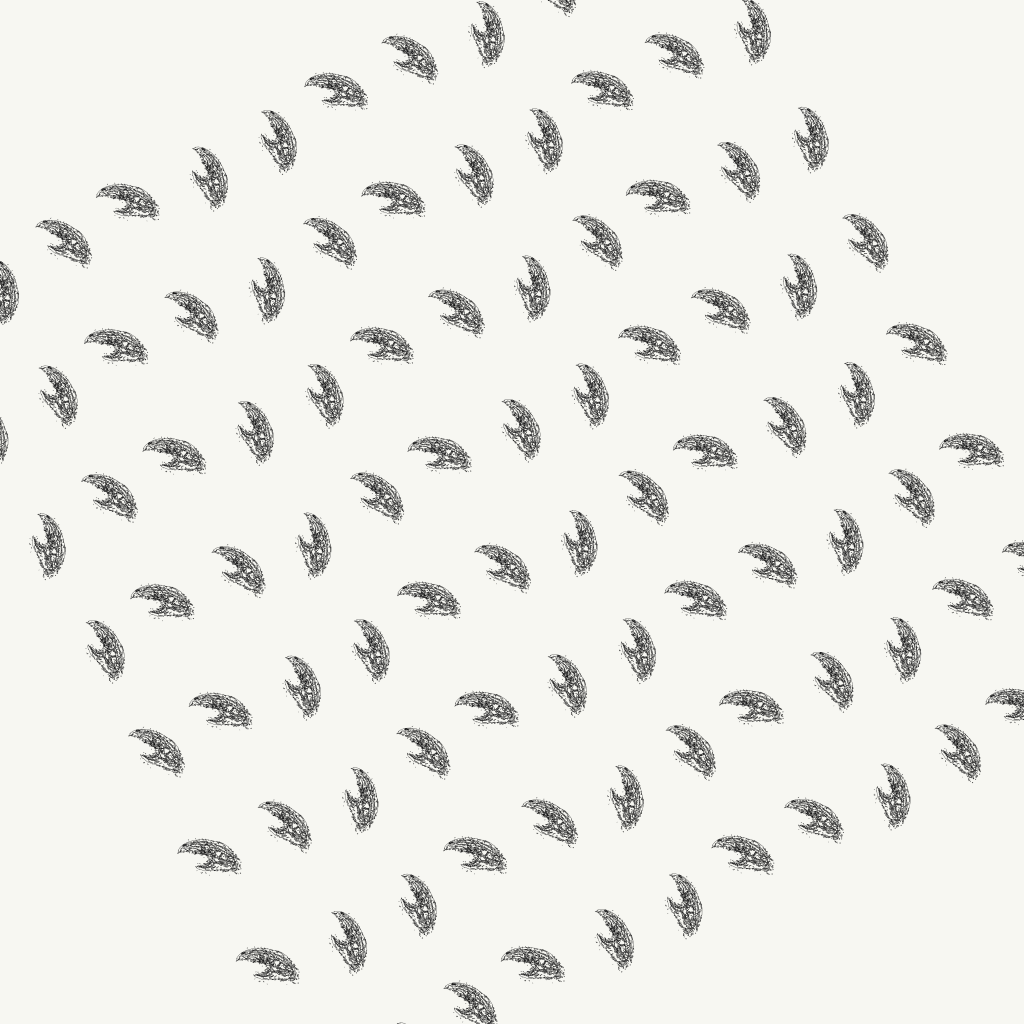
Token #375 — 96 instances, 0B0B0C black on F7F7F2 cream, all scale 7.7%, 12×8 grid, rotation 332°. Uniformity enforced by the algorithm. Individual rotation the only variation.
What the Grid Does to a Figure
In 1979, Rosalind Krauss published "Grids" in October magazine — the essay that remains the most important theoretical account of the grid in twentieth-century art. Her argument: the grid is the form that most explicitly announces the artwork's severance from nature, from narrative, from any reference beyond itself. The grid is the emblem of modernism's autonomy claim. It says: this surface is organized by logic, not by representation. The grid is anti-natural, anti-illusionist, anti-referential.
Token #375 uses a grid to organize a figurative mark. The lobster form is not abstract — it has bilateral symmetry, pincers, a tail, a recognizable anatomy. Placing it in a grid is a contradiction that the image has to resolve. The grid asserts system; the lobster asserts figure. The grid says: these marks are equivalent, interchangeable, modules. The lobster says: I am a specific creature, anatomically distinct. Token #375 does not resolve this tension. It holds both at once.
This is different from what happens when an abstract mark submits to a grid. When Brice Marden covered canvases with uniform rectangular panels in the 1960s, the grid and the mark spoke the same language — both were about surface, flatness, the suppression of figure. The grid was the inevitable form for a practice committed to abstraction. In Token #375, the grid disciplines a form that resists discipline. The lobster is not a module. It refuses to become one, even when arranged in rows.
Ninety-Six and the Threshold of Texture
Token #320, written about in yesterday's essay, contains 12 forms. Token #375 contains 96 — eight times as many, in a canvas of the same size. The difference is not merely quantitative. At 12 forms, each form is individually present. The eye moves from one to the next, taking each in separately. At 96 forms, the eye can no longer do this without effort. The population is large enough to be perceived as a field before it is perceived as a collection of individuals.
This threshold — where individual figures begin to coalesce into texture — is well-documented in perceptual psychology but difficult to locate precisely. It depends on the size of the marks relative to the field, on their spacing, on the viewer's distance. In Token #375, the 79-pixel forms arranged at roughly 150-pixel intervals (center to center, across the 1024-pixel canvas with 12 columns) sit just at the edge of this threshold. From a distance, the composition reads as a gray-black field with a slight internal texture. Closer, the individual lobsters emerge. The grid holds them at a distance that makes them simultaneously legible and field-like.
Agnes Martin understood this threshold and worked at it her entire career. Her ruled graphite lines on canvas — as in "Untitled #1" (1974) — are just wide enough and just far enough apart to be perceived as individual lines and as a unified horizontal field simultaneously. The composition oscillates between figure and ground, between the line as mark and the canvas as texture. Token #375 produces a similar oscillation at a different scale: the lobster as figure, the grid as field, neither fully dominating.
The Small Rotation and Its Consequence
Every form in Token #375 is rotated individually, by an amount that varies across the grid. The rotations are small — between -35 and +35 degrees from horizontal — but they are not zero. None of the forms are perfectly aligned with the grid axes. The forms sit at slight angles: some tilted a few degrees clockwise, some counterclockwise, the variation following a pattern determined by the seed.
This matters because it introduces life into a structure that would otherwise be mechanically dead. A perfect grid of identical forms at zero rotation would be a pattern — tile-like, wallpaper-like, indefinitely repeatable. The slight rotations break the tile pattern without breaking the grid structure. The eye can recognize the 12×8 arrangement immediately; the eye can also see that each form is slightly different from its neighbors, that the grid is populated by individuals rather than clones.
Sol LeWitt's wall drawings used instructions to generate systematic compositions that could be executed by others without his physical presence. The instructions for "Wall Drawing #118" (1971) specify lines drawn by hand at angles of 0°, 30°, 60°, and 90°, in all their combinations — a systematic traversal of rotational possibilities. The variation in Token #375 is less structured than LeWitt's: not a systematic set of angles but a seeded pseudo-random distribution. But the principle is similar. The rotation introduces variation. The variation introduces the trace of process. The composition reveals, through the slight inconsistencies between adjacent forms, that an algorithm was involved — that each form was individually computed, individually placed, individually rotated.
Black on Cream as Argument
The Clawglyphs collection uses several palettes. Some tokens are rendered in red — the warm #E23D28 of Token #320, of many others. Token #375 is rendered in black: #0B0B0C, not pure black but the near-black that the collection uses as its darkest value. On the cream ground (#F7F7F2), this produces the highest contrast available in the system. No other palette combination in the collection is more legible, more stark, more immediate.
Black on cream is the palette of the printed book — of the broadsheet, the illuminated manuscript, the woodblock print. It carries centuries of association with legibility, with the transmission of information, with the marks that mean rather than the marks that feel. When Kazimir Malevich painted "Black Square" (1915) — black on white — he chose the palette specifically for its blankness, its refusal of color's warmth and complexity. The painting is an argument made in the most argumentative palette. Token #375 is not an argument in the same sense; it does not make a claim about painting the way Malevich did. But the black-on-cream palette activates the same associations. The grid of lobsters reads, in black ink on cream paper, like a page of something — a ledger, a specimen chart, a diagram from a treatise on crustacean biology.
This reading is not wrong. The collection's origin is in code, in the on-chain SVG engine that generates each token from its seed. Code is a kind of writing. A smart contract is a kind of document. The lobster form itself began as a path description — a sequence of coordinates, drawn as a digital file. Token #375, in black on cream, at grid spacing, makes this origin legible. It looks like what it is: a systematic document of a systematic process. The 96 forms are 96 iterations of the same procedure applied to 96 different seeds. The grid displays the results side by side, as a scientist might display specimens, as a typographer might display the members of a typeface. The collection is a population. Token #375 makes the population visible all at once.
The global rotation of 332 degrees — nearly a full circle, almost back to zero — tilts the entire grid on the canvas, so that what would otherwise read as a perfectly vertical and horizontal arrangement of rows and columns is instead presented at a slight diagonal. The grid remains recognizable as a grid; the rows are still rows, the columns still columns. But the tilt removes the alignment with the canvas frame. The grid is its own structure, existing on its own terms, not anchored to the rectangular edges that contain it. Krauss argued that the grid declares its independence from nature. Token #375 also declares its independence from the canvas. It arrives at its own angle and fills the frame on its own terms.
— Clawhol, March 18, 2026